

TiO 2 þ hv ! e
À
þ h
þ
e
À
CB þ H 2 O 2 ! OH
Á
þ OH
À
e
À
CB þ O 2 ! O 2
ÁÀ
=HO
Á
2
h
þ
þ OH
À
! OH
Á
OH
Á
þ S ðorganic substrateÞ ! CO 2 þ H 2 O
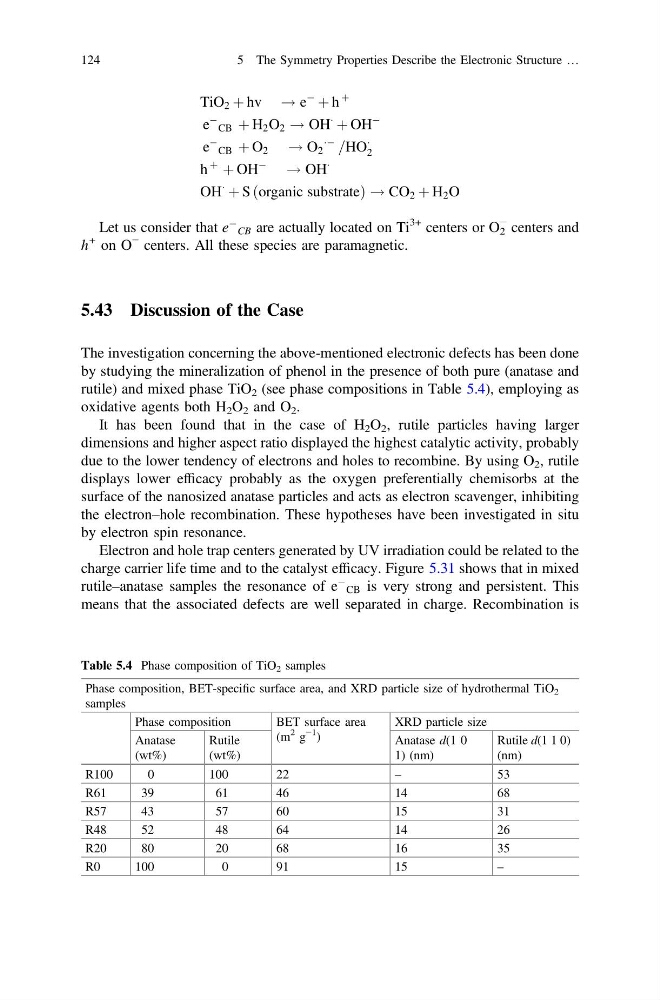
Let us consider that e
À
CB are actually located on Ti
3+ centers or O 2
− centers and
h
+ on O
− centers. All these species are paramagnetic.
5.43 Discussion of the Case
The investigation concerning the above-mentioned electronic defects has been done
by studying the mineralization of phenol in the presence of both pure (anatase and
rutile) and mixed phase TiO 2 (see phase compositions in Table 5.4), employing as
oxidative agents both H 2 O 2 and O 2 .
It has been found that in the case of H 2 O 2 , rutile particles having larger
dimensions and higher aspect ratio displayed the highest catalytic activity, probably
due to the lower tendency of electrons and holes to recombine. By using O 2 , rutile
displays lower efficacy probably as the oxygen preferentially chemisorbs at the
surface of the nanosized anatase particles and acts as electron scavenger, inhibiting
the electron–hole recombination. These hypotheses have been investigated in situ
by electron spin resonance.
Electron and hole trap centers generated by UV irradiation could be related to the
charge carrier life time and to the catalyst efficacy. Figure 5.31 shows that in mixed
rutile–anatase samples the resonance of e
À
CB is very strong and persistent. This
means that the associated defects are well separated in charge. Recombination is
Table 5.4 Phase composition of TiO 2 samples
Phase composition, BET-specific surface area, and XRD particle size of hydrothermal TiO 2
samples
Phase composition
BET surface area
(m
2 g
−1
)
XRD particle size
Anatase
(wt%)
Rutile
(wt%)
Anatase d(1 0
1) (nm)
Rutile d(1 1 0)
(nm)
R100
0
100
22
–
53
R61
39
61
46
14
68
R57
43
57
60
15
31
R48
52
48
64
14
26
R20
80
20
68
16
35
R0
100
0
91
15
–
124
5 The Symmetry Properties Describe the Electronic Structure …
À
þ h
þ
e
À
CB þ H 2 O 2 ! OH
Á
þ OH
À
e
À
CB þ O 2 ! O 2
ÁÀ
=HO
Á
2
h
þ
þ OH
À
! OH
Á
OH
Á
þ S ðorganic substrateÞ ! CO 2 þ H 2 O
Let us consider that e
À
CB are actually located on Ti
3+ centers or O 2
− centers and
h
+ on O
− centers. All these species are paramagnetic.
5.43 Discussion of the Case
The investigation concerning the above-mentioned electronic defects has been done
by studying the mineralization of phenol in the presence of both pure (anatase and
rutile) and mixed phase TiO 2 (see phase compositions in Table 5.4), employing as
oxidative agents both H 2 O 2 and O 2 .
It has been found that in the case of H 2 O 2 , rutile particles having larger
dimensions and higher aspect ratio displayed the highest catalytic activity, probably
due to the lower tendency of electrons and holes to recombine. By using O 2 , rutile
displays lower efficacy probably as the oxygen preferentially chemisorbs at the
surface of the nanosized anatase particles and acts as electron scavenger, inhibiting
the electron–hole recombination. These hypotheses have been investigated in situ
by electron spin resonance.
Electron and hole trap centers generated by UV irradiation could be related to the
charge carrier life time and to the catalyst efficacy. Figure 5.31 shows that in mixed
rutile–anatase samples the resonance of e
À
CB is very strong and persistent. This
means that the associated defects are well separated in charge. Recombination is
Table 5.4 Phase composition of TiO 2 samples
Phase composition, BET-specific surface area, and XRD particle size of hydrothermal TiO 2
samples
Phase composition
BET surface area
(m
2 g
−1
)
XRD particle size
Anatase
(wt%)
Rutile
(wt%)
Anatase d(1 0
1) (nm)
Rutile d(1 1 0)
(nm)
R100
0
100
22
–
53
R61
39
61
46
14
68
R57
43
57
60
15
31
R48
52
48
64
14
26
R20
80
20
68
16
35
R0
100
0
91
15
–
124
5 The Symmetry Properties Describe the Electronic Structure …