

where O 0 is an oxygen in a regular site of oxygen. In the presence of doping
transition metal ions, the gas sensitivity increases; however, a direct inspection of
the electronic configuration of the metal and of its relation with the activation
mechanism is needed.
5.32 Discussion of the Case
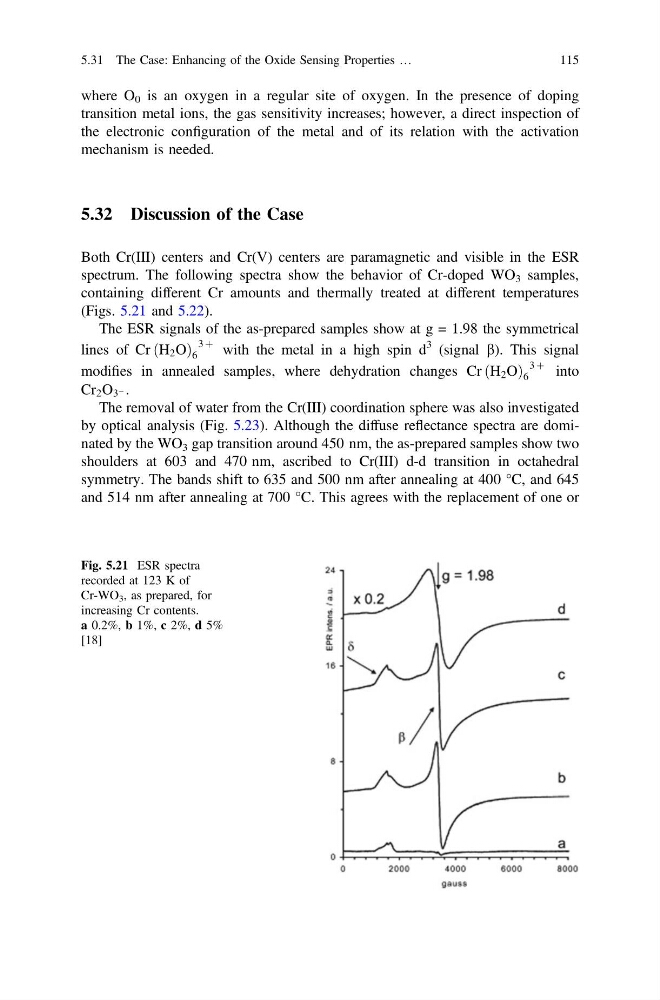
Both Cr(III) centers and Cr(V) centers are paramagnetic and visible in the ESR
spectrum. The following spectra show the behavior of Cr-doped WO 3 samples,
containing different Cr amounts and thermally treated at different temperatures
(Figs. 5.21 and 5.22).
The ESR signals of the as-prepared samples show at g = 1.98 the symmetrical
lines of Cr H 2 O
ð
Þ 6
3 þ with the metal in a high spin d
3 (signal b). This signal
modifies in annealed samples, where dehydration changes Cr H 2 O
ð
Þ 6
3 þ into
Cr 2 O 3 À .
The removal of water from the Cr(III) coordination sphere was also investigated
by optical analysis (Fig. 5.23). Although the diffuse reflectance spectra are dominated by the WO 3 gap transition around 450 nm, the as-prepared samples show two
shoulders at 603 and 470 nm, ascribed to Cr(III) d-d transition in octahedral
symmetry. The bands shift to 635 and 500 nm after annealing at 400 °C, and 645
and 514 nm after annealing at 700 °C. This agrees with the replacement of one or
Fig. 5.21 ESR spectra
recorded at 123 K of
Cr-WO 3 , as prepared, for
increasing Cr contents.
a 0.2%, b 1%, c 2%, d 5%
[18]
5.31 The Case: Enhancing of the Oxide Sensing Properties …
115
transition metal ions, the gas sensitivity increases; however, a direct inspection of
the electronic configuration of the metal and of its relation with the activation
mechanism is needed.
5.32 Discussion of the Case
Both Cr(III) centers and Cr(V) centers are paramagnetic and visible in the ESR
spectrum. The following spectra show the behavior of Cr-doped WO 3 samples,
containing different Cr amounts and thermally treated at different temperatures
(Figs. 5.21 and 5.22).
The ESR signals of the as-prepared samples show at g = 1.98 the symmetrical
lines of Cr H 2 O
ð
Þ 6
3 þ with the metal in a high spin d
3 (signal b). This signal
modifies in annealed samples, where dehydration changes Cr H 2 O
ð
Þ 6
3 þ into
Cr 2 O 3 À .
The removal of water from the Cr(III) coordination sphere was also investigated
by optical analysis (Fig. 5.23). Although the diffuse reflectance spectra are dominated by the WO 3 gap transition around 450 nm, the as-prepared samples show two
shoulders at 603 and 470 nm, ascribed to Cr(III) d-d transition in octahedral
symmetry. The bands shift to 635 and 500 nm after annealing at 400 °C, and 645
and 514 nm after annealing at 700 °C. This agrees with the replacement of one or
Fig. 5.21 ESR spectra
recorded at 123 K of
Cr-WO 3 , as prepared, for
increasing Cr contents.
a 0.2%, b 1%, c 2%, d 5%
[18]
5.31 The Case: Enhancing of the Oxide Sensing Properties …
115