

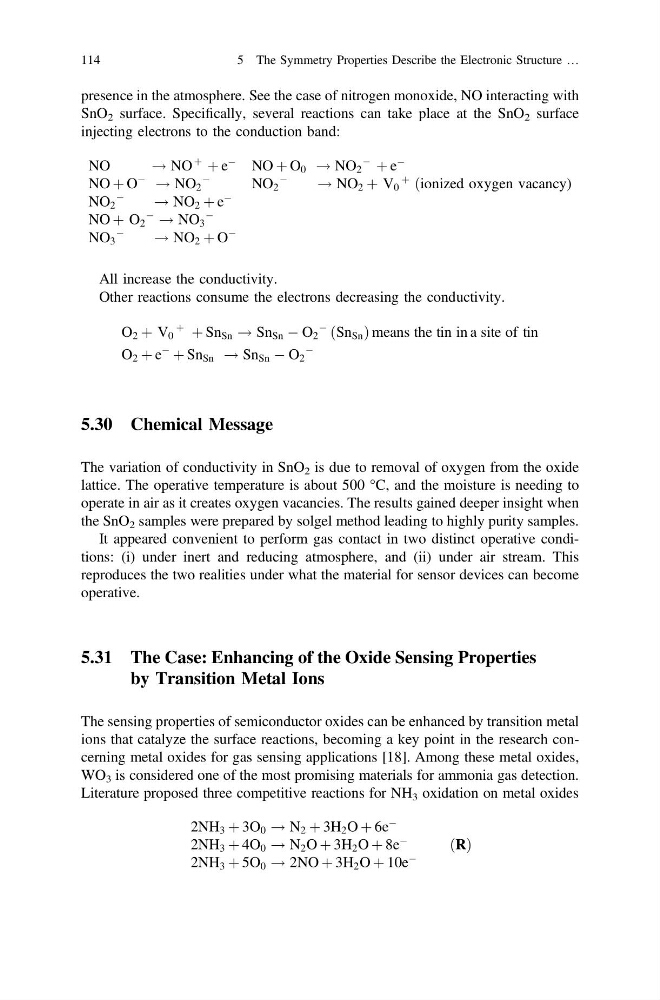
presence in the atmosphere. See the case of nitrogen monoxide, NO interacting with
SnO 2 surface. Specifically, several reactions can take place at the SnO 2 surface
injecting electrons to the conduction band:
NO
! NO
þ
þ e
À
NO þ O 0 ! NO 2
À
þ e
À
NO þ O
À
! NO 2
À
NO 2
À
! NO 2 þ V 0
þ
ðionized oxygen vacancy)
NO 2
À
! NO 2 þ e
À
NO þ O 2
À
! NO 3
À
NO 3
À
! NO 2 þ O
À
All increase the conductivity.
Other reactions consume the electrons decreasing the conductivity.
O 2 þ V 0
þ
þ Sn Sn ! Sn Sn À O 2
À Sn Sn
ð
Þmeans the tin in a site of tin
O 2 þ e
À
þ Sn Sn ! Sn Sn À O 2
À
5.30 Chemical Message
The variation of conductivity in SnO 2 is due to removal of oxygen from the oxide
lattice. The operative temperature is about 500 °C, and the moisture is needing to
operate in air as it creates oxygen vacancies. The results gained deeper insight when
the SnO 2 samples were prepared by solgel method leading to highly purity samples.
It appeared convenient to perform gas contact in two distinct operative conditions: (i) under inert and reducing atmosphere, and (ii) under air stream. This
reproduces the two realities under what the material for sensor devices can become
operative.
5.31 The Case: Enhancing of the Oxide Sensing Properties
by Transition Metal Ions
The sensing properties of semiconductor oxides can be enhanced by transition metal
ions that catalyze the surface reactions, becoming a key point in the research concerning metal oxides for gas sensing applications [18]. Among these metal oxides,
WO 3 is considered one of the most promising materials for ammonia gas detection.
Literature proposed three competitive reactions for NH 3 oxidation on metal oxides
2NH 3 þ 3O 0 ! N 2 þ 3H 2 O þ 6e
À
2NH 3 þ 4O 0 ! N 2 O þ 3H 2 O þ 8e
À
2NH 3 þ 5O 0 ! 2NO þ 3H 2 O þ 10e
À
ðRÞ
114
5 The Symmetry Properties Describe the Electronic Structure …
SnO 2 surface. Specifically, several reactions can take place at the SnO 2 surface
injecting electrons to the conduction band:
NO
! NO
þ
þ e
À
NO þ O 0 ! NO 2
À
þ e
À
NO þ O
À
! NO 2
À
NO 2
À
! NO 2 þ V 0
þ
ðionized oxygen vacancy)
NO 2
À
! NO 2 þ e
À
NO þ O 2
À
! NO 3
À
NO 3
À
! NO 2 þ O
À
All increase the conductivity.
Other reactions consume the electrons decreasing the conductivity.
O 2 þ V 0
þ
þ Sn Sn ! Sn Sn À O 2
À Sn Sn
ð
Þmeans the tin in a site of tin
O 2 þ e
À
þ Sn Sn ! Sn Sn À O 2
À
5.30 Chemical Message
The variation of conductivity in SnO 2 is due to removal of oxygen from the oxide
lattice. The operative temperature is about 500 °C, and the moisture is needing to
operate in air as it creates oxygen vacancies. The results gained deeper insight when
the SnO 2 samples were prepared by solgel method leading to highly purity samples.
It appeared convenient to perform gas contact in two distinct operative conditions: (i) under inert and reducing atmosphere, and (ii) under air stream. This
reproduces the two realities under what the material for sensor devices can become
operative.
5.31 The Case: Enhancing of the Oxide Sensing Properties
by Transition Metal Ions
The sensing properties of semiconductor oxides can be enhanced by transition metal
ions that catalyze the surface reactions, becoming a key point in the research concerning metal oxides for gas sensing applications [18]. Among these metal oxides,
WO 3 is considered one of the most promising materials for ammonia gas detection.
Literature proposed three competitive reactions for NH 3 oxidation on metal oxides
2NH 3 þ 3O 0 ! N 2 þ 3H 2 O þ 6e
À
2NH 3 þ 4O 0 ! N 2 O þ 3H 2 O þ 8e
À
2NH 3 þ 5O 0 ! 2NO þ 3H 2 O þ 10e
À
ðRÞ
114
5 The Symmetry Properties Describe the Electronic Structure …