

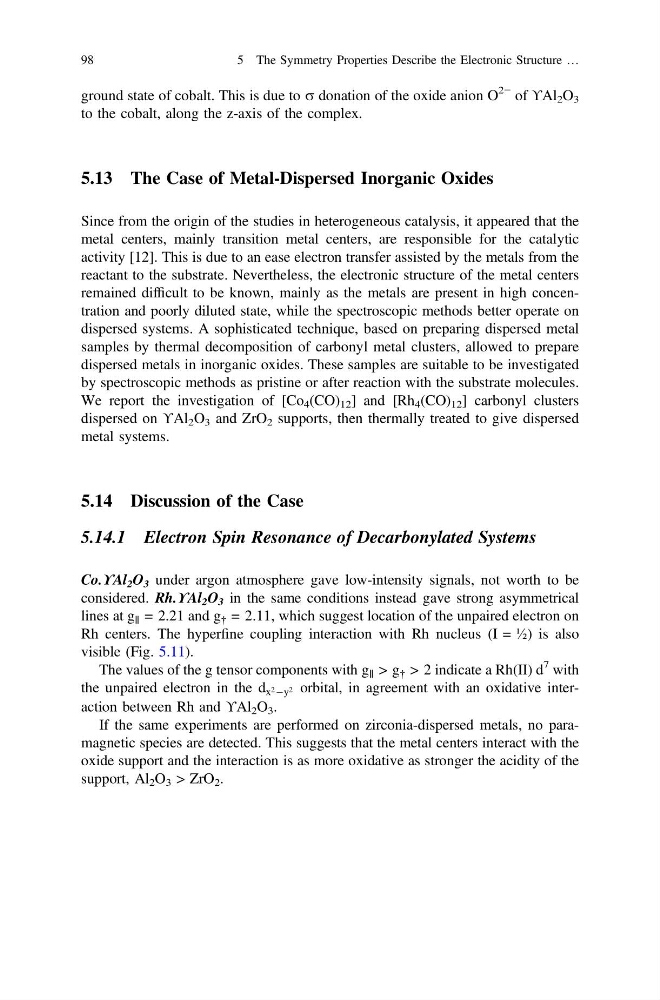
ground state of cobalt. This is due to r donation of the oxide anion O
2− of ϒAl 2 O 3
to the cobalt, along the z-axis of the complex.
5.13 The Case of Metal-Dispersed Inorganic Oxides
Since from the origin of the studies in heterogeneous catalysis, it appeared that the
metal centers, mainly transition metal centers, are responsible for the catalytic
activity [12]. This is due to an ease electron transfer assisted by the metals from the
reactant to the substrate. Nevertheless, the electronic structure of the metal centers
remained difficult to be known, mainly as the metals are present in high concentration and poorly diluted state, while the spectroscopic methods better operate on
dispersed systems. A sophisticated technique, based on preparing dispersed metal
samples by thermal decomposition of carbonyl metal clusters, allowed to prepare
dispersed metals in inorganic oxides. These samples are suitable to be investigated
by spectroscopic methods as pristine or after reaction with the substrate molecules.
We report the investigation of [Co 4 (CO) 12 ] and [Rh 4 (CO) 12 ] carbonyl clusters
dispersed on ϒAl 2 O 3 and ZrO 2 supports, then thermally treated to give dispersed
metal systems.
5.14 Discussion of the Case
5.14.1 Electron Spin Resonance of Decarbonylated Systems
Co.ϒAl 2 O 3 under argon atmosphere gave low-intensity signals, not worth to be
considered. Rh.ϒAl 2 O 3 in the same conditions instead gave strong asymmetrical
lines at g ‖ = 2.21 and g † = 2.11, which suggest location of the unpaired electron on
Rh centers. The hyperfine coupling interaction with Rh nucleus (I = ½) is also
visible (Fig. 5.11).
The values of the g tensor components with g ‖ > g † > 2 indicate a Rh(II) d
7 with
the unpaired electron in the d x 2 Ày 2 orbital, in agreement with an oxidative interaction between Rh and ϒAl 2 O 3 .
If the same experiments are performed on zirconia-dispersed metals, no paramagnetic species are detected. This suggests that the metal centers interact with the
oxide support and the interaction is as more oxidative as stronger the acidity of the
support, Al 2 O 3 > ZrO 2 .
98
5 The Symmetry Properties Describe the Electronic Structure …
2− of ϒAl 2 O 3
to the cobalt, along the z-axis of the complex.
5.13 The Case of Metal-Dispersed Inorganic Oxides
Since from the origin of the studies in heterogeneous catalysis, it appeared that the
metal centers, mainly transition metal centers, are responsible for the catalytic
activity [12]. This is due to an ease electron transfer assisted by the metals from the
reactant to the substrate. Nevertheless, the electronic structure of the metal centers
remained difficult to be known, mainly as the metals are present in high concentration and poorly diluted state, while the spectroscopic methods better operate on
dispersed systems. A sophisticated technique, based on preparing dispersed metal
samples by thermal decomposition of carbonyl metal clusters, allowed to prepare
dispersed metals in inorganic oxides. These samples are suitable to be investigated
by spectroscopic methods as pristine or after reaction with the substrate molecules.
We report the investigation of [Co 4 (CO) 12 ] and [Rh 4 (CO) 12 ] carbonyl clusters
dispersed on ϒAl 2 O 3 and ZrO 2 supports, then thermally treated to give dispersed
metal systems.
5.14 Discussion of the Case
5.14.1 Electron Spin Resonance of Decarbonylated Systems
Co.ϒAl 2 O 3 under argon atmosphere gave low-intensity signals, not worth to be
considered. Rh.ϒAl 2 O 3 in the same conditions instead gave strong asymmetrical
lines at g ‖ = 2.21 and g † = 2.11, which suggest location of the unpaired electron on
Rh centers. The hyperfine coupling interaction with Rh nucleus (I = ½) is also
visible (Fig. 5.11).
The values of the g tensor components with g ‖ > g † > 2 indicate a Rh(II) d
7 with
the unpaired electron in the d x 2 Ày 2 orbital, in agreement with an oxidative interaction between Rh and ϒAl 2 O 3 .
If the same experiments are performed on zirconia-dispersed metals, no paramagnetic species are detected. This suggests that the metal centers interact with the
oxide support and the interaction is as more oxidative as stronger the acidity of the
support, Al 2 O 3 > ZrO 2 .
98
5 The Symmetry Properties Describe the Electronic Structure …