

heterogeneous catalysts in different types of oxidative processes, e.g., hydrocarbon
oxidation, and to investigate the relations between surface chemisorbed species and
catalytic properties. It is well known that CoPc in solution gives superoxo
derivatives where the unpaired electron of Co(II) d
7 is transferred to the O 2
molecule. The possibility of an analogous electron transfer in the solid state was the
basis for the investigation.
5.11 Discussion of the Case
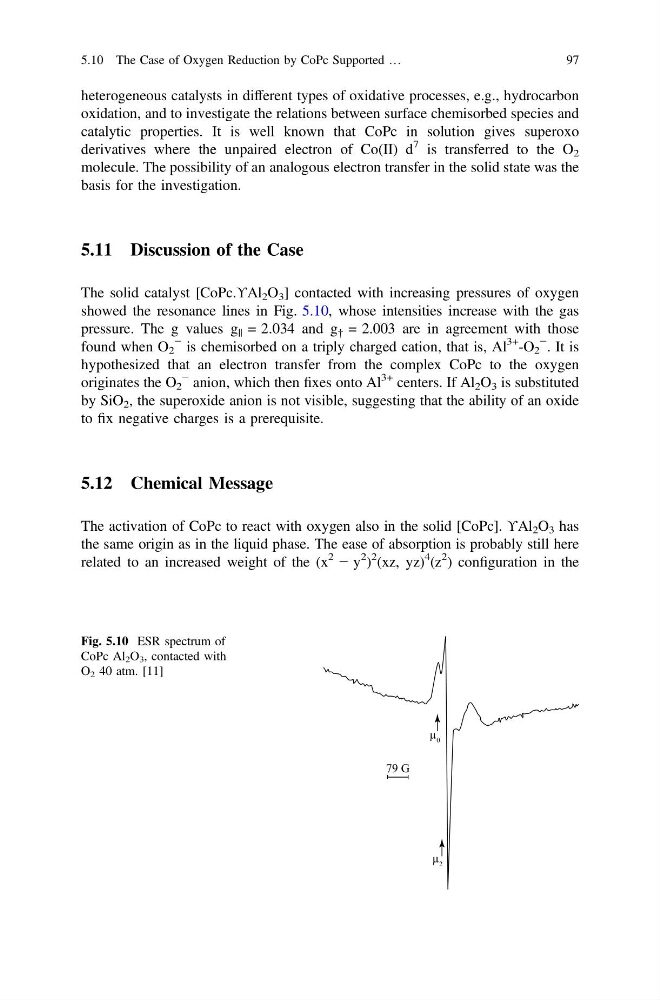
The solid catalyst [CoPc.ϒAl 2 O 3 ] contacted with increasing pressures of oxygen
showed the resonance lines in Fig. 5.10, whose intensities increase with the gas
pressure. The g values g ‖ = 2.034 and g † = 2.003 are in agreement with those
found when O 2
− is chemisorbed on a triply charged cation, that is, Al
3+ -O 2
− . It is
hypothesized that an electron transfer from the complex CoPc to the oxygen
originates the O 2
− anion, which then fixes onto Al
3+ centers. If Al 2 O 3 is substituted
by SiO 2 , the superoxide anion is not visible, suggesting that the ability of an oxide
to fix negative charges is a prerequisite.
5.12 Chemical Message
The activation of CoPc to react with oxygen also in the solid [CoPc]. ϒAl 2 O 3 has
the same origin as in the liquid phase. The ease of absorption is probably still here
related to an increased weight of the (x
2
− y
2
)
2 (xz, yz)
4 (z
2 ) configuration in the
79 G
μ 0
μ 2
Fig. 5.10 ESR spectrum of
CoPc Al 2 O 3 , contacted with
O 2 40 atm. [11]
5.10 The Case of Oxygen Reduction by CoPc Supported …
97
oxidation, and to investigate the relations between surface chemisorbed species and
catalytic properties. It is well known that CoPc in solution gives superoxo
derivatives where the unpaired electron of Co(II) d
7 is transferred to the O 2
molecule. The possibility of an analogous electron transfer in the solid state was the
basis for the investigation.
5.11 Discussion of the Case
The solid catalyst [CoPc.ϒAl 2 O 3 ] contacted with increasing pressures of oxygen
showed the resonance lines in Fig. 5.10, whose intensities increase with the gas
pressure. The g values g ‖ = 2.034 and g † = 2.003 are in agreement with those
found when O 2
− is chemisorbed on a triply charged cation, that is, Al
3+ -O 2
− . It is
hypothesized that an electron transfer from the complex CoPc to the oxygen
originates the O 2
− anion, which then fixes onto Al
3+ centers. If Al 2 O 3 is substituted
by SiO 2 , the superoxide anion is not visible, suggesting that the ability of an oxide
to fix negative charges is a prerequisite.
5.12 Chemical Message
The activation of CoPc to react with oxygen also in the solid [CoPc]. ϒAl 2 O 3 has
the same origin as in the liquid phase. The ease of absorption is probably still here
related to an increased weight of the (x
2
− y
2
)
2 (xz, yz)
4 (z
2 ) configuration in the
79 G
μ 0
μ 2
Fig. 5.10 ESR spectrum of
CoPc Al 2 O 3 , contacted with
O 2 40 atm. [11]
5.10 The Case of Oxygen Reduction by CoPc Supported …
97