

88
PROPERTIES OF INDIVIDUAL NANOPARTICLES
souice of clusters
ncln uniform megnstic
field
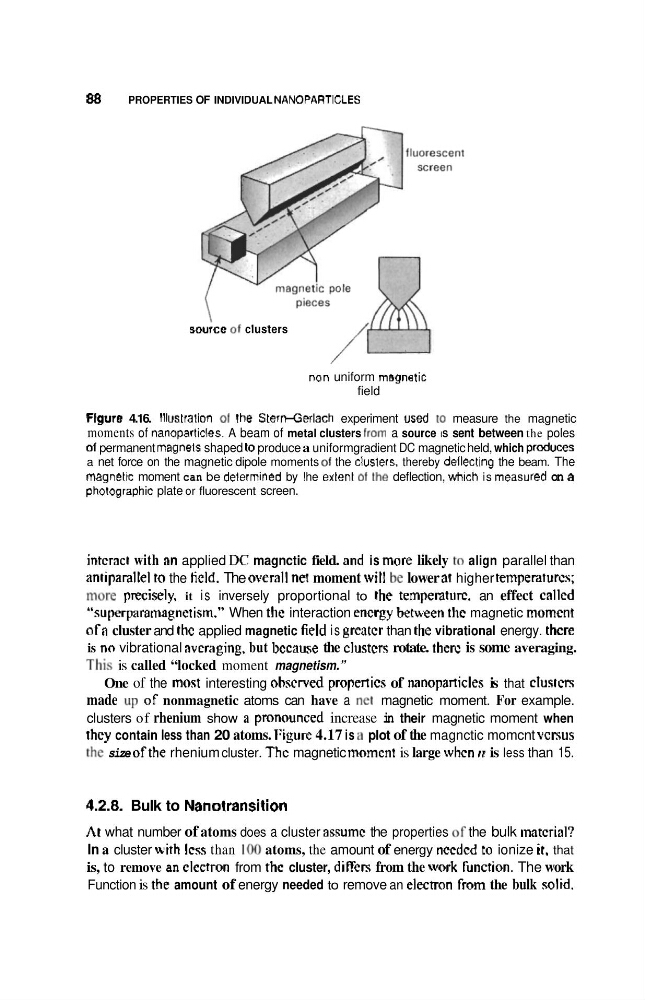
FEgurs 4.16. Illustralinn a! !he SterMerlach experiment used TO measure the magnetic
moments of nanopartdes. A beam of metal clusters horn a source IS sent between the poles
01 permanent magnels shaped to produce a uniform gradient DC magnetic held, which prduces
a net force on the magnetic dipole moments of the cluslers. thereby dellecting the beam. The
magnettc moment can be defermined by !he extent of the deflection, which is measured on a
pholographic plate or fluorescent screen.
intcract with an applied DC magnctic field. and is more likely to align parallel than
anlipamllel to the held. The overall net moment wit! he lower af higher Itemperaturcs;
more precisely, it is inversely proportional to the tempemtun. an effect callcd
“superparamagnetism.” When the interaction encrgy between the magnetic morncnt
of n cluster and lhc applied magnetic field is greater than thc vibrational energy. thcre
is no vibrational svrraging, but bccause the clustcrs rotate. therc is some averaging.
This is called “locked moment magnetism.”
One of the most interesting ohscrved propertics of nanoparticles is that clustcs
made up of nonmagnetic atoms can have a net magnetic moment. For example.
clusters of rhenium show a pronounced increase in their magnetic moment when
thcy contain less than 20 atoms. Figure 4.17 is 11 plot of the magnctic momcnt vcrsus
the size ofthe rhenium cluster. Thc magnetic momcnt is large whcn tr is less than 15.
4.2.8. Bulk to Nanotransition
At what number of atoms does a cluster assume the properties of the bulk inntcrial?
In a cluster with lcss than 100 atoms, the amount of energy necdcd EO ionize it, that
is, to remove an clcctron from thc cluster, differs from the work runction. The work
Function is the amount of energy needed to remove an electron from the bulk solEd.
PROPERTIES OF INDIVIDUAL NANOPARTICLES
souice of clusters
ncln uniform megnstic
field
FEgurs 4.16. Illustralinn a! !he SterMerlach experiment used TO measure the magnetic
moments of nanopartdes. A beam of metal clusters horn a source IS sent between the poles
01 permanent magnels shaped to produce a uniform gradient DC magnetic held, which prduces
a net force on the magnetic dipole moments of the cluslers. thereby dellecting the beam. The
magnettc moment can be defermined by !he extent of the deflection, which is measured on a
pholographic plate or fluorescent screen.
intcract with an applied DC magnctic field. and is more likely to align parallel than
anlipamllel to the held. The overall net moment wit! he lower af higher Itemperaturcs;
more precisely, it is inversely proportional to the tempemtun. an effect callcd
“superparamagnetism.” When the interaction encrgy between the magnetic morncnt
of n cluster and lhc applied magnetic field is greater than thc vibrational energy. thcre
is no vibrational svrraging, but bccause the clustcrs rotate. therc is some averaging.
This is called “locked moment magnetism.”
One of the most interesting ohscrved propertics of nanoparticles is that clustcs
made up of nonmagnetic atoms can have a net magnetic moment. For example.
clusters of rhenium show a pronounced increase in their magnetic moment when
thcy contain less than 20 atoms. Figure 4.17 is 11 plot of the magnctic momcnt vcrsus
the size ofthe rhenium cluster. Thc magnetic momcnt is large whcn tr is less than 15.
4.2.8. Bulk to Nanotransition
At what number of atoms does a cluster assume the properties of the bulk inntcrial?
In a cluster with lcss than 100 atoms, the amount of energy necdcd EO ionize it, that
is, to remove an clcctron from thc cluster, differs from the work runction. The work
Function is the amount of energy needed to remove an electron from the bulk solEd.