

86
PROPERTIES OF INDIVIDUAL NANOPARTICLES
e
e
e.
e
I I I I I I I 1 1 1 1 1 1 1 1 1 1 1 1 1 1 1 1
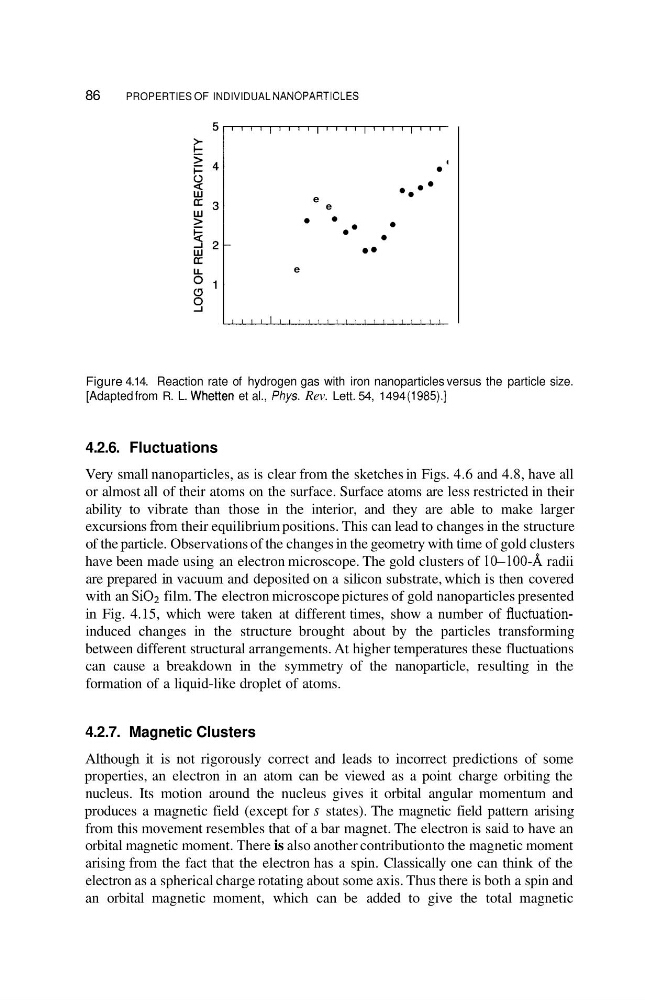
Figure 4.14. Reaction rate of hydrogen gas with iron nanoparticles versus the particle size.
[Adapted from R. L. Whetten et al., Phys. Rev. Lett. 54, 1494 (1985).]
4.2.6. Fluctuations
Very small nanoparticles, as is clear from the sketches in Figs. 4.6 and 4.8, have all
or almost all of their atoms on the surface. Surface atoms are less restricted in their
ability to vibrate than those in the interior, and they are able to make larger
excursions from their equilibrium positions. This can lead to changes in the structure
of the particle. Observations of the changes in the geometry with time of gold clusters
have been made using an electron microscope. The gold clusters of 1CrlOO-8, radii
are prepared in vacuum and deposited on a silicon substrate, which is then covered
with an SiOz film. The electron microscope pictures of gold nanoparticles presented
in Fig. 4.15, which were taken at different times, show a number of fluctuationinduced changes in the structure brought about by the particles transforming
between different structural arrangements. At higher temperatures these fluctuations
can cause a breakdown in the symmetry of the nanoparticle, resulting in the
formation of a liquid-like droplet of atoms.
4.2.7. Magnetic Clusters
Although it is not rigorously correct and leads to incorrect predictions of some
properties, an electron in an atom can be viewed as a point charge orbiting the
nucleus. Its motion around the nucleus gives it orbital angular momentum and
produces a magnetic field (except for s states). The magnetic field pattern arising
from this movement resembles that of a bar magnet. The electron is said to have an
orbital magnetic moment. There is also another contribution to the magnetic moment
arising from the fact that the electron has a spin. Classically one can think of the
electron as a spherical charge rotating about some axis. Thus there is both a spin and
an orbital magnetic moment, which can be added to give the total magnetic
PROPERTIES OF INDIVIDUAL NANOPARTICLES
e
e
e.
e
I I I I I I I 1 1 1 1 1 1 1 1 1 1 1 1 1 1 1 1
Figure 4.14. Reaction rate of hydrogen gas with iron nanoparticles versus the particle size.
[Adapted from R. L. Whetten et al., Phys. Rev. Lett. 54, 1494 (1985).]
4.2.6. Fluctuations
Very small nanoparticles, as is clear from the sketches in Figs. 4.6 and 4.8, have all
or almost all of their atoms on the surface. Surface atoms are less restricted in their
ability to vibrate than those in the interior, and they are able to make larger
excursions from their equilibrium positions. This can lead to changes in the structure
of the particle. Observations of the changes in the geometry with time of gold clusters
have been made using an electron microscope. The gold clusters of 1CrlOO-8, radii
are prepared in vacuum and deposited on a silicon substrate, which is then covered
with an SiOz film. The electron microscope pictures of gold nanoparticles presented
in Fig. 4.15, which were taken at different times, show a number of fluctuationinduced changes in the structure brought about by the particles transforming
between different structural arrangements. At higher temperatures these fluctuations
can cause a breakdown in the symmetry of the nanoparticle, resulting in the
formation of a liquid-like droplet of atoms.
4.2.7. Magnetic Clusters
Although it is not rigorously correct and leads to incorrect predictions of some
properties, an electron in an atom can be viewed as a point charge orbiting the
nucleus. Its motion around the nucleus gives it orbital angular momentum and
produces a magnetic field (except for s states). The magnetic field pattern arising
from this movement resembles that of a bar magnet. The electron is said to have an
orbital magnetic moment. There is also another contribution to the magnetic moment
arising from the fact that the electron has a spin. Classically one can think of the
electron as a spherical charge rotating about some axis. Thus there is both a spin and
an orbital magnetic moment, which can be added to give the total magnetic