

4.2. METAL NANOCLUSTERS
85
- 0
100 200 300 400 500 600
MASSICHARGE
120
L
I
MASSICHARGE
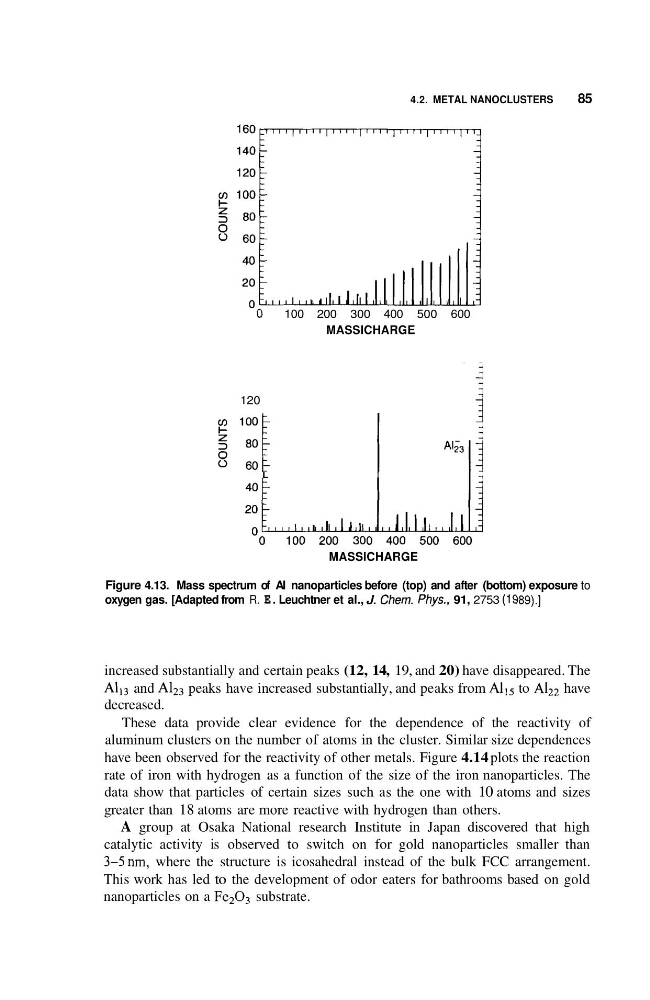
Figure 4.13. Mass spectrum of AI nanoparticles before (top) and after (bottom) exposure to
oxygen gas. [Adapted from R. E. Leuchtner et al., J. Chern. Phys., 91, 2753 (1989).]
increased substantially and certain peaks (12, 14, 19, and 20) have disappeared. The
A113 and Al2, peaks have increased substantially, and peaks from All5 to
have
decreased.
These data provide clear evidence for the dependence of the reactivity of
aluminum clusters on the number of atoms in the cluster. Similar size dependences
have been observed for the reactivity of other metals. Figure 4.14 plots the reaction
rate of iron with hydrogen as a function of the size of the iron nanoparticles. The
data show that particles of certain sizes such as the one with 10 atoms and sizes
greater than 18 atoms are more reactive with hydrogen than others.
A group at Osaka National research Institute in Japan discovered that high
catalytic activity is observed to switch on for gold nanoparticles smaller than
3-5nm, where the structure is icosahedral instead of the bulk FCC arrangement.
This work has led to the development of odor eaters for bathrooms based on gold
nanoparticles on a Fe203 substrate.
85
- 0
100 200 300 400 500 600
MASSICHARGE
120
L
I
MASSICHARGE
Figure 4.13. Mass spectrum of AI nanoparticles before (top) and after (bottom) exposure to
oxygen gas. [Adapted from R. E. Leuchtner et al., J. Chern. Phys., 91, 2753 (1989).]
increased substantially and certain peaks (12, 14, 19, and 20) have disappeared. The
A113 and Al2, peaks have increased substantially, and peaks from All5 to
have
decreased.
These data provide clear evidence for the dependence of the reactivity of
aluminum clusters on the number of atoms in the cluster. Similar size dependences
have been observed for the reactivity of other metals. Figure 4.14 plots the reaction
rate of iron with hydrogen as a function of the size of the iron nanoparticles. The
data show that particles of certain sizes such as the one with 10 atoms and sizes
greater than 18 atoms are more reactive with hydrogen than others.
A group at Osaka National research Institute in Japan discovered that high
catalytic activity is observed to switch on for gold nanoparticles smaller than
3-5nm, where the structure is icosahedral instead of the bulk FCC arrangement.
This work has led to the development of odor eaters for bathrooms based on gold
nanoparticles on a Fe203 substrate.