

66
METHODS OF MEASURING PROPERTIES
presence of two superposed lines; a main one at 444.6 eV arising from In in InP, and
a weaker one at 442.7 attributed to In in the oxide In20,. The phosphorus 2p X P S
spectrum of Fig. 3.30b exhibits two well-resolved phosphorus peaks, one from InP
and one from a phosphorus-oxygen species.
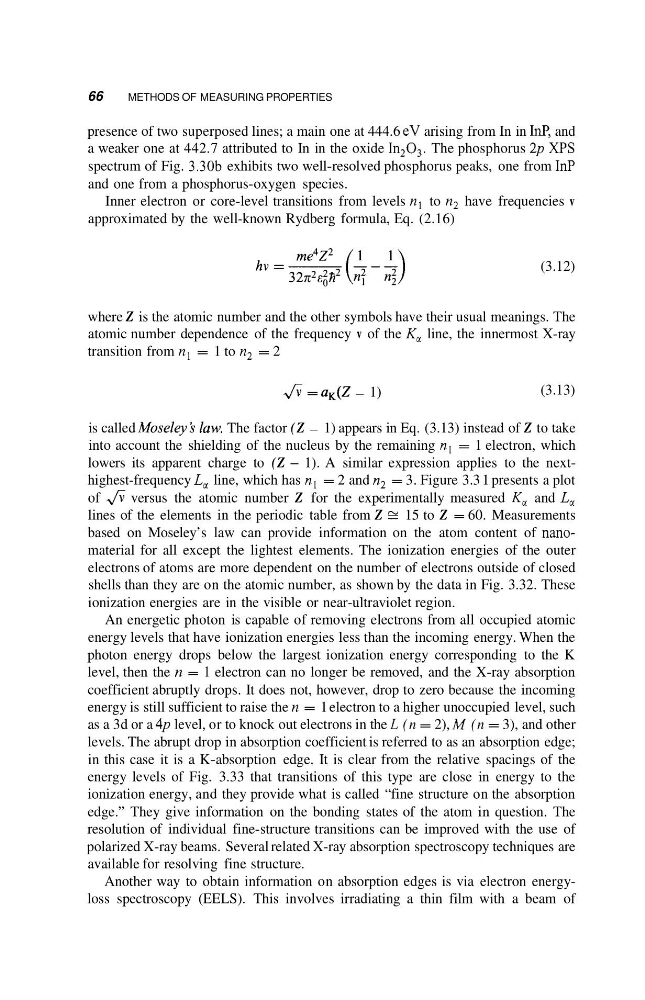
Inner electron or core-level transitions from levels n l to n2 have frequencies v
approximated by the well-known Rydberg formula, Eq. (2.16)
(3.12)
where Z is the atomic number and the other symbols have their usual meanings. The
atomic number dependence of the frequency v of the K, line, the innermost X-ray
transition from n l = 1 to n2 = 2
.J; = a,(Z - 1)
(3.13)
is called Moseleyk law. The factor (Z - 1) appears in Eq. (3.13) instead of Z to take
into account the shielding of the nucleus by the remaining n l = 1 electron, which
lowers its apparent charge to (Z - 1). A similar expression applies to the nexthighest-frequency L, line, which has n l = 2 and n2 = 3. Figure 3.3 1 presents a plot
of f i versus the atomic number Z for the experimentally measured K, and L,
lines of the elements in the periodic table from Z
15 to Z = 60. Measurements
based on Moseley’s law can provide information on the atom content of nanomaterial for all except the lightest elements. The ionization energies of the outer
electrons of atoms are more dependent on the number of electrons outside of closed
shells than they are on the atomic number, as shown by the data in Fig. 3.32. These
ionization energies are in the visible or near-ultraviolet region.
An energetic photon is capable of removing electrons from all occupied atomic
energy levels that have ionization energies less than the incoming energy. When the
photon energy drops below the largest ionization energy corresponding to the K
level, then the n = 1 electron can no longer be removed, and the X-ray absorption
coefficient abruptly drops. It does not, however, drop to zero because the incoming
energy is still sufficient to raise the n = 1 electron to a higher unoccupied level, such
as a 3d or a 4p level, or to knock out electrons in the L (n = 2), M (n = 3), and other
levels. The abrupt drop in absorption coefficient is referred to as an absorption edge;
in this case it is a K-absorption edge. It is clear from the relative spacings of the
energy levels of Fig. 3.33 that transitions of this type are close in energy to the
ionization energy, and they provide what is called “fine structure on the absorption
edge.” They give information on the bonding states of the atom in question. The
resolution of individual fine-structure transitions can be improved with the use of
polarized X-ray beams. Several related X-ray absorption spectroscopy techniques are
available for resolving fine structure.
Another way to obtain information on absorption edges is via electron energyloss spectroscopy (EELS). This involves irradiating a thin film with a beam of
METHODS OF MEASURING PROPERTIES
presence of two superposed lines; a main one at 444.6 eV arising from In in InP, and
a weaker one at 442.7 attributed to In in the oxide In20,. The phosphorus 2p X P S
spectrum of Fig. 3.30b exhibits two well-resolved phosphorus peaks, one from InP
and one from a phosphorus-oxygen species.
Inner electron or core-level transitions from levels n l to n2 have frequencies v
approximated by the well-known Rydberg formula, Eq. (2.16)
(3.12)
where Z is the atomic number and the other symbols have their usual meanings. The
atomic number dependence of the frequency v of the K, line, the innermost X-ray
transition from n l = 1 to n2 = 2
.J; = a,(Z - 1)
(3.13)
is called Moseleyk law. The factor (Z - 1) appears in Eq. (3.13) instead of Z to take
into account the shielding of the nucleus by the remaining n l = 1 electron, which
lowers its apparent charge to (Z - 1). A similar expression applies to the nexthighest-frequency L, line, which has n l = 2 and n2 = 3. Figure 3.3 1 presents a plot
of f i versus the atomic number Z for the experimentally measured K, and L,
lines of the elements in the periodic table from Z
15 to Z = 60. Measurements
based on Moseley’s law can provide information on the atom content of nanomaterial for all except the lightest elements. The ionization energies of the outer
electrons of atoms are more dependent on the number of electrons outside of closed
shells than they are on the atomic number, as shown by the data in Fig. 3.32. These
ionization energies are in the visible or near-ultraviolet region.
An energetic photon is capable of removing electrons from all occupied atomic
energy levels that have ionization energies less than the incoming energy. When the
photon energy drops below the largest ionization energy corresponding to the K
level, then the n = 1 electron can no longer be removed, and the X-ray absorption
coefficient abruptly drops. It does not, however, drop to zero because the incoming
energy is still sufficient to raise the n = 1 electron to a higher unoccupied level, such
as a 3d or a 4p level, or to knock out electrons in the L (n = 2), M (n = 3), and other
levels. The abrupt drop in absorption coefficient is referred to as an absorption edge;
in this case it is a K-absorption edge. It is clear from the relative spacings of the
energy levels of Fig. 3.33 that transitions of this type are close in energy to the
ionization energy, and they provide what is called “fine structure on the absorption
edge.” They give information on the bonding states of the atom in question. The
resolution of individual fine-structure transitions can be improved with the use of
polarized X-ray beams. Several related X-ray absorption spectroscopy techniques are
available for resolving fine structure.
Another way to obtain information on absorption edges is via electron energyloss spectroscopy (EELS). This involves irradiating a thin film with a beam of