

38
METHODS OF MEASURING PROPERTIES
is related to the X-ray energy E expressed in the units kiloelectronvolts (keV)
through the expression
1.240
/I=nm
E
Ordinarily the beam is fixed in direction and the crystal is rotated through a broad
range of angles to record the X-ray spectrum, which is also called a diffractometer
recording or X-ray-diffraction scan. Each detected X-ray signal corresponds to a
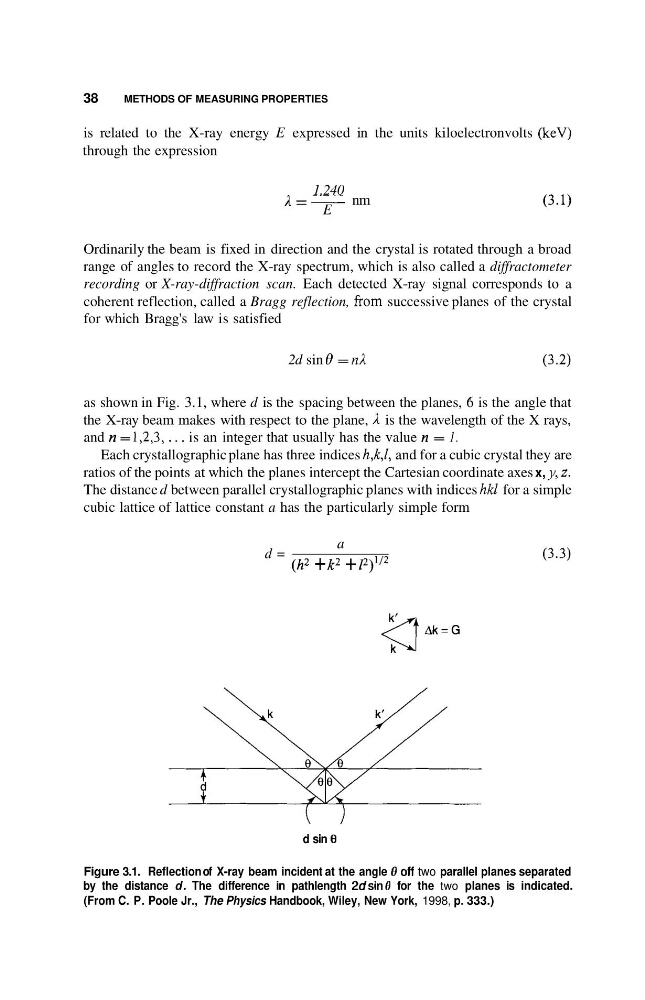
coherent reflection, called a Bragg reflection, from successive planes of the crystal
for which Bragg's law is satisfied
2d sin 6' = nll
(3.2)
as shown in Fig. 3.1, where d is the spacing between the planes, 6' is the angle that
the X-ray beam makes with respect to the plane, ll is the wavelength of the X rays,
and n = 1,2,3, . . . is an integer that usually has the value n = 1.
Each crystallographic plane has three indices h,k,l, and for a cubic crystal they are
ratios of the points at which the planes intercept the Cartesian coordinate axes x, y, z.
The distance d between parallel crystallographic planes with indices hkZ for a simple
cubic lattice of lattice constant a has the particularly simple form
a
d =
(h2 + k2 + Z2)1/2
A k = G
a
(3.3)
d sin 0
Figure 3.1. Reflection of X-ray beam incident at the angle 0 off two parallel planes separated
by the distance d. The difference in pathlength 2dsinO for the two planes is indicated.
(From C. P. Poole Jr., The Physics Handbook, Wiley, New York, 1998, p. 333.)
METHODS OF MEASURING PROPERTIES
is related to the X-ray energy E expressed in the units kiloelectronvolts (keV)
through the expression
1.240
/I=nm
E
Ordinarily the beam is fixed in direction and the crystal is rotated through a broad
range of angles to record the X-ray spectrum, which is also called a diffractometer
recording or X-ray-diffraction scan. Each detected X-ray signal corresponds to a
coherent reflection, called a Bragg reflection, from successive planes of the crystal
for which Bragg's law is satisfied
2d sin 6' = nll
(3.2)
as shown in Fig. 3.1, where d is the spacing between the planes, 6' is the angle that
the X-ray beam makes with respect to the plane, ll is the wavelength of the X rays,
and n = 1,2,3, . . . is an integer that usually has the value n = 1.
Each crystallographic plane has three indices h,k,l, and for a cubic crystal they are
ratios of the points at which the planes intercept the Cartesian coordinate axes x, y, z.
The distance d between parallel crystallographic planes with indices hkZ for a simple
cubic lattice of lattice constant a has the particularly simple form
a
d =
(h2 + k2 + Z2)1/2
A k = G
a
(3.3)
d sin 0
Figure 3.1. Reflection of X-ray beam incident at the angle 0 off two parallel planes separated
by the distance d. The difference in pathlength 2dsinO for the two planes is indicated.
(From C. P. Poole Jr., The Physics Handbook, Wiley, New York, 1998, p. 333.)