

3.2. STRUCTURE
37
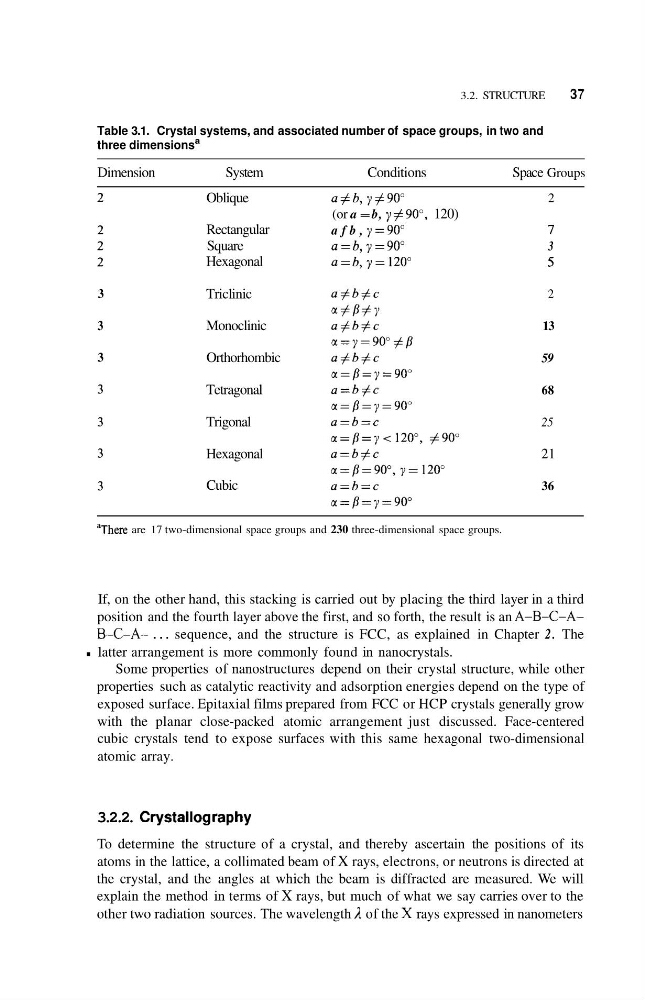
Table 3.1. Crystal systems, and associated number of space groups, in two and
three dimensions
a
Dimension
System
Conditions
Space Groups
3
3
3
Oblique
Rectangular
Square
Hexagonal
Triclinic
Monoclinic
Orthorhombic
Tetragonal
Trigonal
Hexagonal
Cubic
a f b , r f 9 0 "
(or a = b, y f go", 120)
a f b , y=90"
a = b , y=90"
a=b,y=120"
2
I
3
5
2
13
59
68
25
21
36
aThere are 17 two-dimensional space groups and 230 three-dimensional space groups.
If, on the other hand, this stacking is carried out by placing the third layer in a third
position and the fourth layer above the first, and so forth, the result is an A-B-C-AB-C-A- . . . sequence, and the structure is FCC, as explained in Chapter 2. The
. latter arrangement is more commonly found in nanocrystals.
Some properties of nanostructures depend on their crystal structure, while other
properties such as catalytic reactivity and adsorption energies depend on the type of
exposed surface. Epitaxial films prepared from FCC or HCP crystals generally grow
with the planar close-packed atomic arrangement just discussed. Face-centered
cubic crystals tend to expose surfaces with this same hexagonal two-dimensional
atomic array.
3.2.2. Crystallography
To determine the structure of a crystal, and thereby ascertain the positions of its
atoms in the lattice, a collimated beam of X rays, electrons, or neutrons is directed at
the crystal, and the angles at which the beam is diffracted are measured. We will
explain the method in terms of X rays, but much of what we say carries over to the
other two radiation sources. The wavelength A of the X rays expressed in nanometers
37
Table 3.1. Crystal systems, and associated number of space groups, in two and
three dimensions
a
Dimension
System
Conditions
Space Groups
3
3
3
Oblique
Rectangular
Square
Hexagonal
Triclinic
Monoclinic
Orthorhombic
Tetragonal
Trigonal
Hexagonal
Cubic
a f b , r f 9 0 "
(or a = b, y f go", 120)
a f b , y=90"
a = b , y=90"
a=b,y=120"
2
I
3
5
2
13
59
68
25
21
36
aThere are 17 two-dimensional space groups and 230 three-dimensional space groups.
If, on the other hand, this stacking is carried out by placing the third layer in a third
position and the fourth layer above the first, and so forth, the result is an A-B-C-AB-C-A- . . . sequence, and the structure is FCC, as explained in Chapter 2. The
. latter arrangement is more commonly found in nanocrystals.
Some properties of nanostructures depend on their crystal structure, while other
properties such as catalytic reactivity and adsorption energies depend on the type of
exposed surface. Epitaxial films prepared from FCC or HCP crystals generally grow
with the planar close-packed atomic arrangement just discussed. Face-centered
cubic crystals tend to expose surfaces with this same hexagonal two-dimensional
atomic array.
3.2.2. Crystallography
To determine the structure of a crystal, and thereby ascertain the positions of its
atoms in the lattice, a collimated beam of X rays, electrons, or neutrons is directed at
the crystal, and the angles at which the beam is diffracted are measured. We will
explain the method in terms of X rays, but much of what we say carries over to the
other two radiation sources. The wavelength A of the X rays expressed in nanometers