

26
INTRODUCTION TO PHYSICS OF THE SOLID STATE
2v 1
400
500
1,000
1ol8 io16 1014 io12 io1O io8 io6
n (ern")
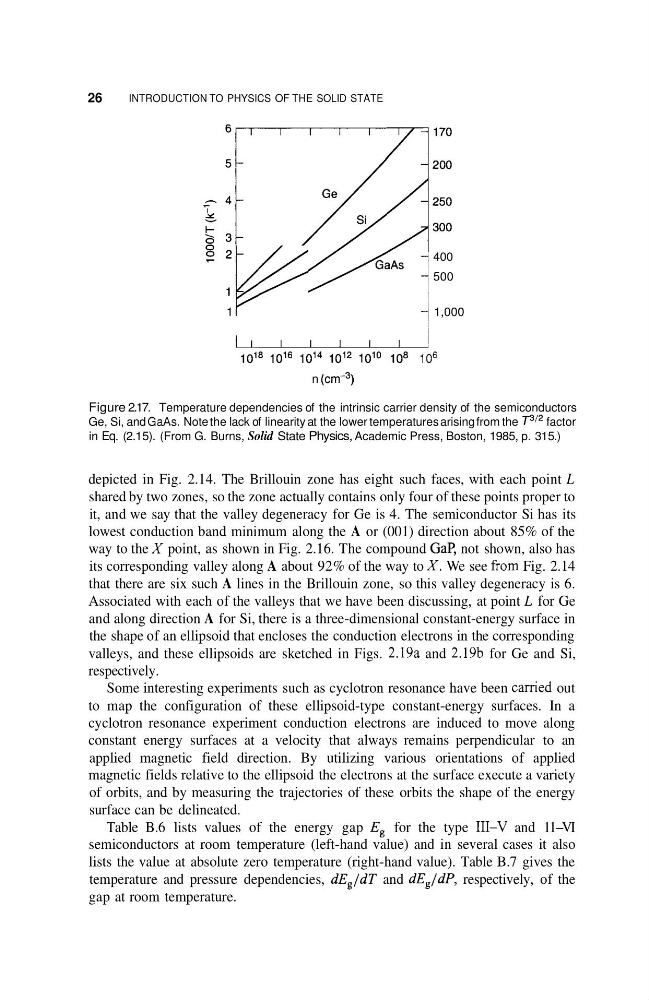
Figure 2.17. Temperature dependencies of the intrinsic carrier density of the semiconductors
Ge, Si, and GaAs. Note the lack of linearity at the lower temperatures arising from the T3I2 factor
in Eq. (2.1 5). (From G. Burns, Solid State Physics, Academic Press, Boston, 1985, p. 31 5.)
depicted in Fig. 2.14. The Brillouin zone has eight such faces, with each point L
shared by two zones, so the zone actually contains only four of these points proper to
it, and we say that the valley degeneracy for Ge is 4. The semiconductor Si has its
lowest conduction band minimum along the A or (001) direction about 85% of the
way to the X point, as shown in Fig. 2.16. The compound Gap, not shown, also has
its corresponding valley along A about 92% of the way to X. We see from Fig. 2.14
that there are six such A lines in the Brillouin zone, so this valley degeneracy is 6.
Associated with each of the valleys that we have been discussing, at point L for Ge
and along direction A for Si, there is a three-dimensional constant-energy surface in
the shape of an ellipsoid that encloses the conduction electrons in the corresponding
valleys, and these ellipsoids are sketched in Figs. 2.19a and 2.19b for Ge and Si,
respectively.
Some interesting experiments such as cyclotron resonance have been camed out
to map the configuration of these ellipsoid-type constant-energy surfaces. In a
cyclotron resonance experiment conduction electrons are induced to move along
constant energy surfaces at a velocity that always remains perpendicular to an
applied magnetic field direction. By utilizing various orientations of applied
magnetic fields relative to the ellipsoid the electrons at the surface execute a variety
of orbits, and by measuring the trajectories of these orbits the shape of the energy
surface can be delineated.
Table B.6 lists values of the energy gap Eg for the type 111-V and 11-VI
semiconductors at room temperature (left-hand value) and in several cases it also
lists the value at absolute zero temperature (right-hand value). Table B.7 gives the
temperature and pressure dependencies, dE,ldT and dE,ldP, respectively, of the
gap at room temperature.
INTRODUCTION TO PHYSICS OF THE SOLID STATE
2v 1
400
500
1,000
1ol8 io16 1014 io12 io1O io8 io6
n (ern")
Figure 2.17. Temperature dependencies of the intrinsic carrier density of the semiconductors
Ge, Si, and GaAs. Note the lack of linearity at the lower temperatures arising from the T3I2 factor
in Eq. (2.1 5). (From G. Burns, Solid State Physics, Academic Press, Boston, 1985, p. 31 5.)
depicted in Fig. 2.14. The Brillouin zone has eight such faces, with each point L
shared by two zones, so the zone actually contains only four of these points proper to
it, and we say that the valley degeneracy for Ge is 4. The semiconductor Si has its
lowest conduction band minimum along the A or (001) direction about 85% of the
way to the X point, as shown in Fig. 2.16. The compound Gap, not shown, also has
its corresponding valley along A about 92% of the way to X. We see from Fig. 2.14
that there are six such A lines in the Brillouin zone, so this valley degeneracy is 6.
Associated with each of the valleys that we have been discussing, at point L for Ge
and along direction A for Si, there is a three-dimensional constant-energy surface in
the shape of an ellipsoid that encloses the conduction electrons in the corresponding
valleys, and these ellipsoids are sketched in Figs. 2.19a and 2.19b for Ge and Si,
respectively.
Some interesting experiments such as cyclotron resonance have been camed out
to map the configuration of these ellipsoid-type constant-energy surfaces. In a
cyclotron resonance experiment conduction electrons are induced to move along
constant energy surfaces at a velocity that always remains perpendicular to an
applied magnetic field direction. By utilizing various orientations of applied
magnetic fields relative to the ellipsoid the electrons at the surface execute a variety
of orbits, and by measuring the trajectories of these orbits the shape of the energy
surface can be delineated.
Table B.6 lists values of the energy gap Eg for the type 111-V and 11-VI
semiconductors at room temperature (left-hand value) and in several cases it also
lists the value at absolute zero temperature (right-hand value). Table B.7 gives the
temperature and pressure dependencies, dE,ldT and dE,ldP, respectively, of the
gap at room temperature.