

13.2. NANOELECTROMECHANICAL SYSTEMS (NEMSs)
335
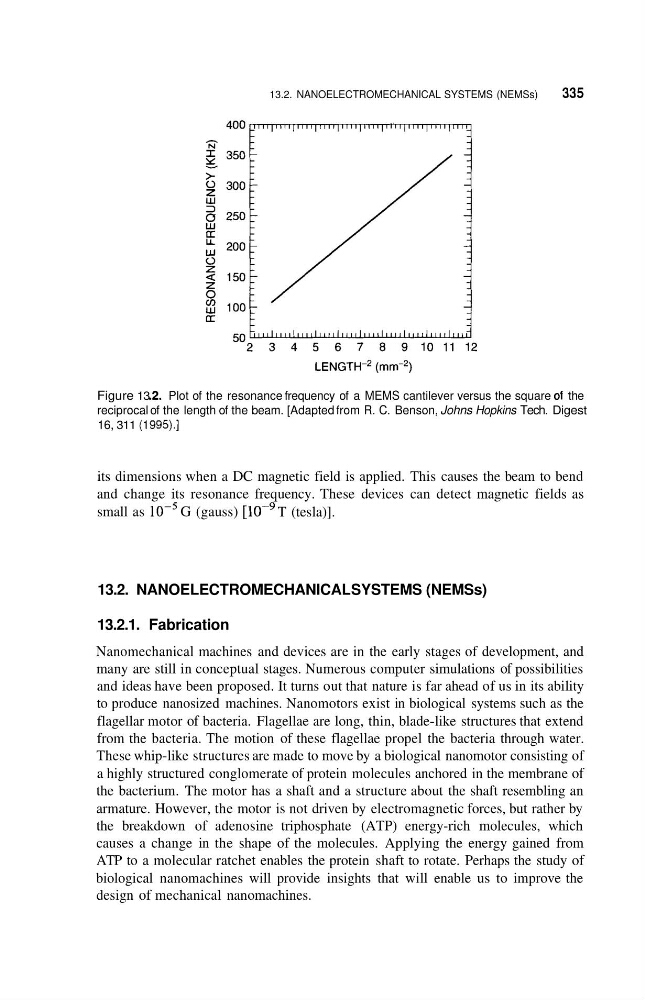
Figure 13 Plot of the resonance frequency of a MEMS cantilever versus the square c the
reciprocal of the length of the beam. [Adapted from R. C. Benson, Johns Hopkins Tech. Digest
16, 311 (1995).]
its dimensions when a DC magnetic field is applied. This causes the beam to bend
and change its resonance frequency. These devices can detect magnetic fields as
small as lop5 G (gauss)
T (tesla)].
13.2. NANOELECTROMECHANICAL SYSTEMS (NEMSs)
13.2.1. Fabrication
Nanomechanical machines and devices are in the early stages of development, and
many are still in conceptual stages. Numerous computer simulations of possibilities
and ideas have been proposed. It turns out that nature is far ahead of us in its ability
to produce nanosized machines. Nanomotors exist in biological systems such as the
flagellar motor of bacteria. Flagellae are long, thin, blade-like structures that extend
from the bacteria. The motion of these flagellae propel the bacteria through water.
These whip-like structures are made to move by a biological nanomotor consisting of
a highly structured conglomerate of protein molecules anchored in the membrane of
the bacterium. The motor has a shaft and a structure about the shaft resembling an
armature. However, the motor is not driven by electromagnetic forces, but rather by
the breakdown of adenosine triphosphate (ATP) energy-rich molecules, which
causes a change in the shape of the molecules. Applying the energy gained from
ATP to a molecular ratchet enables the protein shaft to rotate. Perhaps the study of
biological nanomachines will provide insights that will enable us to improve the
design of mechanical nanomachines.
335
Figure 13 Plot of the resonance frequency of a MEMS cantilever versus the square c the
reciprocal of the length of the beam. [Adapted from R. C. Benson, Johns Hopkins Tech. Digest
16, 311 (1995).]
its dimensions when a DC magnetic field is applied. This causes the beam to bend
and change its resonance frequency. These devices can detect magnetic fields as
small as lop5 G (gauss)
T (tesla)].
13.2. NANOELECTROMECHANICAL SYSTEMS (NEMSs)
13.2.1. Fabrication
Nanomechanical machines and devices are in the early stages of development, and
many are still in conceptual stages. Numerous computer simulations of possibilities
and ideas have been proposed. It turns out that nature is far ahead of us in its ability
to produce nanosized machines. Nanomotors exist in biological systems such as the
flagellar motor of bacteria. Flagellae are long, thin, blade-like structures that extend
from the bacteria. The motion of these flagellae propel the bacteria through water.
These whip-like structures are made to move by a biological nanomotor consisting of
a highly structured conglomerate of protein molecules anchored in the membrane of
the bacterium. The motor has a shaft and a structure about the shaft resembling an
armature. However, the motor is not driven by electromagnetic forces, but rather by
the breakdown of adenosine triphosphate (ATP) energy-rich molecules, which
causes a change in the shape of the molecules. Applying the energy gained from
ATP to a molecular ratchet enables the protein shaft to rotate. Perhaps the study of
biological nanomachines will provide insights that will enable us to improve the
design of mechanical nanomachines.