

334
NANOMACHINES AND NANODEVICES
CANTILEVER BAR
CAPACITOR PLATES
ANCHOR POINTS
(a)
FORCE F --3
>
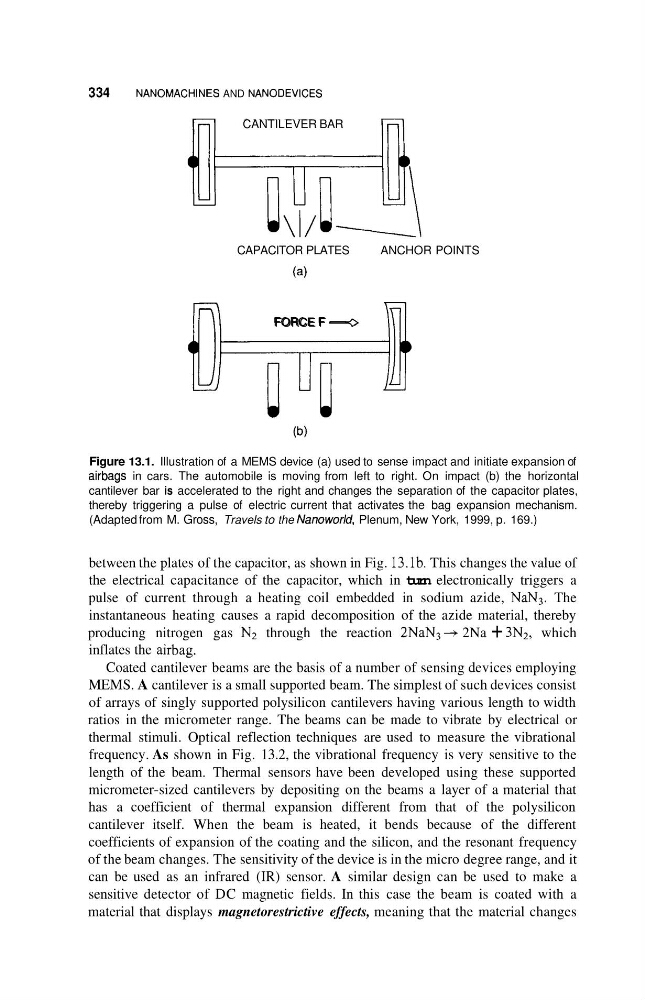
Figure 13.1. Illustration of a MEMS device (a) used to sense impact and initiate expansion of
airbags in cars. The automobile is moving from left to right. On impact (b) the horizontal
cantilever bar is accelerated to the right and changes the separation of the capacitor plates,
thereby triggering a pulse of electric current that activates the bag expansion mechanism.
(Adapted from M. Gross, Travels to the Nanoworlcf, Plenum, New York, 1999, p. 169.)
between the plates of the capacitor, as shown in Fig. 13.lb. This changes the value of
the electrical capacitance of the capacitor, which in turn electronically triggers a
pulse of current through a heating coil embedded in sodium azide, NaN3. The
instantaneous heating causes a rapid decomposition of the azide material, thereby
producing nitrogen gas N2 through the reaction 2NaN3 + 2Na + 3N2, which
inflates the airbag.
Coated cantilever beams are the basis of a number of sensing devices employing
MEMS. A cantilever is a small supported beam. The simplest of such devices consist
of arrays of singly supported polysilicon cantilevers having various length to width
ratios in the micrometer range. The beams can be made to vibrate by electrical or
thermal stimuli. Optical reflection techniques are used to measure the vibrational
frequency. As shown in Fig. 13.2, the vibrational frequency is very sensitive to the
length of the beam. Thermal sensors have been developed using these supported
micrometer-sized cantilevers by depositing on the beams a layer of a material that
has a coefficient of thermal expansion different from that of the polysilicon
cantilever itself. When the beam is heated, it bends because of the different
coefficients of expansion of the coating and the silicon, and the resonant frequency
of the beam changes. The sensitivity of the device is in the micro degree range, and it
can be used as an infrared (IR) sensor. A similar design can be used to make a
sensitive detector of DC magnetic fields. In this case the beam is coated with a
material that displays magnetorestrictive effects, meaning that the material changes
NANOMACHINES AND NANODEVICES
CANTILEVER BAR
CAPACITOR PLATES
ANCHOR POINTS
(a)
FORCE F --3
>
Figure 13.1. Illustration of a MEMS device (a) used to sense impact and initiate expansion of
airbags in cars. The automobile is moving from left to right. On impact (b) the horizontal
cantilever bar is accelerated to the right and changes the separation of the capacitor plates,
thereby triggering a pulse of electric current that activates the bag expansion mechanism.
(Adapted from M. Gross, Travels to the Nanoworlcf, Plenum, New York, 1999, p. 169.)
between the plates of the capacitor, as shown in Fig. 13.lb. This changes the value of
the electrical capacitance of the capacitor, which in turn electronically triggers a
pulse of current through a heating coil embedded in sodium azide, NaN3. The
instantaneous heating causes a rapid decomposition of the azide material, thereby
producing nitrogen gas N2 through the reaction 2NaN3 + 2Na + 3N2, which
inflates the airbag.
Coated cantilever beams are the basis of a number of sensing devices employing
MEMS. A cantilever is a small supported beam. The simplest of such devices consist
of arrays of singly supported polysilicon cantilevers having various length to width
ratios in the micrometer range. The beams can be made to vibrate by electrical or
thermal stimuli. Optical reflection techniques are used to measure the vibrational
frequency. As shown in Fig. 13.2, the vibrational frequency is very sensitive to the
length of the beam. Thermal sensors have been developed using these supported
micrometer-sized cantilevers by depositing on the beams a layer of a material that
has a coefficient of thermal expansion different from that of the polysilicon
cantilever itself. When the beam is heated, it bends because of the different
coefficients of expansion of the coating and the silicon, and the resonant frequency
of the beam changes. The sensitivity of the device is in the micro degree range, and it
can be used as an infrared (IR) sensor. A similar design can be used to make a
sensitive detector of DC magnetic fields. In this case the beam is coated with a
material that displays magnetorestrictive effects, meaning that the material changes