

2.2. ENERGY BANDS
23
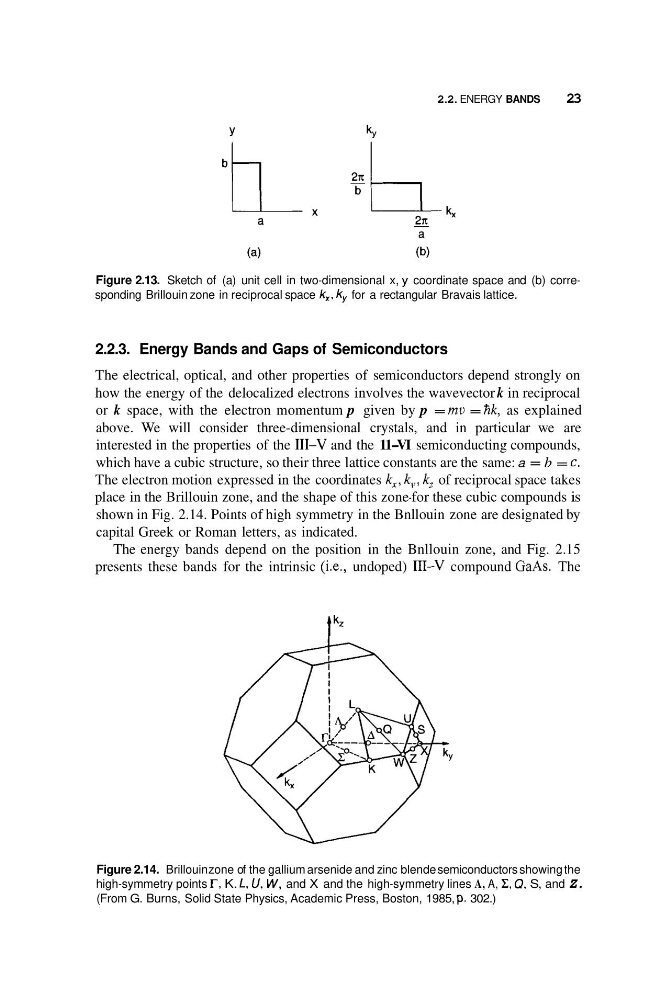
Figure 2.13. Sketch of (a) unit cell in two-dimensional x, y coordinate space and (b) corresponding Brillouin zone in reciprocal space k,, ky for a rectangular Bravais lattice.
2.2.3. Energy Bands and Gaps of Semiconductors
The electrical, optical, and other properties of semiconductors depend strongly on
how the energy of the delocalized electrons involves the wavevector k in reciprocal
or k space, with the electron momentum p given by p = mu = Ak, as explained
above. We will consider three-dimensional crystals, and in particular we are
interested in the properties of the 111-V and the 11-VI semiconducting compounds,
which have a cubic structure, so their three lattice constants are the same: a = b = c.
The electron motion expressed in the coordinates kx, k,, k, of reciprocal space takes
place in the Brillouin zone, and the shape of this zone-for these cubic compounds is
shown in Fig. 2.14. Points of high symmetry in the Bnllouin zone are designated by
capital Greek or Roman letters, as indicated.
The energy bands depend on the position in the Bnllouin zone, and Fig. 2.15
presents these bands for the intrinsic (i.e., undoped) 111-V compound GaAs. The
t kz
Figure 2.14. Brillouin zone of the gallium arsenide and zinc blende semiconductors showing the
high-symmetry points r, K. L, U, W , and X and the high-symmetry lines A, A, E, Q. S, and Z.
(From G. Burns, Solid State Physics, Academic Press, Boston, 1985, p. 302.)
23
Figure 2.13. Sketch of (a) unit cell in two-dimensional x, y coordinate space and (b) corresponding Brillouin zone in reciprocal space k,, ky for a rectangular Bravais lattice.
2.2.3. Energy Bands and Gaps of Semiconductors
The electrical, optical, and other properties of semiconductors depend strongly on
how the energy of the delocalized electrons involves the wavevector k in reciprocal
or k space, with the electron momentum p given by p = mu = Ak, as explained
above. We will consider three-dimensional crystals, and in particular we are
interested in the properties of the 111-V and the 11-VI semiconducting compounds,
which have a cubic structure, so their three lattice constants are the same: a = b = c.
The electron motion expressed in the coordinates kx, k,, k, of reciprocal space takes
place in the Brillouin zone, and the shape of this zone-for these cubic compounds is
shown in Fig. 2.14. Points of high symmetry in the Bnllouin zone are designated by
capital Greek or Roman letters, as indicated.
The energy bands depend on the position in the Bnllouin zone, and Fig. 2.15
presents these bands for the intrinsic (i.e., undoped) 111-V compound GaAs. The
t kz
Figure 2.14. Brillouin zone of the gallium arsenide and zinc blende semiconductors showing the
high-symmetry points r, K. L, U, W , and X and the high-symmetry lines A, A, E, Q. S, and Z.
(From G. Burns, Solid State Physics, Academic Press, Boston, 1985, p. 302.)