

12.4. BIOLOGICAL NANOSTRUCTURES
327
water
p e 113
spherical
micelle
water
oval or
'I3 e e 'I2 cylindrical micelle
water
0
Air
oil
p = l
P > l
vesicle
plane layer
or bilayer
reversed
micelle
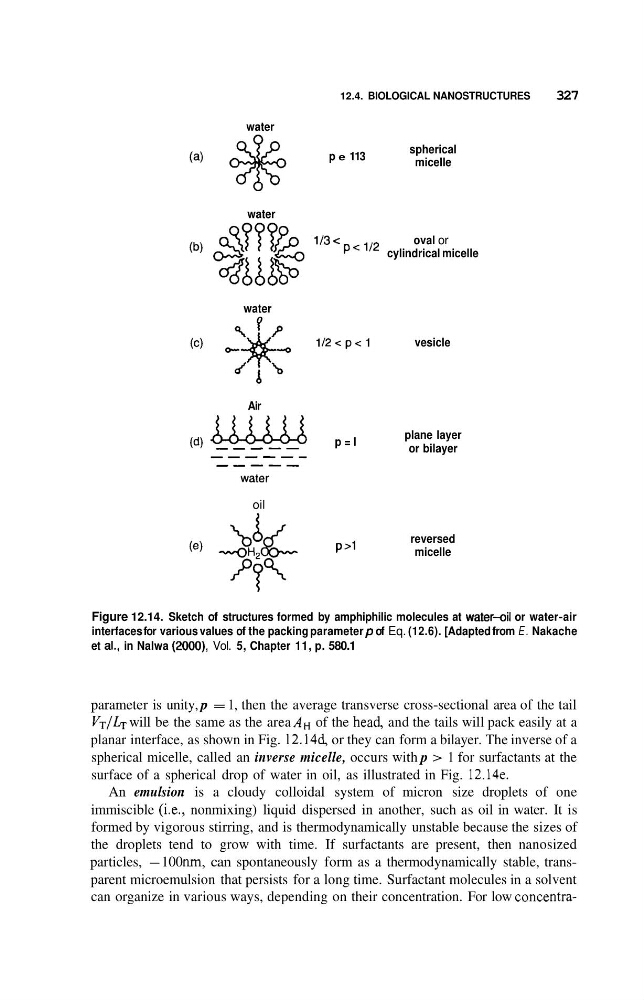
Figure 12.14. Sketch of structures formed by amphiphilic molecules at water-oil or water-air
interfaces for various values of the packing parameter p of Eq. (12.6). [Adapted from E . Nakache
et al., in Nalwa (2000), Vol. 5, Chapter 11, p. 580.1
parameter is unity, p = 1, then the average transverse cross-sectional area of the tail
V,/L, will be the same as the area A H of the head, and the tails will pack easily at a
planar interface, as shown in Fig. 12.146 or they can form a bilayer. The inverse of a
spherical micelle, called an inverse micelle, occurs with p =- 1 for surfactants at the
surface of a spherical drop of water in oil, as illustrated in Fig. 12.14e.
An emulsion is a cloudy colloidal system of micron size droplets of one
immiscible (i.e., nonmixing) liquid dispersed in another, such as oil in water. It is
formed by vigorous stirring, and is thermodynamically unstable because the sizes of
the droplets tend to grow with time. If surfactants are present, then nanosized
particles, -100 nm, can spontaneously form as a thermodynamically stable, transparent microemulsion that persists for a long time. Surfactant molecules in a solvent
can organize in various ways, depending on their concentration. For low concentra-
327
water
p e 113
spherical
micelle
water
oval or
'I3 e e 'I2 cylindrical micelle
water
0
Air
oil
p = l
P > l
vesicle
plane layer
or bilayer
reversed
micelle
Figure 12.14. Sketch of structures formed by amphiphilic molecules at water-oil or water-air
interfaces for various values of the packing parameter p of Eq. (12.6). [Adapted from E . Nakache
et al., in Nalwa (2000), Vol. 5, Chapter 11, p. 580.1
parameter is unity, p = 1, then the average transverse cross-sectional area of the tail
V,/L, will be the same as the area A H of the head, and the tails will pack easily at a
planar interface, as shown in Fig. 12.146 or they can form a bilayer. The inverse of a
spherical micelle, called an inverse micelle, occurs with p =- 1 for surfactants at the
surface of a spherical drop of water in oil, as illustrated in Fig. 12.14e.
An emulsion is a cloudy colloidal system of micron size droplets of one
immiscible (i.e., nonmixing) liquid dispersed in another, such as oil in water. It is
formed by vigorous stirring, and is thermodynamically unstable because the sizes of
the droplets tend to grow with time. If surfactants are present, then nanosized
particles, -100 nm, can spontaneously form as a thermodynamically stable, transparent microemulsion that persists for a long time. Surfactant molecules in a solvent
can organize in various ways, depending on their concentration. For low concentra-