

326
BIOLOGICAL MATERIALS
12.4.2. Micelles and Vesicles
A surfactant (surface-active agent) is an amphiphilic chemical compound, so named
because it contains a hydrophilic or water-seeking head group at one end, and a
hydrophobic or water-avoiding (i.e., lipophilic or oil-seeking) tail group at the other
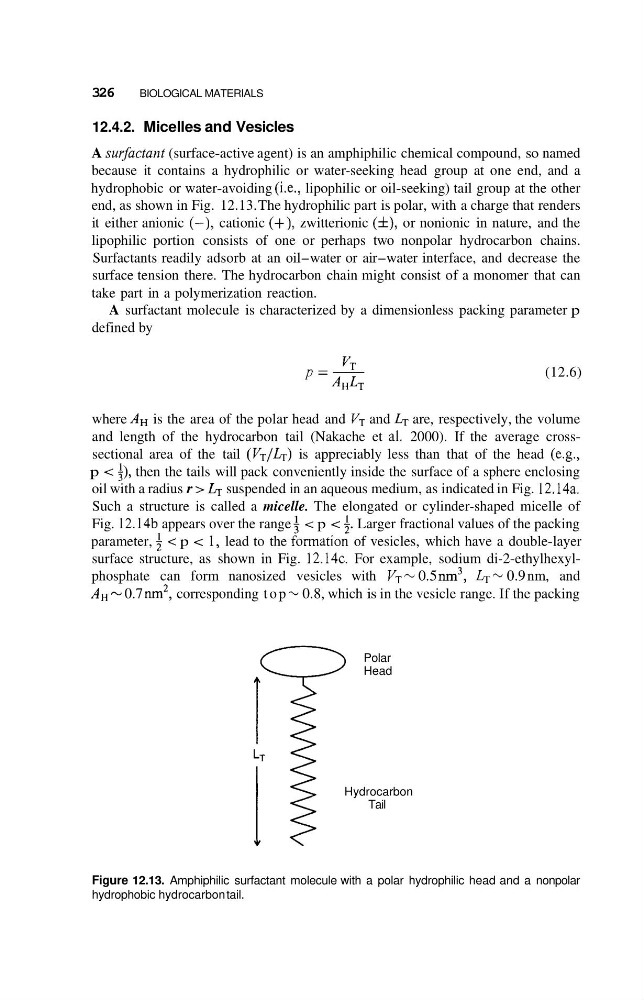
end, as shown in Fig. 12.13. The hydrophilic part is polar, with a charge that renders
it either anionic (-), cationic (+), zwitterionic (&), or nonionic in nature, and the
lipophilic portion consists of one or perhaps two nonpolar hydrocarbon chains.
Surfactants readily adsorb at an oil-water or air-water interface, and decrease the
surface tension there. The hydrocarbon chain might consist of a monomer that can
take part in a polymerization reaction.
A surfactant molecule is characterized by a dimensionless packing parameter p
defined by
“T
p = -
AHLT
(12.6)
where AH is the area of the polar head and VT and & are, respectively, the volume
and length of the hydrocarbon tail (Nakache et al. 2000). If the average crosssectional area of the tail (VT/L,-) is appreciably less than that of the head (e.g.,
p < #, then the tails will pack conveniently inside the surface of a sphere enclosing
oil with a radius r > & suspended in an aqueous medium, as indicated in Fig. I2.14a.
Such a structure is called a micelle. The elongated or cylinder-shaped micelle of
Fig. 12.14b appears over the range f < p < 4. Larger fractional values of the packing
parameter, 2 < p < 1, lead to the formation of vesicles, which have a double-layer
surface structure, as shown in Fig. 12.14~. For example, sodium di-2-ethylhexylphosphate can form nanosized vesicles with VT - 0.5 nm3, L,- - 0.9 nm, and
AH - 0.7 nm2, corresponding t o p - 0.8, which is in the vesicle range. If the packing
Polar
Head
LT
Hydrocarbon
Tail
Figure 12.13. Amphiphilic surfactant molecule with a polar hydrophilic head and a nonpolar
hydrophobic hydrocarbon tail.
BIOLOGICAL MATERIALS
12.4.2. Micelles and Vesicles
A surfactant (surface-active agent) is an amphiphilic chemical compound, so named
because it contains a hydrophilic or water-seeking head group at one end, and a
hydrophobic or water-avoiding (i.e., lipophilic or oil-seeking) tail group at the other
end, as shown in Fig. 12.13. The hydrophilic part is polar, with a charge that renders
it either anionic (-), cationic (+), zwitterionic (&), or nonionic in nature, and the
lipophilic portion consists of one or perhaps two nonpolar hydrocarbon chains.
Surfactants readily adsorb at an oil-water or air-water interface, and decrease the
surface tension there. The hydrocarbon chain might consist of a monomer that can
take part in a polymerization reaction.
A surfactant molecule is characterized by a dimensionless packing parameter p
defined by
“T
p = -
AHLT
(12.6)
where AH is the area of the polar head and VT and & are, respectively, the volume
and length of the hydrocarbon tail (Nakache et al. 2000). If the average crosssectional area of the tail (VT/L,-) is appreciably less than that of the head (e.g.,
p < #, then the tails will pack conveniently inside the surface of a sphere enclosing
oil with a radius r > & suspended in an aqueous medium, as indicated in Fig. I2.14a.
Such a structure is called a micelle. The elongated or cylinder-shaped micelle of
Fig. 12.14b appears over the range f < p < 4. Larger fractional values of the packing
parameter, 2 < p < 1, lead to the formation of vesicles, which have a double-layer
surface structure, as shown in Fig. 12.14~. For example, sodium di-2-ethylhexylphosphate can form nanosized vesicles with VT - 0.5 nm3, L,- - 0.9 nm, and
AH - 0.7 nm2, corresponding t o p - 0.8, which is in the vesicle range. If the packing
Polar
Head
LT
Hydrocarbon
Tail
Figure 12.13. Amphiphilic surfactant molecule with a polar hydrophilic head and a nonpolar
hydrophobic hydrocarbon tail.