

12.3. NUCLEIC ACIDS
323
alphabet there are 43 = 64 possible words, and 6 1 of these are used as codewords for
amino acids.
DNA is the carrier of heredity in the human body. This double-stranded
molecule has a companion single-stranded molecule, ribonucleic acid (RNA),
which is involved in the synthesis of proteins using the information transcribed
or passed on to it from DNA. To form RNA, the DNA uncoils, and sections of the
RNA strand are synthesized one nucleotide at a time, in sequence, a process called
transcription. The RNA strand structure differs from the DNA strand through the
replacement of one hydrogen atom (H) of the sugar molecule by an hydroxyl group
(OH), thereby forming the sugar ribose (instead of desoxyribose), as indicated at
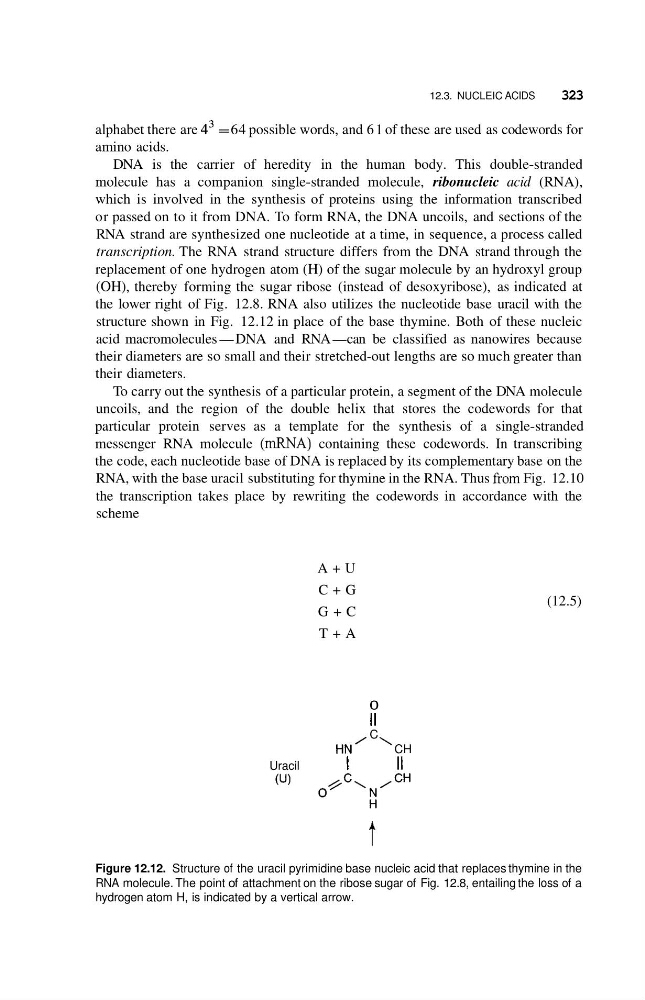
the lower right of Fig. 12.8. RNA also utilizes the nucleotide base uracil with the
structure shown in Fig. 12.12 in place of the base thymine. Both of these nucleic
acid macromolecules-DNA and RNA-can be classified as nanowires because
their diameters are so small and their stretched-out lengths are so much greater than
their diameters.
To carry out the synthesis of a particular protein, a segment of the DNA molecule
uncoils, and the region of the double helix that stores the codewords for that
particular protein serves as a template for the synthesis of a single-stranded
messenger RNA molecule (mRNA) containing these codewords. In transcribing
the code, each nucleotide base of DNA is replaced by its complementary base on the
RNA, with the base uracil substituting for thymine in the RNA. Thus from Fig. 12.10
the transcription takes place by rewriting the codewords in accordance with the
scheme
A + U
C + G
G + C
T + A
0
C
HN/
' CH
II
Uracil
I
I 1
t
(12.5)
Figure 12.12. Structure of the uracil pyrimidine base nucleic acid that replaces thymine in the
RNA molecule. The point of attachment on the ribose sugar of Fig. 12.8, entailing the loss of a
hydrogen atom H, is indicated by a vertical arrow.
323
alphabet there are 43 = 64 possible words, and 6 1 of these are used as codewords for
amino acids.
DNA is the carrier of heredity in the human body. This double-stranded
molecule has a companion single-stranded molecule, ribonucleic acid (RNA),
which is involved in the synthesis of proteins using the information transcribed
or passed on to it from DNA. To form RNA, the DNA uncoils, and sections of the
RNA strand are synthesized one nucleotide at a time, in sequence, a process called
transcription. The RNA strand structure differs from the DNA strand through the
replacement of one hydrogen atom (H) of the sugar molecule by an hydroxyl group
(OH), thereby forming the sugar ribose (instead of desoxyribose), as indicated at
the lower right of Fig. 12.8. RNA also utilizes the nucleotide base uracil with the
structure shown in Fig. 12.12 in place of the base thymine. Both of these nucleic
acid macromolecules-DNA and RNA-can be classified as nanowires because
their diameters are so small and their stretched-out lengths are so much greater than
their diameters.
To carry out the synthesis of a particular protein, a segment of the DNA molecule
uncoils, and the region of the double helix that stores the codewords for that
particular protein serves as a template for the synthesis of a single-stranded
messenger RNA molecule (mRNA) containing these codewords. In transcribing
the code, each nucleotide base of DNA is replaced by its complementary base on the
RNA, with the base uracil substituting for thymine in the RNA. Thus from Fig. 12.10
the transcription takes place by rewriting the codewords in accordance with the
scheme
A + U
C + G
G + C
T + A
0
C
HN/
' CH
II
Uracil
I
I 1
t
(12.5)
Figure 12.12. Structure of the uracil pyrimidine base nucleic acid that replaces thymine in the
RNA molecule. The point of attachment on the ribose sugar of Fig. 12.8, entailing the loss of a
hydrogen atom H, is indicated by a vertical arrow.