

316
BIOLOGICAL MATERIALS
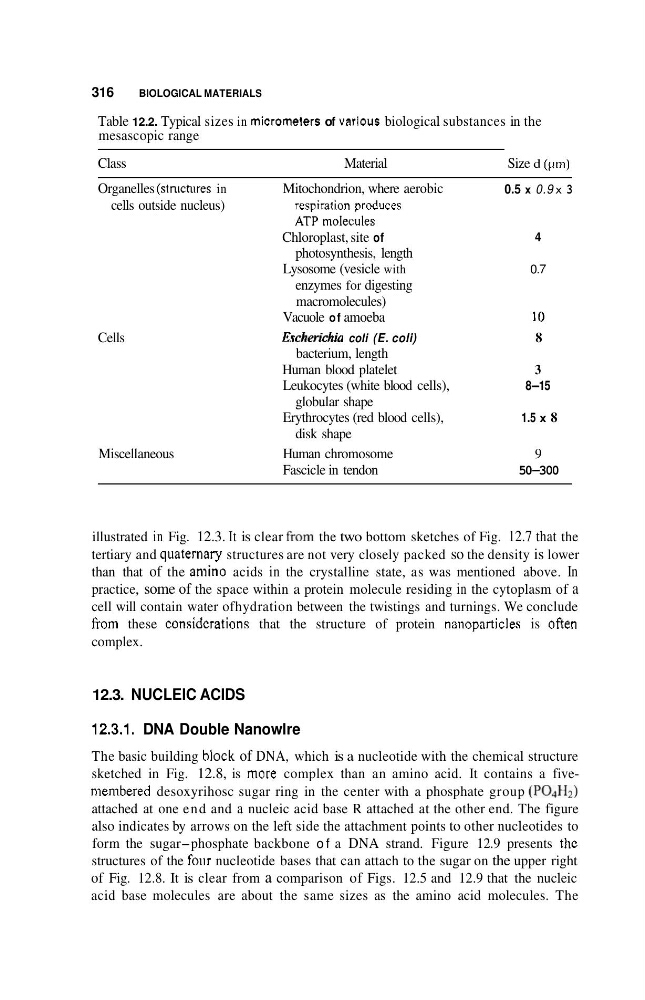
Table 12.2. Typical sizes in micromelers of varlous biological substances in the
mesascopic range
Class
Material
Size d (p)
Organelles (stnshlres in
Mitochondrion, where aerobic
0.5 x 0.9 x 3
cells outside nucleus)
resuiration uroduces
Cells
A ~ P
molecies
Chloroplast, site of
photosynthesis, length
Lysosome (vesicle with
enzymes for digesting
macromolecules)
Vacuole of amoeba
EFcherichia coli (E. coli)
bacterium, length
Human blood platelet
Leukocytes (white blood cells),
Erythrocytes (red blood cells),
globular shape
disk shape
Miscellaneous
Human chromosome
Fascicle in tendon
4
0.7
IO
8
3
8-15
1.5 x 8
9
50-300
illustrated in Fig. 12.3. It is clear from the two bottom sketches of Fig. 12.7 that the
tertiary and quaternary structures are not very closely packed so the density is lower
than that of the amino acids in the crystalline state, as was mentioned above. In
practice, some of the space within a protein molecule residing in the cytoplasm of a
cell will contain water ofhydration between the twistings and turnings. We conclude
fiom these considerations that the structure of protein nanoparticles is often
complex.
12.3. NUCLEIC ACIDS
12.3.1. DNA Double Nanowlre
The basic building hlock of DNA, which is a nucleotide with the chemical structure
sketched in Fig. 12.8, is more complex than an amino acid. It contains a fivemembered desoxyrihosc sugar ring in the center with a phosphate group (P04H2)
attached at one end and a nucleic acid base R attached at the other end. The figure
also indicates by arrows on the left side the attachment points to other nucleotides to
form the sugar-phosphate backbone o f a DNA strand. Figure 12.9 presents the
structures of the four nucleotide bases that can attach to the sugar on the upper right
of Fig. 12.8. It is clear from a comparison of Figs. 12.5 and 12.9 that the nucleic
acid base molecules are about the same sizes as the amino acid molecules. The
BIOLOGICAL MATERIALS
Table 12.2. Typical sizes in micromelers of varlous biological substances in the
mesascopic range
Class
Material
Size d (p)
Organelles (stnshlres in
Mitochondrion, where aerobic
0.5 x 0.9 x 3
cells outside nucleus)
resuiration uroduces
Cells
A ~ P
molecies
Chloroplast, site of
photosynthesis, length
Lysosome (vesicle with
enzymes for digesting
macromolecules)
Vacuole of amoeba
EFcherichia coli (E. coli)
bacterium, length
Human blood platelet
Leukocytes (white blood cells),
Erythrocytes (red blood cells),
globular shape
disk shape
Miscellaneous
Human chromosome
Fascicle in tendon
4
0.7
IO
8
3
8-15
1.5 x 8
9
50-300
illustrated in Fig. 12.3. It is clear from the two bottom sketches of Fig. 12.7 that the
tertiary and quaternary structures are not very closely packed so the density is lower
than that of the amino acids in the crystalline state, as was mentioned above. In
practice, some of the space within a protein molecule residing in the cytoplasm of a
cell will contain water ofhydration between the twistings and turnings. We conclude
fiom these considerations that the structure of protein nanoparticles is often
complex.
12.3. NUCLEIC ACIDS
12.3.1. DNA Double Nanowlre
The basic building hlock of DNA, which is a nucleotide with the chemical structure
sketched in Fig. 12.8, is more complex than an amino acid. It contains a fivemembered desoxyrihosc sugar ring in the center with a phosphate group (P04H2)
attached at one end and a nucleic acid base R attached at the other end. The figure
also indicates by arrows on the left side the attachment points to other nucleotides to
form the sugar-phosphate backbone o f a DNA strand. Figure 12.9 presents the
structures of the four nucleotide bases that can attach to the sugar on the upper right
of Fig. 12.8. It is clear from a comparison of Figs. 12.5 and 12.9 that the nucleic
acid base molecules are about the same sizes as the amino acid molecules. The