

12.2. BIOLOGICAL BUILDING BLOCKS
315
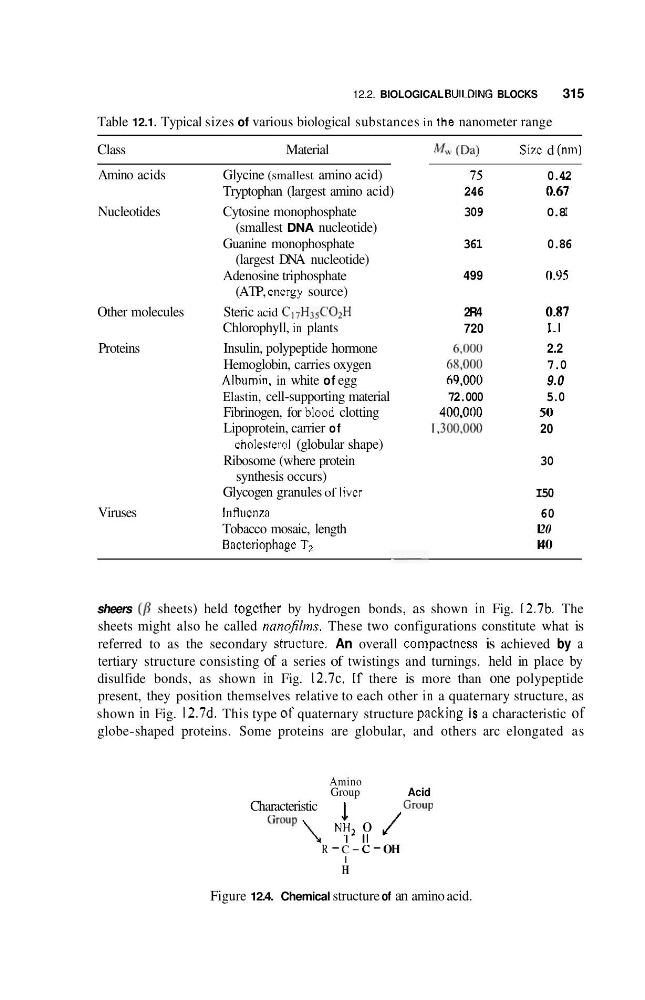
Table 12.1. Typical sizes of various biological substances in the nanometer range
Class
Material
Amino acids
Glycine (smallest amino acid)
Tryptophan (largest amino acid)
Nucleotides
Cytosine monophosphate
(smallest DNA nucleotide)
Guanine monophosphate
(largest DNA nucleotide)
Adenosine triphosphate
(ATP, energy source)
Other molecules
Steric acid CI7H,,CO2H
Proteins
Insulin, polypeptide hormone
Chlorophyll, in plants
Hemoglobin, carries oxygen
Alhumin. in white of egg
Elastin, cell-supporting material
Fibrinogen, for blood clotting
Lipoprotein, carrier of
cholesteml (globular shape)
Ribosome (where protein
synthesis occurs)
Glycogen granules of liver
Tobacco mosaic, length
Bactcriophagc T,
Viruses
Influcnzs
MV
S i x d (nm)
75
0.42
246
0.67
309
0.8 I
361
0.86
499
0.95
2R4
0 3 7
720
1.1
6.nnn
2.2
6x,ono
7.0
69,000
9.0
72.000
5.0
40o.ono
50
I.~O~,OOO
20
30
I50
60
I 20
I 40
sheers (p sheets) held togcther by hydrogen bonds, as shown in Fig. 12.7h. The
sheets might also he called ncinoJilms. These two configurations constitute what is
referred to as the secondary struchire. An overall compactncss is achieved by a
tertiary structure consisting of a series of twistings and turnings. held in place by
disulfide bonds, as shown in Fig. 12.7~. If there is more than one polypeptide
present, they position themselves relative to each other in a quaternary structure, as
shown in Fig. 12.7d. This type of quaternary structure packing is a characteristic of
globe-shaped proteins. Some proteins are globular, and others arc elongated as
Amino
Group
Acid
CKNp
1
Characteristic
(iroup \ NH2 0 ,/
R - C - C - OH
I II
I
H
Figure 12.4. Chemical structure of an amino acid.
315
Table 12.1. Typical sizes of various biological substances in the nanometer range
Class
Material
Amino acids
Glycine (smallest amino acid)
Tryptophan (largest amino acid)
Nucleotides
Cytosine monophosphate
(smallest DNA nucleotide)
Guanine monophosphate
(largest DNA nucleotide)
Adenosine triphosphate
(ATP, energy source)
Other molecules
Steric acid CI7H,,CO2H
Proteins
Insulin, polypeptide hormone
Chlorophyll, in plants
Hemoglobin, carries oxygen
Alhumin. in white of egg
Elastin, cell-supporting material
Fibrinogen, for blood clotting
Lipoprotein, carrier of
cholesteml (globular shape)
Ribosome (where protein
synthesis occurs)
Glycogen granules of liver
Tobacco mosaic, length
Bactcriophagc T,
Viruses
Influcnzs
MV
S i x d (nm)
75
0.42
246
0.67
309
0.8 I
361
0.86
499
0.95
2R4
0 3 7
720
1.1
6.nnn
2.2
6x,ono
7.0
69,000
9.0
72.000
5.0
40o.ono
50
I.~O~,OOO
20
30
I50
60
I 20
I 40
sheers (p sheets) held togcther by hydrogen bonds, as shown in Fig. 12.7h. The
sheets might also he called ncinoJilms. These two configurations constitute what is
referred to as the secondary struchire. An overall compactncss is achieved by a
tertiary structure consisting of a series of twistings and turnings. held in place by
disulfide bonds, as shown in Fig. 12.7~. If there is more than one polypeptide
present, they position themselves relative to each other in a quaternary structure, as
shown in Fig. 12.7d. This type of quaternary structure packing is a characteristic of
globe-shaped proteins. Some proteins are globular, and others arc elongated as
Amino
Group
Acid
CKNp
1
Characteristic
(iroup \ NH2 0 ,/
R - C - C - OH
I II
I
H
Figure 12.4. Chemical structure of an amino acid.