

294
ORGANIC COMPOUNDS AND POLYMERS
section to a linear sequence of n monomers of type B. An example of a diblock
polymer is pobacetylene-transih'on section-polystyrene with the following structure
[End group] --[polyacteylene] -[transition member] --[polystyrene] - [end group]
(11.17)
which for a particular case may be written in a more detailed manner as
where the end groups have been chosen as the ethyl -C2H5 and methyl -CH3
radicals, and the transition member that joins the two polymer sequences is the
chemical group -CH2-C4, -. Of greater practical importance are more complex
copolymers that contain several or many monomer sequences of the types (A),,,
and (B),,.
If the conditions are right, then individual polymers are able to self-assemble to
produce copolymers. In many cases one polymer component is water-soluble and the
other is not. Some examples of nanostructures fabricated from copolymers are hairy
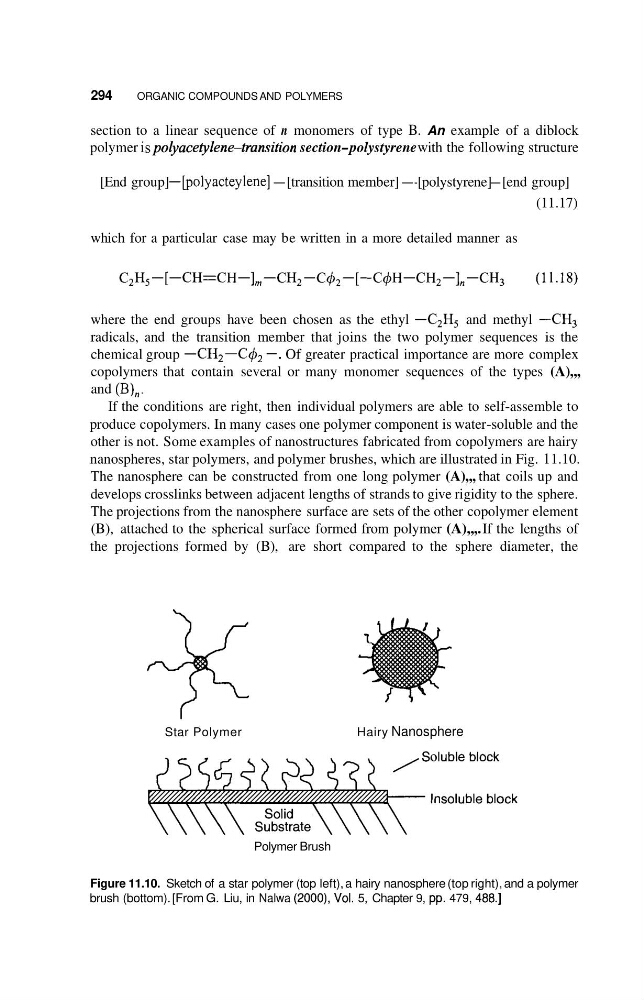
nanospheres, star polymers, and polymer brushes, which are illustrated in Fig. 1 1.10.
The nanosphere can be constructed from one long polymer (A),,, that coils up and
develops crosslinks between adjacent lengths of strands to give rigidity to the sphere.
The projections from the nanosphere surface are sets of the other copolymer element
(B), attached to the spherical surface formed from polymer (A),,,. If the lengths of
the projections formed by (B), are short compared to the sphere diameter, the
Star Polymer
Hairy Nanosphere
Polymer Brush
Figure 11.10. Sketch of a star polymer (top left), a hairy nanosphere (top right), and a polymer
brush (bottom). [From G. Liu, in Nalwa (2000), Vol. 5, Chapter 9, pp. 479, 488.1
ORGANIC COMPOUNDS AND POLYMERS
section to a linear sequence of n monomers of type B. An example of a diblock
polymer is pobacetylene-transih'on section-polystyrene with the following structure
[End group] --[polyacteylene] -[transition member] --[polystyrene] - [end group]
(11.17)
which for a particular case may be written in a more detailed manner as
where the end groups have been chosen as the ethyl -C2H5 and methyl -CH3
radicals, and the transition member that joins the two polymer sequences is the
chemical group -CH2-C4, -. Of greater practical importance are more complex
copolymers that contain several or many monomer sequences of the types (A),,,
and (B),,.
If the conditions are right, then individual polymers are able to self-assemble to
produce copolymers. In many cases one polymer component is water-soluble and the
other is not. Some examples of nanostructures fabricated from copolymers are hairy
nanospheres, star polymers, and polymer brushes, which are illustrated in Fig. 1 1.10.
The nanosphere can be constructed from one long polymer (A),,, that coils up and
develops crosslinks between adjacent lengths of strands to give rigidity to the sphere.
The projections from the nanosphere surface are sets of the other copolymer element
(B), attached to the spherical surface formed from polymer (A),,,. If the lengths of
the projections formed by (B), are short compared to the sphere diameter, the
Star Polymer
Hairy Nanosphere
Polymer Brush
Figure 11.10. Sketch of a star polymer (top left), a hairy nanosphere (top right), and a polymer
brush (bottom). [From G. Liu, in Nalwa (2000), Vol. 5, Chapter 9, pp. 479, 488.1