

11.4. POLYMERS
293
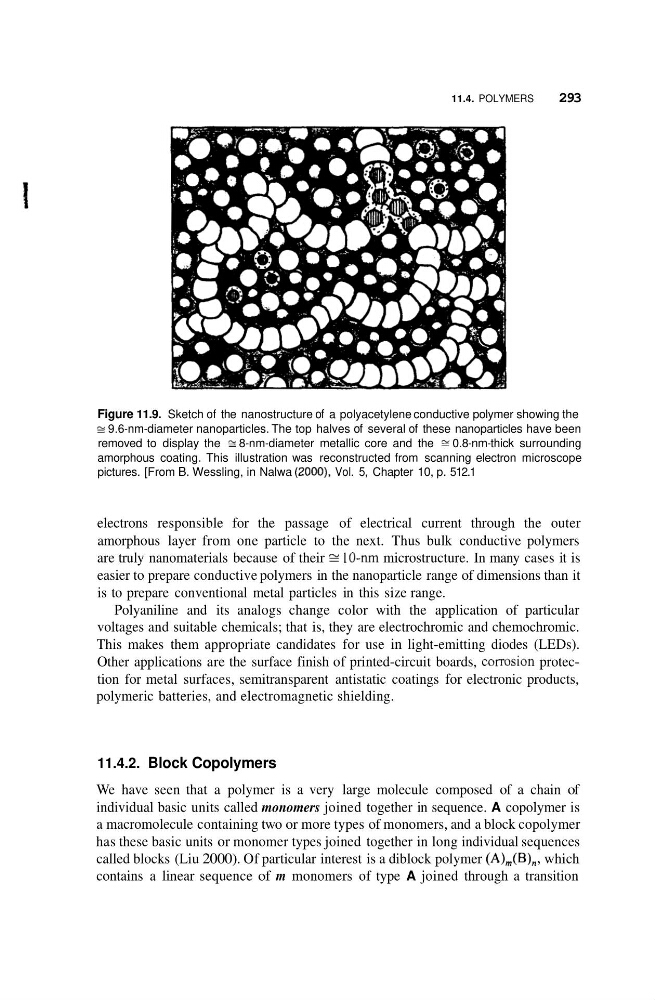
Figure 11.9. Sketch of the nanostructure of a polyacetylene conductive polymer showing the
% 9.6-nm-diameter nanoparticles. The top halves of several of these nanoparticles have been
removed to display the E 8-nm-diameter metallic core and the E 0.8-nm-thick surrounding
amorphous coating. This illustration was reconstructed from scanning electron microscope
pictures. [From B. Wessling, in Nalwa (ZOOO), Vol. 5, Chapter 10, p. 512.1
electrons responsible for the passage of electrical current through the outer
amorphous layer from one particle to the next. Thus bulk conductive polymers
are truly nanomaterials because of their E IO-nm microstructure. In many cases it is
easier to prepare conductive polymers in the nanoparticle range of dimensions than it
is to prepare conventional metal particles in this size range.
Polyaniline and its analogs change color with the application of particular
voltages and suitable chemicals; that is, they are electrochromic and chemochromic.
This makes them appropriate candidates for use in light-emitting diodes (LEDs).
Other applications are the surface finish of printed-circuit boards, comsion protection for metal surfaces, semitransparent antistatic coatings for electronic products,
polymeric batteries, and electromagnetic shielding.
11.4.2. Block Copolymers
We have seen that a polymer is a very large molecule composed of a chain of
individual basic units called monomers joined together in sequence. A copolymer is
a macromolecule containing two or more types of monomers, and a block copolymer
has these basic units or monomer types joined together in long individual sequences
called blocks (Liu 2000). Of particular interest is a diblock polymer (A)m(B)n, which
contains a linear sequence of m monomers of type A joined through a transition
293
Figure 11.9. Sketch of the nanostructure of a polyacetylene conductive polymer showing the
% 9.6-nm-diameter nanoparticles. The top halves of several of these nanoparticles have been
removed to display the E 8-nm-diameter metallic core and the E 0.8-nm-thick surrounding
amorphous coating. This illustration was reconstructed from scanning electron microscope
pictures. [From B. Wessling, in Nalwa (ZOOO), Vol. 5, Chapter 10, p. 512.1
electrons responsible for the passage of electrical current through the outer
amorphous layer from one particle to the next. Thus bulk conductive polymers
are truly nanomaterials because of their E IO-nm microstructure. In many cases it is
easier to prepare conductive polymers in the nanoparticle range of dimensions than it
is to prepare conventional metal particles in this size range.
Polyaniline and its analogs change color with the application of particular
voltages and suitable chemicals; that is, they are electrochromic and chemochromic.
This makes them appropriate candidates for use in light-emitting diodes (LEDs).
Other applications are the surface finish of printed-circuit boards, comsion protection for metal surfaces, semitransparent antistatic coatings for electronic products,
polymeric batteries, and electromagnetic shielding.
11.4.2. Block Copolymers
We have seen that a polymer is a very large molecule composed of a chain of
individual basic units called monomers joined together in sequence. A copolymer is
a macromolecule containing two or more types of monomers, and a block copolymer
has these basic units or monomer types joined together in long individual sequences
called blocks (Liu 2000). Of particular interest is a diblock polymer (A)m(B)n, which
contains a linear sequence of m monomers of type A joined through a transition