

10.1. SELF-ASSEMBLY
259
factor of 2 associated with R1 and R', accounts for the participation of two atoms in
each pair process. Analogous expressions can be written for the rate of change of the
number of pairs dn,ldt, for the rate of change of the number of triplet clusters
dn,ldt, and so forth. Some of the terms for the various rates Ri depend on the extent
of the coverage of the surface, and the equation itself is applicable mainly during the
nucleation stage.
At the second or aggregation stage the percentage of isolated adatoms becomes
negligible, and a free-energy approach can provide some insight into the island
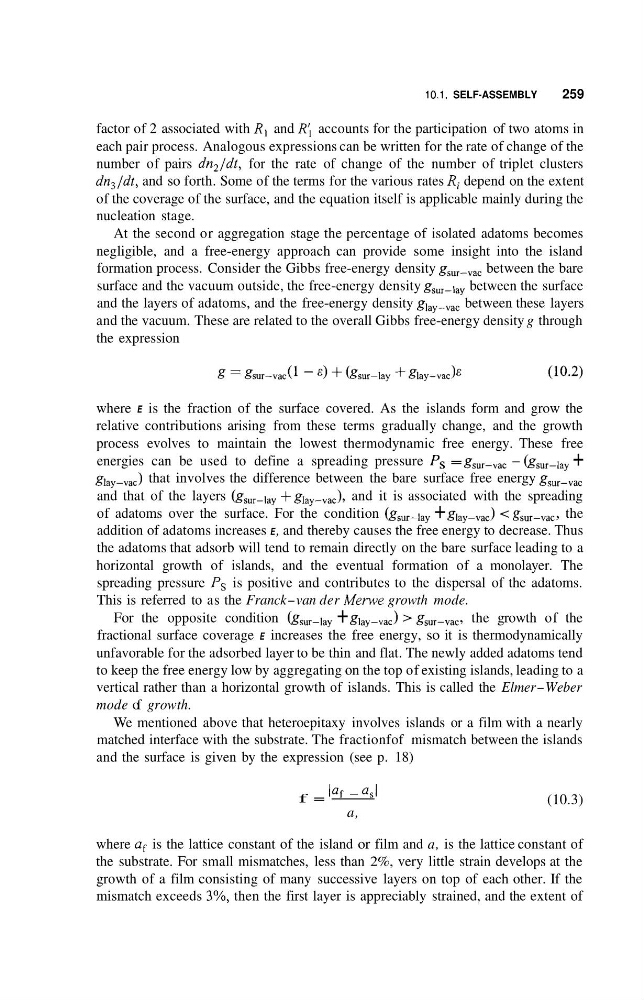
formation process. Consider the Gibbs free-energy density g,,,-,,,
between the bare
surface and the vacuum outside, the free-energy density gsurPlay between the surface
and the layers of adatoms, and the free-energy density glay-vac between these layers
and the vacuum. These are related to the overall Gibbs free-energy density g through
the expression
where E is the fraction of the surface covered. As the islands form and grow the
relative contributions arising from these terms gradually change, and the growth
process evolves to maintain the lowest thermodynamic free energy. These free
energies can be used to define a spreading pressure Ps = g,,,-,,,
- (gs,,-lay +
glayPvac) that involves the difference between the bare surface free energy g,,,-,,,
and that of the layers (gsurPlay +glay-vac), and it is associated with the spreading
of adatoms over the surface. For the condition (gsur-lay + glay-vac) < g,uT-vaC, the
addition of adatoms increases E , and thereby causes the free energy to decrease. Thus
the adatoms that adsorb will tend to remain directly on the bare surface leading to a
horizontal growth of islands, and the eventual formation of a monolayer. The
spreading pressure P, is positive and contributes to the dispersal of the adatoms.
This is referred to as the Franck-van der Menve growth mode.
For the opposite condition (gsur-lay + gIaypvac) > g,uT--VaC, the growth of the
fractional surface coverage E increases the free energy, so it is thermodynamically
unfavorable for the adsorbed layer to be thin and flat. The newly added adatoms tend
to keep the free energy low by aggregating on the top of existing islands, leading to a
vertical rather than a horizontal growth of islands. This is called the Elmer-Weber
mode of growth.
We mentioned above that heteroepitaxy involves islands or a film with a nearly
matched interface with the substrate. The fractionfof mismatch between the islands
and the surface is given by the expression (see p. 18)
bf - a,l
f =a,
(10.3)
where af is the lattice constant of the island or film and a, is the lattice constant of
the substrate. For small mismatches, less than 2%, very little strain develops at the
growth of a film consisting of many successive layers on top of each other. If the
mismatch exceeds 3%, then the first layer is appreciably strained, and the extent of
259
factor of 2 associated with R1 and R', accounts for the participation of two atoms in
each pair process. Analogous expressions can be written for the rate of change of the
number of pairs dn,ldt, for the rate of change of the number of triplet clusters
dn,ldt, and so forth. Some of the terms for the various rates Ri depend on the extent
of the coverage of the surface, and the equation itself is applicable mainly during the
nucleation stage.
At the second or aggregation stage the percentage of isolated adatoms becomes
negligible, and a free-energy approach can provide some insight into the island
formation process. Consider the Gibbs free-energy density g,,,-,,,
between the bare
surface and the vacuum outside, the free-energy density gsurPlay between the surface
and the layers of adatoms, and the free-energy density glay-vac between these layers
and the vacuum. These are related to the overall Gibbs free-energy density g through
the expression
where E is the fraction of the surface covered. As the islands form and grow the
relative contributions arising from these terms gradually change, and the growth
process evolves to maintain the lowest thermodynamic free energy. These free
energies can be used to define a spreading pressure Ps = g,,,-,,,
- (gs,,-lay +
glayPvac) that involves the difference between the bare surface free energy g,,,-,,,
and that of the layers (gsurPlay +glay-vac), and it is associated with the spreading
of adatoms over the surface. For the condition (gsur-lay + glay-vac) < g,uT-vaC, the
addition of adatoms increases E , and thereby causes the free energy to decrease. Thus
the adatoms that adsorb will tend to remain directly on the bare surface leading to a
horizontal growth of islands, and the eventual formation of a monolayer. The
spreading pressure P, is positive and contributes to the dispersal of the adatoms.
This is referred to as the Franck-van der Menve growth mode.
For the opposite condition (gsur-lay + gIaypvac) > g,uT--VaC, the growth of the
fractional surface coverage E increases the free energy, so it is thermodynamically
unfavorable for the adsorbed layer to be thin and flat. The newly added adatoms tend
to keep the free energy low by aggregating on the top of existing islands, leading to a
vertical rather than a horizontal growth of islands. This is called the Elmer-Weber
mode of growth.
We mentioned above that heteroepitaxy involves islands or a film with a nearly
matched interface with the substrate. The fractionfof mismatch between the islands
and the surface is given by the expression (see p. 18)
bf - a,l
f =a,
(10.3)
where af is the lattice constant of the island or film and a, is the lattice constant of
the substrate. For small mismatches, less than 2%, very little strain develops at the
growth of a film consisting of many successive layers on top of each other. If the
mismatch exceeds 3%, then the first layer is appreciably strained, and the extent of