

258
SELF-ASSEMBLY AND CATALYSIS
error-checking, so faulty or improperly attached subunits can be replaced during the
growth.
The traditional organic synthesis of very large molecules called macromolecules
comprises a number of time-consuming steps that involve breaking and remaking
strong covalent bonds, and these steps are carried out under kinetic control. The
yields are small, and errors are not readily recognized or corrected. In contrast to
this, the self-assembly variety of synthesis makes use of weak, noncovalent bonding
interactions such as those involving hydrogen bonds and van der Waals forces,
which permit the reactions to proceed under thermodynamic control, with the
continual correction of errors. The initial individual molecules or subunits are
usually small in size and number and easy to synthesize, and the final product is
produced in a thermodynamic equilibrium state.
10.1.2. Semiconductor Islands
One type of self-assembly involves the preparation of semiconductor islands, and it
can be carried out by a technique called heteroepitaxy, which involves the placement
or deposition of the material that forms the island on a supporting substance called a
substrate made of a different material with a closely matched interface between
them. Heteroepitaxy has been widely used for research, as well as for the fabrication
of many semiconductor devices, so it is a well-developed technique. It involves
bringing atoms or molecules to the surface of the substrate where they do one of
three things. They either are adsorbed and diffuse about on the surface until they join
or nucleate with another adatom to form an island attach themselves to or aggregate
into an existing island, or desorb and thereby leave the surface. Small islands can
continue to grow, migrate to other positions, or evaporate. There is a critical size at
which they become stable, and no longer experience much evaporation. Thus there is
an initial nucleation stage when the number of islands increases with the coverage.
This is followed by an aggregation stage when the number of islands levels off and
the existing ones grow in size. Finally there is the coalescence stage when the main
events that take place involve the merger of existing islands with each other to form
larger clusters.
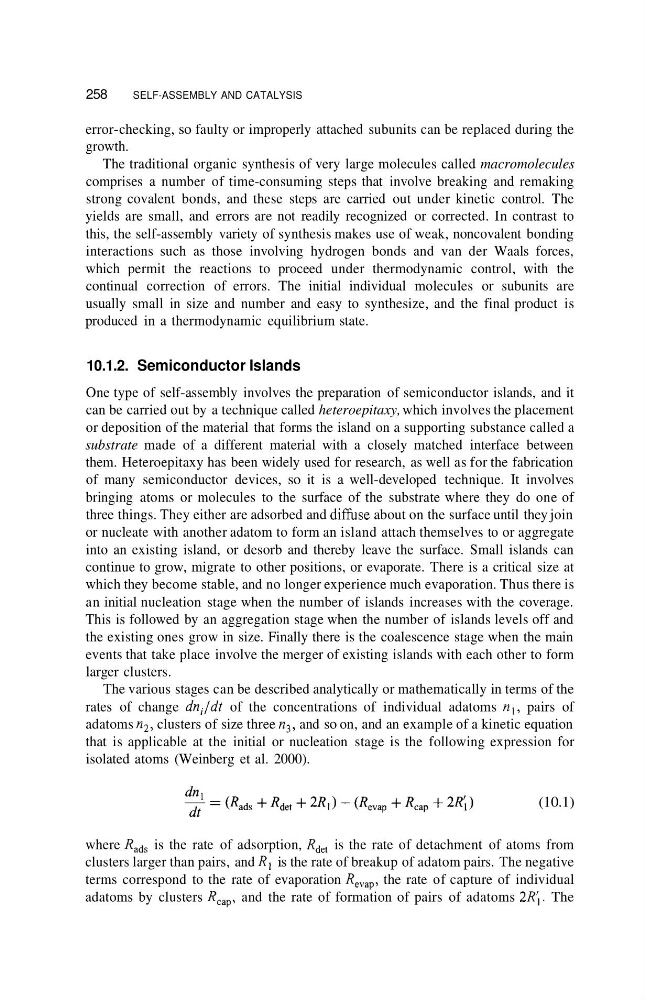
The various stages can be described analytically or mathematically in terms of the
rates of change dnJdt of the concentrations of individual adatoms n l , pairs of
adatoms n2, clusters of size three n3, and so on, and an example of a kinetic equation
that is applicable at the initial or nucleation stage is the following expression for
isolated atoms (Weinberg et al. 2000).
(10.1)
where Rads is the rate of adsorption, Rdet is the rate of detachment of atoms from
clusters larger than pairs, and R, is the rate of breakup of adatom pairs. The negative
terms correspond to the rate of evaporation Revap, the rate of capture of individual
adatoms by clusters Reap, and the rate of formation of pairs of adatoms 2R;. The
SELF-ASSEMBLY AND CATALYSIS
error-checking, so faulty or improperly attached subunits can be replaced during the
growth.
The traditional organic synthesis of very large molecules called macromolecules
comprises a number of time-consuming steps that involve breaking and remaking
strong covalent bonds, and these steps are carried out under kinetic control. The
yields are small, and errors are not readily recognized or corrected. In contrast to
this, the self-assembly variety of synthesis makes use of weak, noncovalent bonding
interactions such as those involving hydrogen bonds and van der Waals forces,
which permit the reactions to proceed under thermodynamic control, with the
continual correction of errors. The initial individual molecules or subunits are
usually small in size and number and easy to synthesize, and the final product is
produced in a thermodynamic equilibrium state.
10.1.2. Semiconductor Islands
One type of self-assembly involves the preparation of semiconductor islands, and it
can be carried out by a technique called heteroepitaxy, which involves the placement
or deposition of the material that forms the island on a supporting substance called a
substrate made of a different material with a closely matched interface between
them. Heteroepitaxy has been widely used for research, as well as for the fabrication
of many semiconductor devices, so it is a well-developed technique. It involves
bringing atoms or molecules to the surface of the substrate where they do one of
three things. They either are adsorbed and diffuse about on the surface until they join
or nucleate with another adatom to form an island attach themselves to or aggregate
into an existing island, or desorb and thereby leave the surface. Small islands can
continue to grow, migrate to other positions, or evaporate. There is a critical size at
which they become stable, and no longer experience much evaporation. Thus there is
an initial nucleation stage when the number of islands increases with the coverage.
This is followed by an aggregation stage when the number of islands levels off and
the existing ones grow in size. Finally there is the coalescence stage when the main
events that take place involve the merger of existing islands with each other to form
larger clusters.
The various stages can be described analytically or mathematically in terms of the
rates of change dnJdt of the concentrations of individual adatoms n l , pairs of
adatoms n2, clusters of size three n3, and so on, and an example of a kinetic equation
that is applicable at the initial or nucleation stage is the following expression for
isolated atoms (Weinberg et al. 2000).
(10.1)
where Rads is the rate of adsorption, Rdet is the rate of detachment of atoms from
clusters larger than pairs, and R, is the rate of breakup of adatom pairs. The negative
terms correspond to the rate of evaporation Revap, the rate of capture of individual
adatoms by clusters Reap, and the rate of formation of pairs of adatoms 2R;. The