

252
QUANTUM WELLS, WIRES, AND DOTS
of view they are quantum dots elongated in one direction. The present section is
devoted to a discussion of quantum-dot lasers, in which the confinement is in all
three spatial directions.
Conventional laser operation requires the presence of a laser medium containing
active atoms with discrete energy levels between which the laser emission transitions
take place. It also requires a mechanism for population inversion whereby an upper
energy level acquires a population of electrons exceeding that of the lower-lying
ground-state level. In a helium-neon gas laser the active atoms are Ne mixed with
He, and in a Nd-YAG solid-state laser the active atoms are neodymium ions
substituted (-10'9cm-3) in a yttruim aluminum garnet crystal. In the quantumdot laser to be described here the quantum dots play the role of the active atoms.
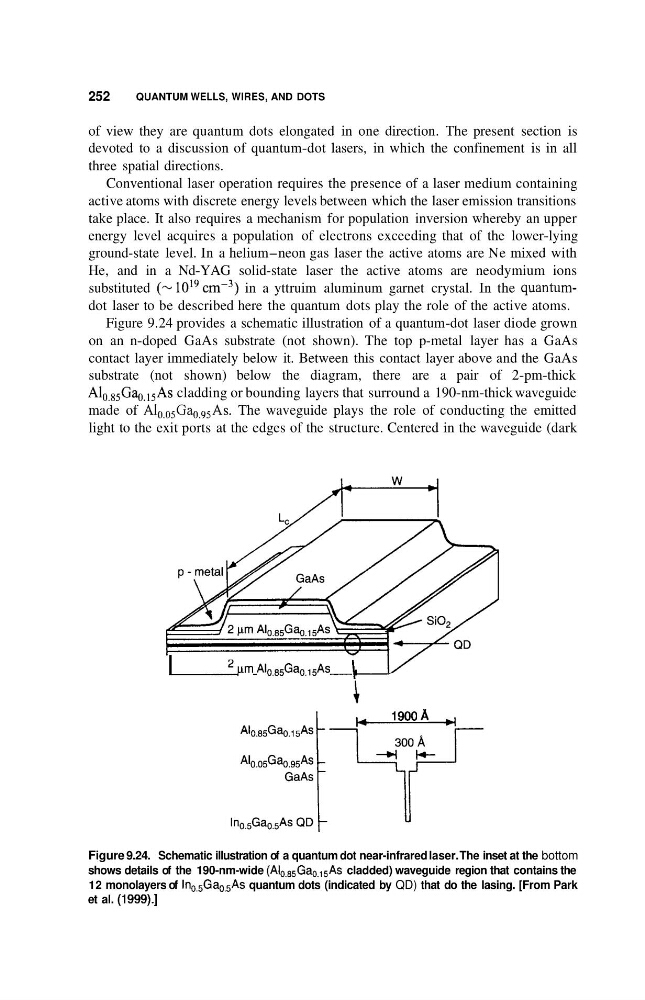
Figure 9.24 provides a schematic illustration of a quantum-dot laser diode grown
on an n-doped GaAs substrate (not shown). The top p-metal layer has a GaAs
contact layer immediately below it. Between this contact layer above and the GaAs
substrate (not shown) below the diagram, there are a pair of 2-pm-thick
Alo,85G+,15As cladding or bounding layers that surround a 190-nm-thick waveguide
made of Al,,,,Ga,,,,As.
The waveguide plays the role of conducting the emitted
light to the exit ports at the edges of the structure. Centered in the waveguide (dark
I
pm A~0.65Ga0.15As
\ I
1900 A
A10.65Ga0.15As
A10.05Ga0.95As
Figure 9.24. Schematic illustration of a quantum dot near-infrared laser. The inset at the bottom
shows details of the 190-nm-wide (AIo~,5Gao,,5As cladded) waveguide region that contains the
12 monolayers of Ino,5Gao,5As quantum dots (indicated by QD) that do the lasing. [From Park
et al. (1999).]
QUANTUM WELLS, WIRES, AND DOTS
of view they are quantum dots elongated in one direction. The present section is
devoted to a discussion of quantum-dot lasers, in which the confinement is in all
three spatial directions.
Conventional laser operation requires the presence of a laser medium containing
active atoms with discrete energy levels between which the laser emission transitions
take place. It also requires a mechanism for population inversion whereby an upper
energy level acquires a population of electrons exceeding that of the lower-lying
ground-state level. In a helium-neon gas laser the active atoms are Ne mixed with
He, and in a Nd-YAG solid-state laser the active atoms are neodymium ions
substituted (-10'9cm-3) in a yttruim aluminum garnet crystal. In the quantumdot laser to be described here the quantum dots play the role of the active atoms.
Figure 9.24 provides a schematic illustration of a quantum-dot laser diode grown
on an n-doped GaAs substrate (not shown). The top p-metal layer has a GaAs
contact layer immediately below it. Between this contact layer above and the GaAs
substrate (not shown) below the diagram, there are a pair of 2-pm-thick
Alo,85G+,15As cladding or bounding layers that surround a 190-nm-thick waveguide
made of Al,,,,Ga,,,,As.
The waveguide plays the role of conducting the emitted
light to the exit ports at the edges of the structure. Centered in the waveguide (dark
I
pm A~0.65Ga0.15As
\ I
1900 A
A10.65Ga0.15As
A10.05Ga0.95As
Figure 9.24. Schematic illustration of a quantum dot near-infrared laser. The inset at the bottom
shows details of the 190-nm-wide (AIo~,5Gao,,5As cladded) waveguide region that contains the
12 monolayers of Ino,5Gao,5As quantum dots (indicated by QD) that do the lasing. [From Park
et al. (1999).]