

9.6. APPLICATIONS
251
o.6
LWIR: T = 77 K
45" incidence
AD = 9.4 pm
"-4
-3
-2
-1
0
1
2
3
4
BIAS (V)
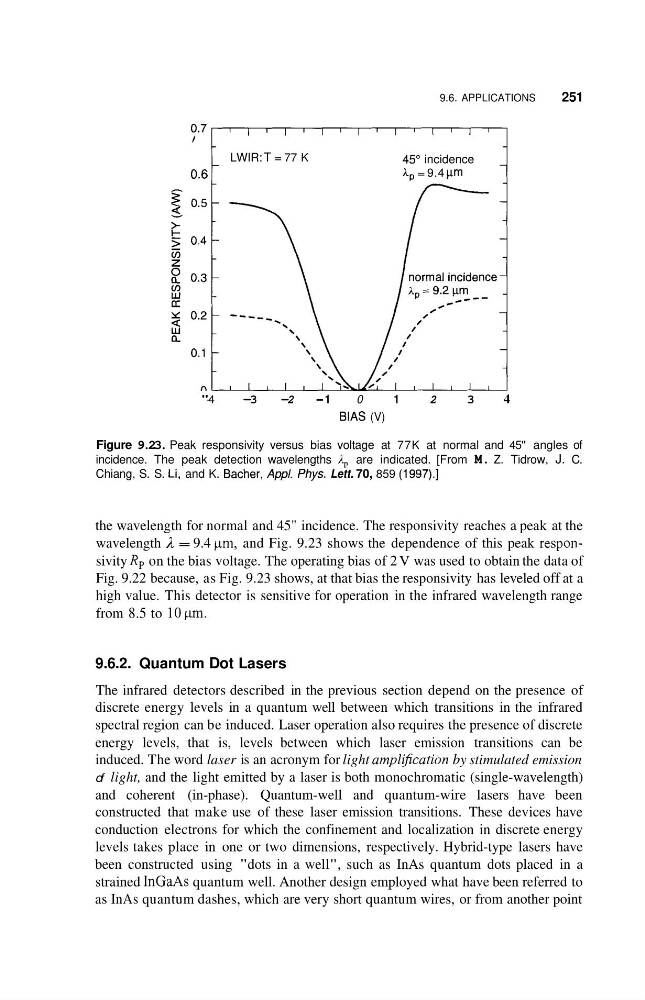
Figure 9.23. Peak responsivity versus bias voltage at 77K at normal and 45" angles of
incidence. The peak detection wavelengths AP are indicated. [From M. Z. Tidrow, J. C.
Chiang, S. S. Li, and K. Bacher, Appl. fbys. Lett. 70, 859 (1997).]
the wavelength for normal and 45" incidence. The responsivity reaches a peak at the
wavelength A = 9.4 pm, and Fig. 9.23 shows the dependence of this peak responsivity R, on the bias voltage. The operating bias of 2 V was used to obtain the data of
Fig. 9.22 because, as Fig. 9.23 shows, at that bias the responsivity has leveled off at a
high value. This detector is sensitive for operation in the infrared wavelength range
from 8.5 to 1Opm.
9.6.2. Quantum Dot Lasers
The infrared detectors described in the previous section depend on the presence of
discrete energy levels in a quantum well between which transitions in the infrared
spectral region can be induced. Laser operation also requires the presence of discrete
energy levels, that is, levels between which laser emission transitions can be
induced. The word laser is an acronym for light ampliJication by stimulated emission
of light, and the light emitted by a laser is both monochromatic (single-wavelength)
and coherent (in-phase). Quantum-well and quantum-wire lasers have been
constructed that make use of these laser emission transitions. These devices have
conduction electrons for which the confinement and localization in discrete energy
levels takes place in one or two dimensions, respectively. Hybrid-type lasers have
been constructed using "dots in a well", such as InAs quantum dots placed in a
strained InGaAs quantum well. Another design employed what have been referred to
as InAs quantum dashes, which are very short quantum wires, or from another point
251
o.6
LWIR: T = 77 K
45" incidence
AD = 9.4 pm
"-4
-3
-2
-1
0
1
2
3
4
BIAS (V)
Figure 9.23. Peak responsivity versus bias voltage at 77K at normal and 45" angles of
incidence. The peak detection wavelengths AP are indicated. [From M. Z. Tidrow, J. C.
Chiang, S. S. Li, and K. Bacher, Appl. fbys. Lett. 70, 859 (1997).]
the wavelength for normal and 45" incidence. The responsivity reaches a peak at the
wavelength A = 9.4 pm, and Fig. 9.23 shows the dependence of this peak responsivity R, on the bias voltage. The operating bias of 2 V was used to obtain the data of
Fig. 9.22 because, as Fig. 9.23 shows, at that bias the responsivity has leveled off at a
high value. This detector is sensitive for operation in the infrared wavelength range
from 8.5 to 1Opm.
9.6.2. Quantum Dot Lasers
The infrared detectors described in the previous section depend on the presence of
discrete energy levels in a quantum well between which transitions in the infrared
spectral region can be induced. Laser operation also requires the presence of discrete
energy levels, that is, levels between which laser emission transitions can be
induced. The word laser is an acronym for light ampliJication by stimulated emission
of light, and the light emitted by a laser is both monochromatic (single-wavelength)
and coherent (in-phase). Quantum-well and quantum-wire lasers have been
constructed that make use of these laser emission transitions. These devices have
conduction electrons for which the confinement and localization in discrete energy
levels takes place in one or two dimensions, respectively. Hybrid-type lasers have
been constructed using "dots in a well", such as InAs quantum dots placed in a
strained InGaAs quantum well. Another design employed what have been referred to
as InAs quantum dashes, which are very short quantum wires, or from another point