

9.5. SINGLE-ELECTRON TUNNELING
245
showing that the exciton has a radius comparable to the dimensions of a typical
nanostructure.
The exciton radius can be taken as an index of the extent of confinement
experienced by a nanoparticle. Two limiting regions of confinement can be identified
on the basis of the ratio of the dimension d of the nanoparticle to the exciton radius
aeff, namely, the weak-confinement regime with d > aeff (but not d >> aeff) and the
strong-confinement regime d < aeff. The more extended limit d >> aeff corresponds
to no confinement. Under weak-confinement conditions the exciton can undergo
unrestricted translational motion, just as in the bulk material, but for strong
confinement this translation motion becomes restricted. There is an increase in the
spatial overlap of the electron and hole wavefunctions with decreasing particle size,
and this has the effect of enhancing the electron-hole interaction. As a result, the
energy splitting becomes greater between the radiative and nonradiative exciton
states. An optical index of the confinement is the blue shift (shift to higher energies)
of the optical absorption edge and the exciton energy with decreasing nanoparticle
size. Another result of the confinement is the appearance at room temperature of
excitonic features in the absorption spectra that are observed only at low temperatures in the bulk material. Further details on exciton spectra are provided in Sections
2.3.3 and 8.2.1.
9.5. SINGLE-ELECTRON TUNNELING
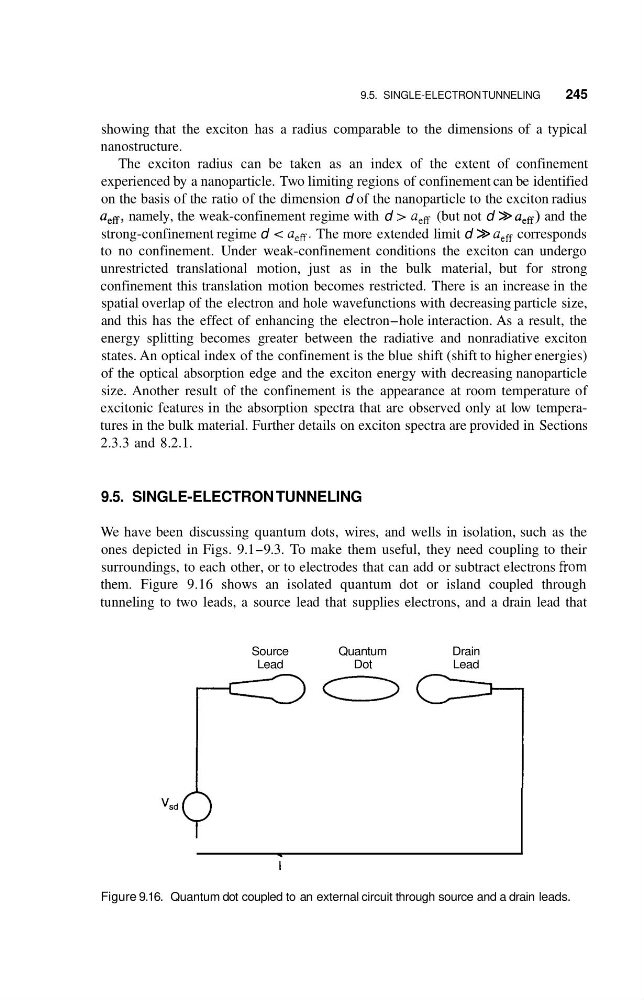
We have been discussing quantum dots, wires, and wells in isolation, such as the
ones depicted in Figs. 9.1-9.3. To make them useful, they need coupling to their
surroundings, to each other, or to electrodes that can add or subtract electrons from
them. Figure 9.16 shows an isolated quantum dot or island coupled through
tunneling to two leads, a source lead that supplies electrons, and a drain lead that
Source
Quantum
Drain
Lead
Dot
Lead
vsdQ
Figure 9.16. Quantum dot coupled to an external circuit through source and a drain leads.
245
showing that the exciton has a radius comparable to the dimensions of a typical
nanostructure.
The exciton radius can be taken as an index of the extent of confinement
experienced by a nanoparticle. Two limiting regions of confinement can be identified
on the basis of the ratio of the dimension d of the nanoparticle to the exciton radius
aeff, namely, the weak-confinement regime with d > aeff (but not d >> aeff) and the
strong-confinement regime d < aeff. The more extended limit d >> aeff corresponds
to no confinement. Under weak-confinement conditions the exciton can undergo
unrestricted translational motion, just as in the bulk material, but for strong
confinement this translation motion becomes restricted. There is an increase in the
spatial overlap of the electron and hole wavefunctions with decreasing particle size,
and this has the effect of enhancing the electron-hole interaction. As a result, the
energy splitting becomes greater between the radiative and nonradiative exciton
states. An optical index of the confinement is the blue shift (shift to higher energies)
of the optical absorption edge and the exciton energy with decreasing nanoparticle
size. Another result of the confinement is the appearance at room temperature of
excitonic features in the absorption spectra that are observed only at low temperatures in the bulk material. Further details on exciton spectra are provided in Sections
2.3.3 and 8.2.1.
9.5. SINGLE-ELECTRON TUNNELING
We have been discussing quantum dots, wires, and wells in isolation, such as the
ones depicted in Figs. 9.1-9.3. To make them useful, they need coupling to their
surroundings, to each other, or to electrodes that can add or subtract electrons from
them. Figure 9.16 shows an isolated quantum dot or island coupled through
tunneling to two leads, a source lead that supplies electrons, and a drain lead that
Source
Quantum
Drain
Lead
Dot
Lead
vsdQ
Figure 9.16. Quantum dot coupled to an external circuit through source and a drain leads.