

14
INTRODUCTION TO PHYSICS OF THE SOLID STATE
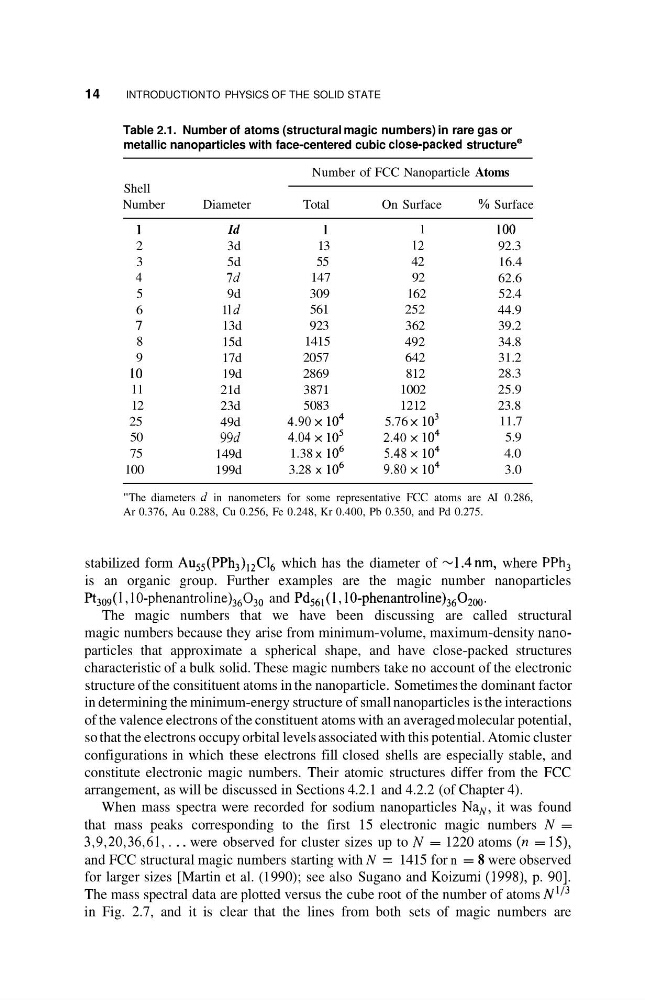
Table 2.1. Number of atoms (structural magic numbers) in rare gas or
metallic nanoparticles with face-centered cubic closepacked structure
e
Number of FCC Nanoparticle Atoms
Shell
Number
Diameter
Total
On Surface
YO Surface
1
2
3
4
5
6
I
8
9
IO
11
12
25
50
75
100
Id
3d
5d
Id
9d
1 Id
13d
15d
17d
19d
21d
23d
49d
99d
149d
199d
1
13
55
147
309
561
923
1415
2057
2869
3871
5083
4.90 io4
4.04 io5
1.38 x lo6
3.28 x lo6
1
12
42
92
162
252
3 62
492
642
812
1002
1212
5.76 io3
2.40 lo4
5.48 io4
9.80 io4
IO0
92.3
16.4
62.6
52.4
44.9
39.2
34.8
31.2
28.3
25.9
23.8
11.7
5.9
4.0
3.0
"The diameters d in nanometers for some representative FCC atoms are AI 0.286,
Ar 0.376, Au 0.288, Cu 0.256, Fe 0.248, Kr 0.400, Pb 0.350, and Pd 0.275.
stabilized form Au55(PPh3)12C16 which has the diameter of -1.4nm, where PPh,
is an organic group. Further examples are the magic number nanoparticles
Pt3,9( 1, 10-phenantroline),,O,, and Pd561 (1,1O-phenantr0line),,0~,,.
The magic numbers that we have been discussing are called structural
magic numbers because they arise from minimum-volume, maximum-density nanoparticles that approximate a spherical shape, and have close-packed structures
characteristic of a bulk solid. These magic numbers take no account of the electronic
structure of the consitituent atoms in the nanoparticle. Sometimes the dominant factor
in determining the minimum-energy structure of small nanoparticles is the interactions
of the valence electrons of the constituent atoms with an averaged molecular potential,
so that the electrons occupy orbital levels associated with this potential. Atomic cluster
configurations in which these electrons fill closed shells are especially stable, and
constitute electronic magic numbers. Their atomic structures differ from the FCC
arrangement, as will be discussed in Sections 4.2.1 and 4.2.2 (of Chapter 4).
When mass spectra were recorded for sodium nanoparticles Na,, it was found
that mass peaks corresponding to the first 15 electronic magic numbers N =
3,9,20,36,61,. . . were observed for cluster sizes up to N = 1220 atoms (n = 15),
and FCC structural magic numbers starting with N = 141 5 for n = 8 were observed
for larger sizes [Martin et al. (1 990); see also Sugano and Koizumi (1 998), p. 901.
The mass spectral data are plotted versus the cube root of the number of atoms N'I3
in Fig. 2.7, and it is clear that the lines from both sets of magic numbers are
INTRODUCTION TO PHYSICS OF THE SOLID STATE
Table 2.1. Number of atoms (structural magic numbers) in rare gas or
metallic nanoparticles with face-centered cubic closepacked structure
e
Number of FCC Nanoparticle Atoms
Shell
Number
Diameter
Total
On Surface
YO Surface
1
2
3
4
5
6
I
8
9
IO
11
12
25
50
75
100
Id
3d
5d
Id
9d
1 Id
13d
15d
17d
19d
21d
23d
49d
99d
149d
199d
1
13
55
147
309
561
923
1415
2057
2869
3871
5083
4.90 io4
4.04 io5
1.38 x lo6
3.28 x lo6
1
12
42
92
162
252
3 62
492
642
812
1002
1212
5.76 io3
2.40 lo4
5.48 io4
9.80 io4
IO0
92.3
16.4
62.6
52.4
44.9
39.2
34.8
31.2
28.3
25.9
23.8
11.7
5.9
4.0
3.0
"The diameters d in nanometers for some representative FCC atoms are AI 0.286,
Ar 0.376, Au 0.288, Cu 0.256, Fe 0.248, Kr 0.400, Pb 0.350, and Pd 0.275.
stabilized form Au55(PPh3)12C16 which has the diameter of -1.4nm, where PPh,
is an organic group. Further examples are the magic number nanoparticles
Pt3,9( 1, 10-phenantroline),,O,, and Pd561 (1,1O-phenantr0line),,0~,,.
The magic numbers that we have been discussing are called structural
magic numbers because they arise from minimum-volume, maximum-density nanoparticles that approximate a spherical shape, and have close-packed structures
characteristic of a bulk solid. These magic numbers take no account of the electronic
structure of the consitituent atoms in the nanoparticle. Sometimes the dominant factor
in determining the minimum-energy structure of small nanoparticles is the interactions
of the valence electrons of the constituent atoms with an averaged molecular potential,
so that the electrons occupy orbital levels associated with this potential. Atomic cluster
configurations in which these electrons fill closed shells are especially stable, and
constitute electronic magic numbers. Their atomic structures differ from the FCC
arrangement, as will be discussed in Sections 4.2.1 and 4.2.2 (of Chapter 4).
When mass spectra were recorded for sodium nanoparticles Na,, it was found
that mass peaks corresponding to the first 15 electronic magic numbers N =
3,9,20,36,61,. . . were observed for cluster sizes up to N = 1220 atoms (n = 15),
and FCC structural magic numbers starting with N = 141 5 for n = 8 were observed
for larger sizes [Martin et al. (1 990); see also Sugano and Koizumi (1 998), p. 901.
The mass spectral data are plotted versus the cube root of the number of atoms N'I3
in Fig. 2.7, and it is clear that the lines from both sets of magic numbers are