

2.1. STRUCTURE
13
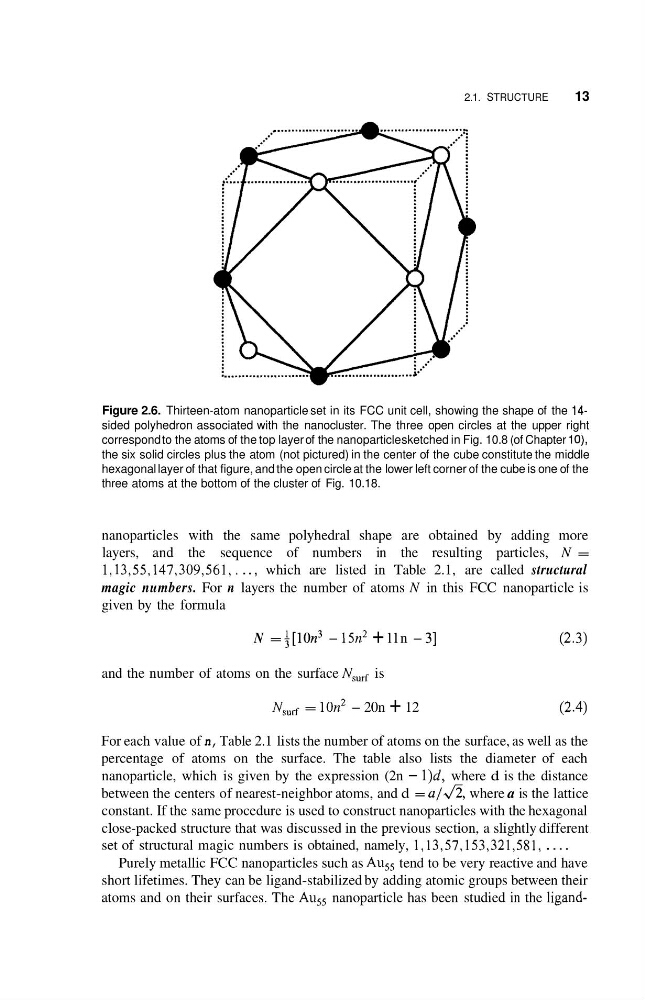
Figure 2.6. Thirteen-atom nanoparticle set in its FCC unit cell, showing the shape of the 14sided polyhedron associated with the nanocluster. The three open circles at the upper right
correspond to the atoms of the top layer of the nanoparticle sketched in Fig. 10.8 (of Chapter lo),
the six solid circles plus the atom (not pictured) in the center of the cube constitute the middle
hexagonal layer of that figure, and the open circle at the lower left corner of the cube is one of the
three atoms at the bottom of the cluster of Fig. 10.18.
nanoparticles with the same polyhedral shape are obtained by adding more
layers, and the sequence of numbers in the resulting particles, N =
1,13,55,147,309,561,. .., which are listed in Table 2.1, are called structural
magic numbers. For n layers the number of atoms N in this FCC nanoparticle is
given by the formula
N = i[10n3 - 15n2 + l l n - 31
(2.3)
and the number of atoms on the surface Nsud is
Nsud = 10n2 - 20n + 12
(2.4)
For each value of n, Table 2.1 lists the number of atoms on the surface, as well as the
percentage of atoms on the surface. The table also lists the diameter of each
nanoparticle, which is given by the expression (2n - l)d, where d is the distance
between the centers of nearest-neighbor atoms, and d = a / & where a is the lattice
constant. If the same procedure is used to construct nanoparticles with the hexagonal
close-packed structure that was discussed in the previous section, a slightly different
set of structural magic numbers is obtained, namely, 1,13,57,153,321,581, . . . .
Purely metallic FCC nanoparticles such as Au,, tend to be very reactive and have
short lifetimes. They can be ligand-stabilized by adding atomic groups between their
atoms and on their surfaces. The Au,, nanoparticle has been studied in the ligand-
13
Figure 2.6. Thirteen-atom nanoparticle set in its FCC unit cell, showing the shape of the 14sided polyhedron associated with the nanocluster. The three open circles at the upper right
correspond to the atoms of the top layer of the nanoparticle sketched in Fig. 10.8 (of Chapter lo),
the six solid circles plus the atom (not pictured) in the center of the cube constitute the middle
hexagonal layer of that figure, and the open circle at the lower left corner of the cube is one of the
three atoms at the bottom of the cluster of Fig. 10.18.
nanoparticles with the same polyhedral shape are obtained by adding more
layers, and the sequence of numbers in the resulting particles, N =
1,13,55,147,309,561,. .., which are listed in Table 2.1, are called structural
magic numbers. For n layers the number of atoms N in this FCC nanoparticle is
given by the formula
N = i[10n3 - 15n2 + l l n - 31
(2.3)
and the number of atoms on the surface Nsud is
Nsud = 10n2 - 20n + 12
(2.4)
For each value of n, Table 2.1 lists the number of atoms on the surface, as well as the
percentage of atoms on the surface. The table also lists the diameter of each
nanoparticle, which is given by the expression (2n - l)d, where d is the distance
between the centers of nearest-neighbor atoms, and d = a / & where a is the lattice
constant. If the same procedure is used to construct nanoparticles with the hexagonal
close-packed structure that was discussed in the previous section, a slightly different
set of structural magic numbers is obtained, namely, 1,13,57,153,321,581, . . . .
Purely metallic FCC nanoparticles such as Au,, tend to be very reactive and have
short lifetimes. They can be ligand-stabilized by adding atomic groups between their
atoms and on their surfaces. The Au,, nanoparticle has been studied in the ligand-