

198
OPTICAL AND VIBRATIONAL SPECTROSCOPY
particle sizes 4 and 2 nm. Thus lowering the temperature influences the spectra very
much in the same way as decreasing the particle size affects them.
8.2.2. Infrared Surface Spectroscopy
The general principles of infrared (IR) spectroscopy, including Fourier transform
infrared spectroscopy (FTIR), were explained in Section 3.4.1. These spectroscopic
techniques measure the absorption of radiation by high frequency (Le., optical
branch) phonon vibrations, and they are also sensitive to the presence of particular
chemical groups such as hydroxyl (-OH), methyl (-CH3), imido (-NH), and
amido (-NH,). Each of these groups absorbs infrared radiation at a characteristic
frequency, and the actual frequency of absorption varies somewhat with the
environment. We discuss some results based on work of Baraton (2000).
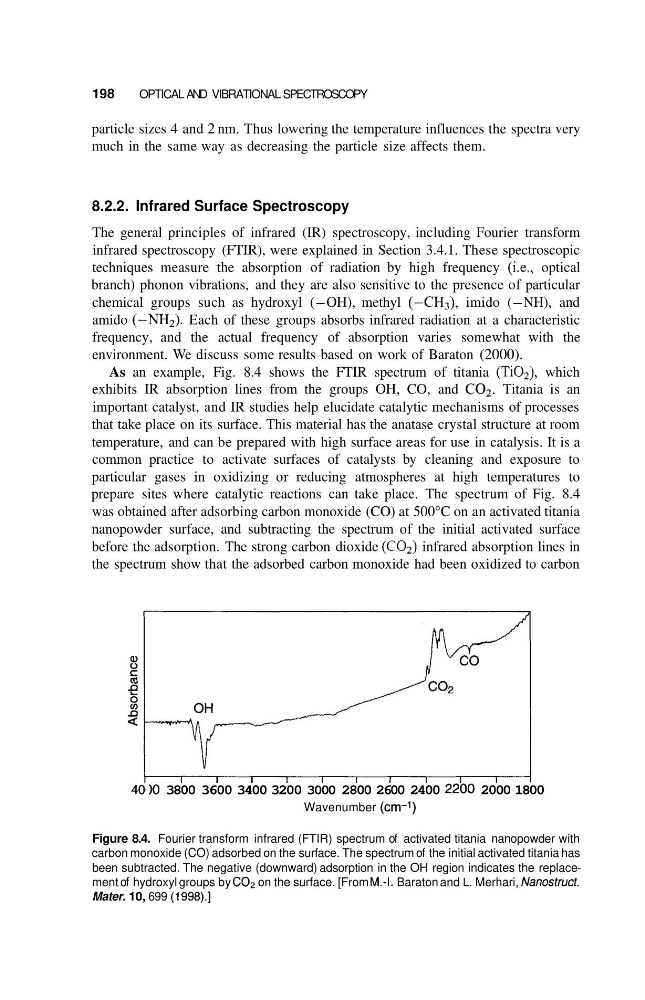
As an example, Fig. 8.4 shows the FTIR spectrum of titania (TiO,), which
exhibits IR absorption lines from the groups OH, CO, and CO,. Titania is an
important catalyst, and IR studies help elucidate catalytic mechanisms of processes
that take place on its surface. This material has the anatase crystal structure at room
temperature, and can be prepared with high surface areas for use in catalysis. It is a
common practice to activate surfaces of catalysts by cleaning and exposure to
particular gases in oxidizing or reducing atmospheres at high temperatures to
prepare sites where catalytic reactions can take place. The spectrum of Fig. 8.4
was obtained after adsorbing carbon monoxide (CO) at 500°C on an activated titania
nanopowder surface, and subtracting the spectrum of the initial activated surface
before the adsorption. The strong carbon dioxide (CO,) infrared absorption lines in
the spectrum show that the adsorbed carbon monoxide had been oxidized to carbon
I
I
I
I
I
I
1
I
I
I
10 3800 3600 3400 3200 3000 2800 2600 2400 2200 2000 1800
Wavenumber (cm-1)
Figure 8.4. Fourier transform infrared (FTIR) spectrum of activated titania nanopowder with
carbon monoxide (CO) adsorbed on the surface. The spectrum of the initial activated titania has
been subtracted. The negative (downward) adsorption in the OH region indicates the replacement of hydroxyl groups by C02 on the surface. [From M.4. Baraton and L. Merhari, Nanostruct.
Mater. 10, 699 (1998).]
OPTICAL AND VIBRATIONAL SPECTROSCOPY
particle sizes 4 and 2 nm. Thus lowering the temperature influences the spectra very
much in the same way as decreasing the particle size affects them.
8.2.2. Infrared Surface Spectroscopy
The general principles of infrared (IR) spectroscopy, including Fourier transform
infrared spectroscopy (FTIR), were explained in Section 3.4.1. These spectroscopic
techniques measure the absorption of radiation by high frequency (Le., optical
branch) phonon vibrations, and they are also sensitive to the presence of particular
chemical groups such as hydroxyl (-OH), methyl (-CH3), imido (-NH), and
amido (-NH,). Each of these groups absorbs infrared radiation at a characteristic
frequency, and the actual frequency of absorption varies somewhat with the
environment. We discuss some results based on work of Baraton (2000).
As an example, Fig. 8.4 shows the FTIR spectrum of titania (TiO,), which
exhibits IR absorption lines from the groups OH, CO, and CO,. Titania is an
important catalyst, and IR studies help elucidate catalytic mechanisms of processes
that take place on its surface. This material has the anatase crystal structure at room
temperature, and can be prepared with high surface areas for use in catalysis. It is a
common practice to activate surfaces of catalysts by cleaning and exposure to
particular gases in oxidizing or reducing atmospheres at high temperatures to
prepare sites where catalytic reactions can take place. The spectrum of Fig. 8.4
was obtained after adsorbing carbon monoxide (CO) at 500°C on an activated titania
nanopowder surface, and subtracting the spectrum of the initial activated surface
before the adsorption. The strong carbon dioxide (CO,) infrared absorption lines in
the spectrum show that the adsorbed carbon monoxide had been oxidized to carbon
I
I
I
I
I
I
1
I
I
I
10 3800 3600 3400 3200 3000 2800 2600 2400 2200 2000 1800
Wavenumber (cm-1)
Figure 8.4. Fourier transform infrared (FTIR) spectrum of activated titania nanopowder with
carbon monoxide (CO) adsorbed on the surface. The spectrum of the initial activated titania has
been subtracted. The negative (downward) adsorption in the OH region indicates the replacement of hydroxyl groups by C02 on the surface. [From M.4. Baraton and L. Merhari, Nanostruct.
Mater. 10, 699 (1998).]