

180
NANOSTRUCTURED FERROMAGNETISM
0.3
0 50 100 150 200 250 300 350
TEMPERATURE (K)
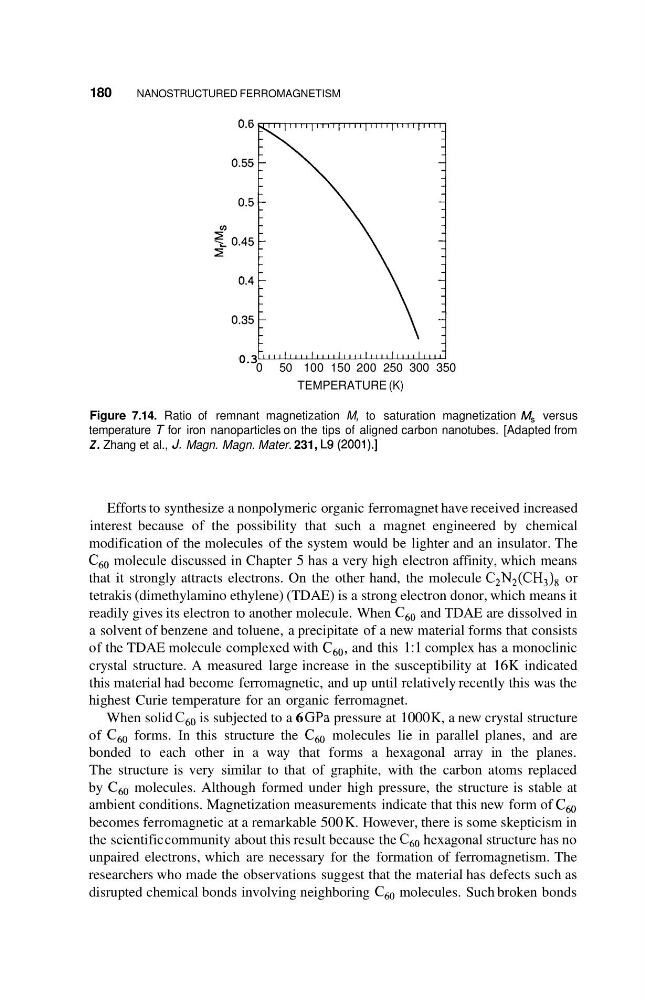
Figure 7.14. Ratio of remnant magnetization M, to saturation magnetization Ms versus
temperature T for iron nanoparticles on the tips of aligned carbon nanotubes. [Adapted from
Z . Zhang et al., J. Magn. Magn. Mater. 231, L9 (2001).]
Efforts to synthesize a nonpolymeric organic ferromagnet have received increased
interest because of the possibility that such a magnet engineered by chemical
modification of the molecules of the system would be lighter and an insulator. The
C60 molecule discussed in Chapter 5 has a very high electron affinity, which means
that it strongly attracts electrons. On the other hand, the molecule C,N2(CH,), or
tetrakis (dimethylamino ethylene) (TDAE) is a strong electron donor, which means it
readily gives its electron to another molecule. When C60 and TDAE are dissolved in
a solvent of benzene and toluene, a precipitate of a new material forms that consists
of the TDAE molecule complexed with C60, and this 1 : 1 complex has a monoclinic
crystal structure. A measured large increase in the susceptibility at 16 K indicated
this material had become ferromagnetic, and up until relatively recently this was the
highest Curie temperature for an organic ferromagnet.
When solid C,, is subjected to a 6 GPa pressure at 1000 K, a new crystal structure
of C60 forms. In this structure the C60 molecules lie in parallel planes, and are
bonded to each other in a way that forms a hexagonal array in the planes.
The structure is very similar to that of graphite, with the carbon atoms replaced
by C60 molecules. Although formed under high pressure, the structure is stable at
ambient conditions. Magnetization measurements indicate that this new form of C6,
becomes ferromagnetic at a remarkable 500 K. However, there is some skepticism in
the scientific community about this result because the C ,
, hexagonal structure has no
unpaired electrons, which are necessary for the formation of ferromagnetism. The
researchers who made the observations suggest that the material has defects such as
disrupted chemical bonds involving neighboring C60 molecules. Such broken bonds
NANOSTRUCTURED FERROMAGNETISM
0.3
0 50 100 150 200 250 300 350
TEMPERATURE (K)
Figure 7.14. Ratio of remnant magnetization M, to saturation magnetization Ms versus
temperature T for iron nanoparticles on the tips of aligned carbon nanotubes. [Adapted from
Z . Zhang et al., J. Magn. Magn. Mater. 231, L9 (2001).]
Efforts to synthesize a nonpolymeric organic ferromagnet have received increased
interest because of the possibility that such a magnet engineered by chemical
modification of the molecules of the system would be lighter and an insulator. The
C60 molecule discussed in Chapter 5 has a very high electron affinity, which means
that it strongly attracts electrons. On the other hand, the molecule C,N2(CH,), or
tetrakis (dimethylamino ethylene) (TDAE) is a strong electron donor, which means it
readily gives its electron to another molecule. When C60 and TDAE are dissolved in
a solvent of benzene and toluene, a precipitate of a new material forms that consists
of the TDAE molecule complexed with C60, and this 1 : 1 complex has a monoclinic
crystal structure. A measured large increase in the susceptibility at 16 K indicated
this material had become ferromagnetic, and up until relatively recently this was the
highest Curie temperature for an organic ferromagnet.
When solid C,, is subjected to a 6 GPa pressure at 1000 K, a new crystal structure
of C60 forms. In this structure the C60 molecules lie in parallel planes, and are
bonded to each other in a way that forms a hexagonal array in the planes.
The structure is very similar to that of graphite, with the carbon atoms replaced
by C60 molecules. Although formed under high pressure, the structure is stable at
ambient conditions. Magnetization measurements indicate that this new form of C6,
becomes ferromagnetic at a remarkable 500 K. However, there is some skepticism in
the scientific community about this result because the C ,
, hexagonal structure has no
unpaired electrons, which are necessary for the formation of ferromagnetism. The
researchers who made the observations suggest that the material has defects such as
disrupted chemical bonds involving neighboring C60 molecules. Such broken bonds