

6.2. NANOSTRUCTURED CRYSTALS
163
semiconductors, which puts an energy level in the energy gap. A wave guide is like a
pipe that confines electromagnetic energy, enabling it to flow in one direction. An
interesting feature of this wave guide is that the light in the photonic crystal guide
can turn very sharp comers, unlike light traveling in a fiberoptic cable. Because the
frequency of the light in the guide is in the forbidden gap, the light cannot escape
into the crystal. It essentially has to turn the sharp comer. Fiberoptic cables rely on
total internal reflection at the inner surface of the cable to move the light along. If the
fiber is bent too much, the angle of incidence is too large for total internal reflection,
and light escapes at the bend.
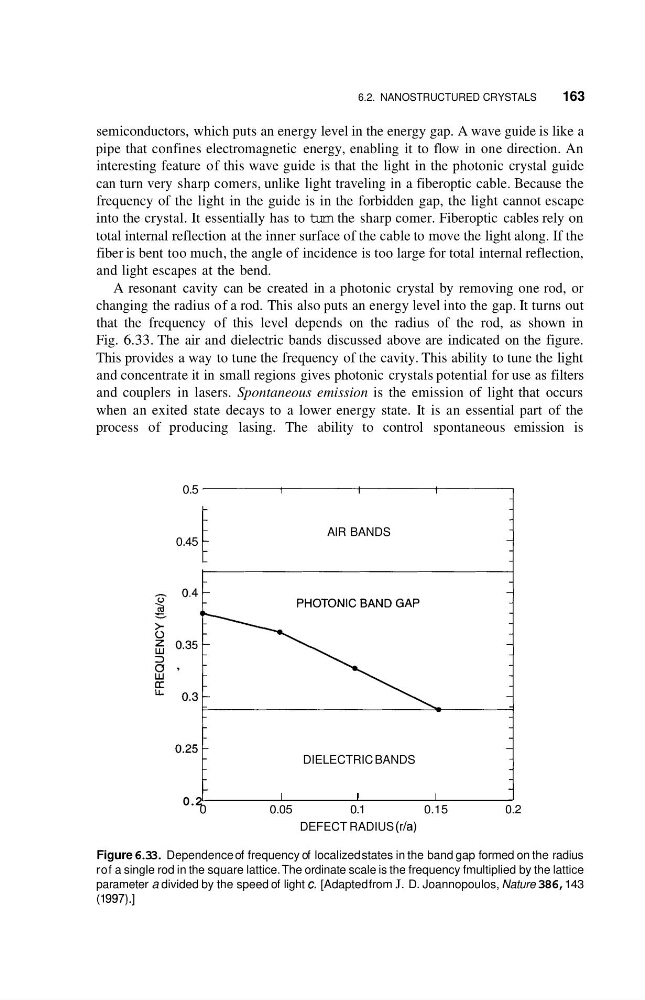
A resonant cavity can be created in a photonic crystal by removing one rod, or
changing the radius of a rod. This also puts an energy level into the gap. It turns out
that the frequency of this level depends on the radius of the rod, as shown in
Fig. 6.33. The air and dielectric bands discussed above are indicated on the figure.
This provides a way to tune the frequency of the cavity. This ability to tune the light
and concentrate it in small regions gives photonic crystals potential for use as filters
and couplers in lasers. Spontaneous emission is the emission of light that occurs
when an exited state decays to a lower energy state. It is an essential part of the
process of producing lasing. The ability to control spontaneous emission is
0.5
I
I
I
I
0.45
AIR BANDS
DIELECTRIC BANDS
I
I
I
1
0
0.05
0.1
0.15
0.2
DEFECT RADIUS (r/a)
0.2 1
Figure 6.33. Dependence of frequency of localized states in the band gap formed on the radius
rof a single rod in the square lattice. The ordinate scale is the frequency fmultiplied by the lattice
parameter a divided by the speed of light c. [Adapted from J. D. Joannopoulos, Nature 386, 143
(1 997).]
163
semiconductors, which puts an energy level in the energy gap. A wave guide is like a
pipe that confines electromagnetic energy, enabling it to flow in one direction. An
interesting feature of this wave guide is that the light in the photonic crystal guide
can turn very sharp comers, unlike light traveling in a fiberoptic cable. Because the
frequency of the light in the guide is in the forbidden gap, the light cannot escape
into the crystal. It essentially has to turn the sharp comer. Fiberoptic cables rely on
total internal reflection at the inner surface of the cable to move the light along. If the
fiber is bent too much, the angle of incidence is too large for total internal reflection,
and light escapes at the bend.
A resonant cavity can be created in a photonic crystal by removing one rod, or
changing the radius of a rod. This also puts an energy level into the gap. It turns out
that the frequency of this level depends on the radius of the rod, as shown in
Fig. 6.33. The air and dielectric bands discussed above are indicated on the figure.
This provides a way to tune the frequency of the cavity. This ability to tune the light
and concentrate it in small regions gives photonic crystals potential for use as filters
and couplers in lasers. Spontaneous emission is the emission of light that occurs
when an exited state decays to a lower energy state. It is an essential part of the
process of producing lasing. The ability to control spontaneous emission is
0.5
I
I
I
I
0.45
AIR BANDS
DIELECTRIC BANDS
I
I
I
1
0
0.05
0.1
0.15
0.2
DEFECT RADIUS (r/a)
0.2 1
Figure 6.33. Dependence of frequency of localized states in the band gap formed on the radius
rof a single rod in the square lattice. The ordinate scale is the frequency fmultiplied by the lattice
parameter a divided by the speed of light c. [Adapted from J. D. Joannopoulos, Nature 386, 143
(1 997).]