

6.1. SOLID DISORDERED NANOSTRUCTURES
143
network is made by taking the gold particles in the form of an aerosol spray and
subjecting them to a fine mist of a thiol such as dodecanethiol RSH, where R is
CI2H2=,. These alkyl thiols have an end group -SH that can attach to a methyl
-CH3, and a methylene chain 8-12 units long that provides steric repulsion between
the chains. The chainlike molecules radiate out from the particle. The encapsulated
gold particles are stable in aliphatic solvents such as hexane. However, the addition
of a small amount of dithiol to the solution causes the formation of a threedimensional cluster network that precipitates out of the solution. Clusters of particles
can also be deposited on flat surfaces once the colloidal solution of encapsulated
nanoparticles has been formed. In-plane electronic conduction has been measured in
two-dimensional arrays of 500-nm gold nanoparticles connected or linked to each
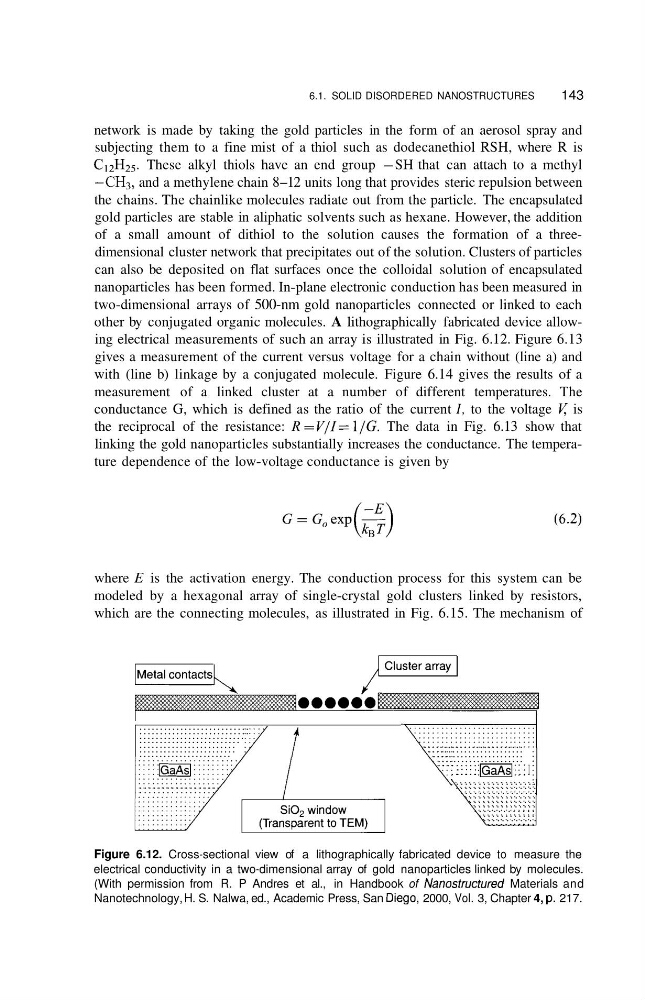
other by conjugated organic molecules. A lithographically fabricated device allowing electrical measurements of such an array is illustrated in Fig. 6.12. Figure 6.13
gives a measurement of the current versus voltage for a chain without (line a) and
with (line b) linkage by a conjugated molecule. Figure 6.14 gives the results of a
measurement of a linked cluster at a number of different temperatures. The
conductance G, which is defined as the ratio of the current I, to the voltage is
the reciprocal of the resistance: R = V/I= 1/G. The data in Fig. 6.13 show that
linking the gold nanoparticles substantially increases the conductance. The temperature dependence of the low-voltage conductance is given by
(6.2)
where E is the activation energy. The conduction process for this system can be
modeled by a hexagonal array of single-crystal gold clusters linked by resistors,
which are the connecting molecules, as illustrated in Fig. 6.15. The mechanism of
IMetal contactsA
Cluster array
w
........................... ...........................
/ t
.......................... ......................... ........................ ........................ .......................
. . . . . . . . . . . . . . . . .
. . . . . . . . . . . . . . . . .
............................ ........................... .......................... .........................
F ......................... ........................ ....................... ...................... . . . . . . . . . .
\ . . . . . . . . . . . . . . . . . . .
: : :: : :WI I f I : I
. . . . . . . . . . . . . . . . . .
. . . . . . . . . . . . . . . . . .
. . . . . . . . . . . . . . . . .
. . . . . . . . . . . . . . . .
. . . . . . . . . . . . . . .
. . . . . . . . . . . . . .
. . . . . . . . . . . . .
. . . . . . . . . . . . .
. . . . . . . . . . . .
i_r . . . . . . . . . .
Figure 6.12. Cross-sectional view of a lithographically fabricated device to measure the
electrical conductivity in a two-dimensional array of gold nanoparticles linked by molecules.
(With permission from R. P Andres et al., in Handbook of Nanostructured Materials and
Nanotechnology, H. S. Nalwa, ed., Academic Press, San Diego, 2000, Vol. 3, Chapter 4, p. 217.
143
network is made by taking the gold particles in the form of an aerosol spray and
subjecting them to a fine mist of a thiol such as dodecanethiol RSH, where R is
CI2H2=,. These alkyl thiols have an end group -SH that can attach to a methyl
-CH3, and a methylene chain 8-12 units long that provides steric repulsion between
the chains. The chainlike molecules radiate out from the particle. The encapsulated
gold particles are stable in aliphatic solvents such as hexane. However, the addition
of a small amount of dithiol to the solution causes the formation of a threedimensional cluster network that precipitates out of the solution. Clusters of particles
can also be deposited on flat surfaces once the colloidal solution of encapsulated
nanoparticles has been formed. In-plane electronic conduction has been measured in
two-dimensional arrays of 500-nm gold nanoparticles connected or linked to each
other by conjugated organic molecules. A lithographically fabricated device allowing electrical measurements of such an array is illustrated in Fig. 6.12. Figure 6.13
gives a measurement of the current versus voltage for a chain without (line a) and
with (line b) linkage by a conjugated molecule. Figure 6.14 gives the results of a
measurement of a linked cluster at a number of different temperatures. The
conductance G, which is defined as the ratio of the current I, to the voltage is
the reciprocal of the resistance: R = V/I= 1/G. The data in Fig. 6.13 show that
linking the gold nanoparticles substantially increases the conductance. The temperature dependence of the low-voltage conductance is given by
(6.2)
where E is the activation energy. The conduction process for this system can be
modeled by a hexagonal array of single-crystal gold clusters linked by resistors,
which are the connecting molecules, as illustrated in Fig. 6.15. The mechanism of
IMetal contactsA
Cluster array
w
........................... ...........................
/ t
.......................... ......................... ........................ ........................ .......................
. . . . . . . . . . . . . . . . .
. . . . . . . . . . . . . . . . .
............................ ........................... .......................... .........................
F ......................... ........................ ....................... ...................... . . . . . . . . . .
\ . . . . . . . . . . . . . . . . . . .
: : :: : :WI I f I : I
. . . . . . . . . . . . . . . . . .
. . . . . . . . . . . . . . . . . .
. . . . . . . . . . . . . . . . .
. . . . . . . . . . . . . . . .
. . . . . . . . . . . . . . .
. . . . . . . . . . . . . .
. . . . . . . . . . . . .
. . . . . . . . . . . . .
. . . . . . . . . . . .
i_r . . . . . . . . . .
Figure 6.12. Cross-sectional view of a lithographically fabricated device to measure the
electrical conductivity in a two-dimensional array of gold nanoparticles linked by molecules.
(With permission from R. P Andres et al., in Handbook of Nanostructured Materials and
Nanotechnology, H. S. Nalwa, ed., Academic Press, San Diego, 2000, Vol. 3, Chapter 4, p. 217.