

5.3. CARBON CLUSTERS
113
30 1
0
14.1
14.2
14.3
14.4
14.5
LATTICE PARAMETER (A)
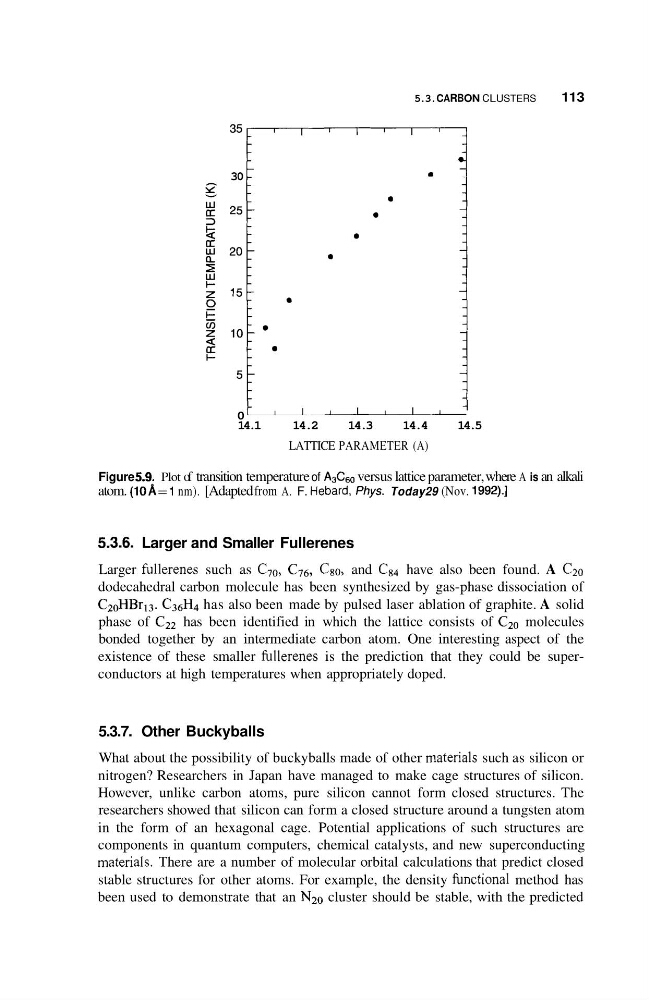
Figure 5.9,. Plot of transition temperature of
atom. (10A=1 nm). [Adapted from A. F. Hebard, Phys. Today29 (Nov. 1992).]
versus lattice parameter, where A is an alkali
5.3.6. Larger and Smaller Fullerenes
Larger hllerenes such as C70, C76, C ~ O ,
and Cs4 have also been found. A C20
dodecahedral carbon molecule has been synthesized by gas-phase dissociation of
C20HBr13. C36H4 has also been made by pulsed laser ablation of graphite. A solid
phase of C22 has been identified in which the lattice consists of C20 molecules
bonded together by an intermediate carbon atom. One interesting aspect of the
existence of these smaller hllerenes is the prediction that they could be superconductors at high temperatures when appropriately doped.
5.3.7. Other Buckyballs
What about the possibility of buckyballs made of other materials such as silicon or
nitrogen? Researchers in Japan have managed to make cage structures of silicon.
However, unlike carbon atoms, pure silicon cannot form closed structures. The
researchers showed that silicon can form a closed structure around a tungsten atom
in the form of an hexagonal cage. Potential applications of such structures are
components in quantum computers, chemical catalysts, and new superconducting
materials. There are a number of molecular orbital calculations that predict closed
stable structures for other atoms. For example, the density fhctional method has
been used to demonstrate that an N20 cluster should be stable, with the predicted
113
30 1
0
14.1
14.2
14.3
14.4
14.5
LATTICE PARAMETER (A)
Figure 5.9,. Plot of transition temperature of
atom. (10A=1 nm). [Adapted from A. F. Hebard, Phys. Today29 (Nov. 1992).]
versus lattice parameter, where A is an alkali
5.3.6. Larger and Smaller Fullerenes
Larger hllerenes such as C70, C76, C ~ O ,
and Cs4 have also been found. A C20
dodecahedral carbon molecule has been synthesized by gas-phase dissociation of
C20HBr13. C36H4 has also been made by pulsed laser ablation of graphite. A solid
phase of C22 has been identified in which the lattice consists of C20 molecules
bonded together by an intermediate carbon atom. One interesting aspect of the
existence of these smaller hllerenes is the prediction that they could be superconductors at high temperatures when appropriately doped.
5.3.7. Other Buckyballs
What about the possibility of buckyballs made of other materials such as silicon or
nitrogen? Researchers in Japan have managed to make cage structures of silicon.
However, unlike carbon atoms, pure silicon cannot form closed structures. The
researchers showed that silicon can form a closed structure around a tungsten atom
in the form of an hexagonal cage. Potential applications of such structures are
components in quantum computers, chemical catalysts, and new superconducting
materials. There are a number of molecular orbital calculations that predict closed
stable structures for other atoms. For example, the density fhctional method has
been used to demonstrate that an N20 cluster should be stable, with the predicted