

11 2
CARBON NANOSTRUCTURES
z
0 0.025
-0.025
k
9 -0.075
z
z
-0.125
N
2 -0.175
0 -0.225
z
molecules. When C60 is doped with potassium to form K3C60, the potassium atoms
become ionized to form Kf and their electrons become associated with the C60,
which becomes a C603- triply negative ion. Thus each C6,, has three extra electrons
that are loosely bonded to the C60, and can move through the lattice making C60
electrically conducting. In this case the C60 is said to he electron-doped.
I I , I , I
I I I , I I I
I ( l I I I
-
* * * * *
-
I
-
-
-
' ' ' ' ' I I I I ' I ' I ' I ' ' ' '
5.3.5. Superconductivity in C6,,
Superconductivity is a state of matter in which the resistance of a sample becomes
zero, and in which no magnetic field is allowed to penetrate the sample. The latter
manifests itself as a reduction of the magnetic susceptibility x of the sample to
x = - 1 (in the MKS system). In 199 1, when A. E Hebard and his co-workers at Bell
Telephone Laboratories doped C6,, crystals with potassium by the methods described
above and tested them for superconductivity, to the surprise of all, evidence was
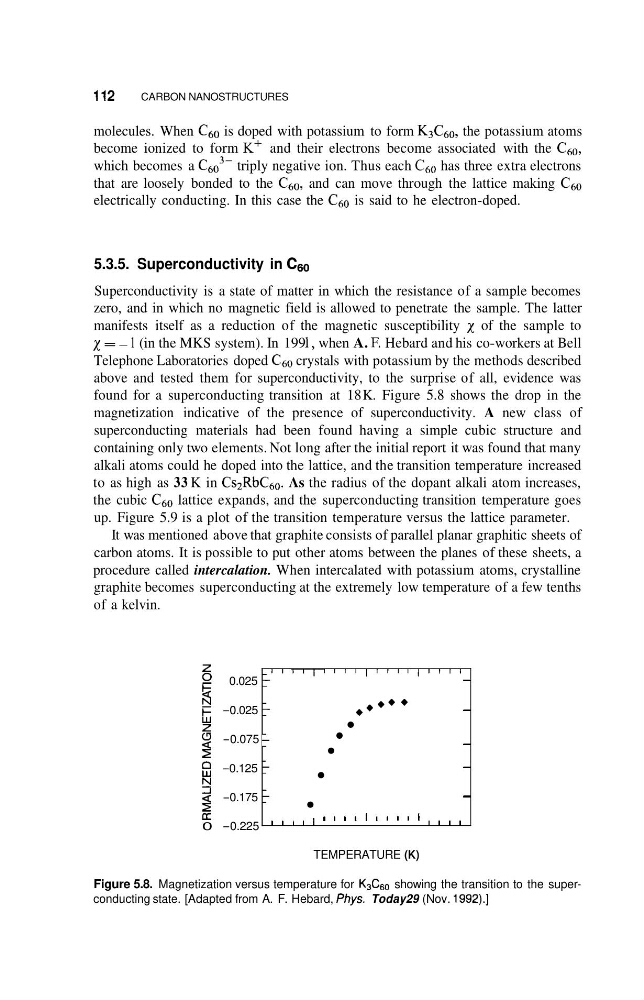
found for a superconducting transition at 18 K. Figure 5.8 shows the drop in the
magnetization indicative of the presence of superconductivity. A new class of
superconducting materials had been found having a simple cubic structure and
containing only two elements. Not long after the initial report it was found that many
alkali atoms could he doped into the lattice, and the transition temperature increased
to as high as 33 K in Cs2RbC60, As the radius of the dopant alkali atom increases,
the cubic C60 lattice expands, and the superconducting transition temperature goes
up. Figure 5.9 is a plot of the transition temperature versus the lattice parameter.
It was mentioned above that graphite consists of parallel planar graphitic sheets of
carbon atoms. It is possible to put other atoms between the planes of these sheets, a
procedure called intercalation. When intercalated with potassium atoms, crystalline
graphite becomes superconducting at the extremely low temperature of a few tenths
of a kelvin.
TEMPERATURE (K)
Figure 5.8. Magnetization versus temperature for K3C6,, showing the transition to the superconducting state. [Adapted from A. F. Hebard, Phys. Today29 (Nov. 1992).]
CARBON NANOSTRUCTURES
z
0 0.025
-0.025
k
9 -0.075
z
z
-0.125
N
2 -0.175
0 -0.225
z
molecules. When C60 is doped with potassium to form K3C60, the potassium atoms
become ionized to form Kf and their electrons become associated with the C60,
which becomes a C603- triply negative ion. Thus each C6,, has three extra electrons
that are loosely bonded to the C60, and can move through the lattice making C60
electrically conducting. In this case the C60 is said to he electron-doped.
I I , I , I
I I I , I I I
I ( l I I I
-
* * * * *
-
I
-
-
-
' ' ' ' ' I I I I ' I ' I ' I ' ' ' '
5.3.5. Superconductivity in C6,,
Superconductivity is a state of matter in which the resistance of a sample becomes
zero, and in which no magnetic field is allowed to penetrate the sample. The latter
manifests itself as a reduction of the magnetic susceptibility x of the sample to
x = - 1 (in the MKS system). In 199 1, when A. E Hebard and his co-workers at Bell
Telephone Laboratories doped C6,, crystals with potassium by the methods described
above and tested them for superconductivity, to the surprise of all, evidence was
found for a superconducting transition at 18 K. Figure 5.8 shows the drop in the
magnetization indicative of the presence of superconductivity. A new class of
superconducting materials had been found having a simple cubic structure and
containing only two elements. Not long after the initial report it was found that many
alkali atoms could he doped into the lattice, and the transition temperature increased
to as high as 33 K in Cs2RbC60, As the radius of the dopant alkali atom increases,
the cubic C60 lattice expands, and the superconducting transition temperature goes
up. Figure 5.9 is a plot of the transition temperature versus the lattice parameter.
It was mentioned above that graphite consists of parallel planar graphitic sheets of
carbon atoms. It is possible to put other atoms between the planes of these sheets, a
procedure called intercalation. When intercalated with potassium atoms, crystalline
graphite becomes superconducting at the extremely low temperature of a few tenths
of a kelvin.
TEMPERATURE (K)
Figure 5.8. Magnetization versus temperature for K3C6,, showing the transition to the superconducting state. [Adapted from A. F. Hebard, Phys. Today29 (Nov. 1992).]