

E1C03 09/14/2010
15:24:52 Page 87
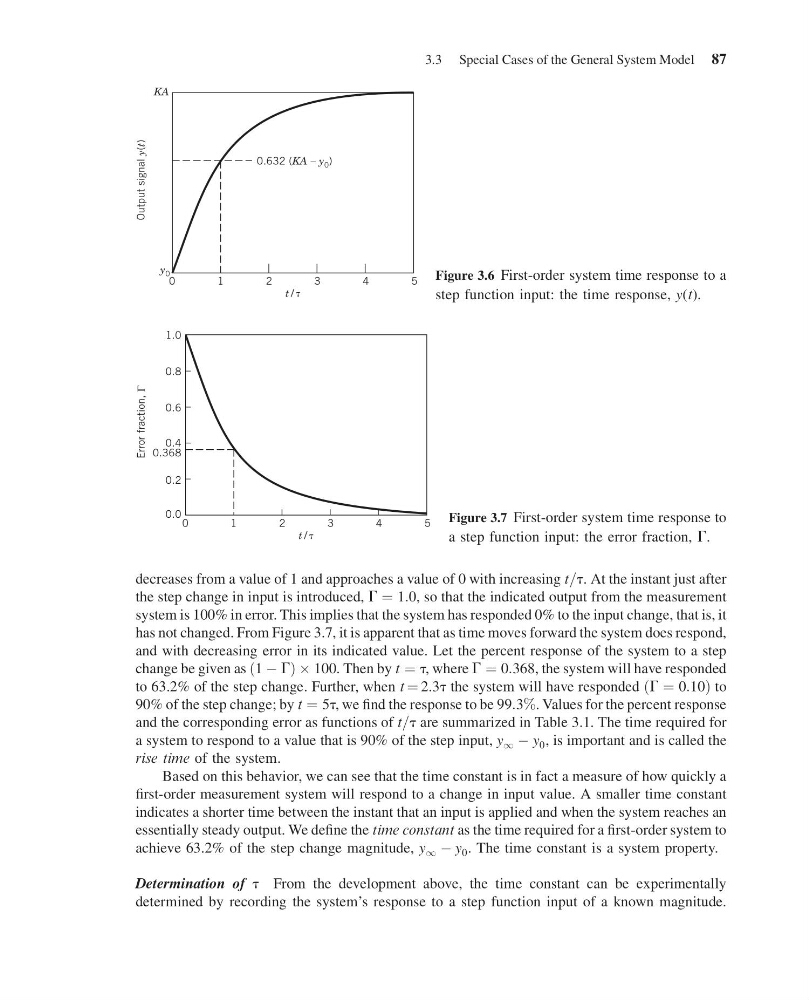
decreases from a value of 1 and approaches a value of 0 with increasing t=t. At the instant just after
the step change in input is introduced, G ¼ 1:0, so that the indicated output from the measurement
system is 100% in error. This implies that the system has responded 0% to the input change, that is, it
has not changed. From Figure 3.7, it is apparent that as time moves forward the system does respond,
and with decreasing error in its indicated value. Let the percent response of the system to a step
change be given as ð1 À GÞ Â 100. Then by t ¼ t, where G ¼ 0:368, the system will have responded
to 63.2% of the step change. Further, when t ¼ 2.3t the system will have responded ðG ¼ 0:10Þ to
90% of the step change; by t ¼ 5t, we find the response to be 99:3%. Values for the percent response
and the corresponding error as functions of t=t are summarized in Table 3.1. The time required for
a system to respond to a value that is 90% of the step input, y 1 À y 0 , is important and is called the
rise time of the system.
Based on this behavior, we can see that the time constant is in fact a measure of how quickly a
first-order measurement system will respond to a change in input value. A smaller time constant
indicates a shorter time between the instant that an input is applied and when the system reaches an
essentially steady output. We define the time constant as the time required for a first-order system to
achieve 63.2% of the step change magnitude, y 1 À y 0 . The time constant is a system property.
Determination of t From the development above, the time constant can be experimentally
determined by recording the system’s response to a step function input of a known magnitude.
0
1
2
3
4
5
Output signal
y(t)
y 0
KA
t/
0.632 (KA – y 0 )
Figure 3.6 First-order system time response to a
step function input: the time response, y(t).
0
0.0
0.2
0.4
0.368
0.6
0.8
1.0
1
2
3
4
5
Error fraction,
Γ
t/
Figure 3.7 First-order system time response to
a step function input: the error fraction, G.
3.3 Special Cases of the General System Model 87
15:24:52 Page 87
decreases from a value of 1 and approaches a value of 0 with increasing t=t. At the instant just after
the step change in input is introduced, G ¼ 1:0, so that the indicated output from the measurement
system is 100% in error. This implies that the system has responded 0% to the input change, that is, it
has not changed. From Figure 3.7, it is apparent that as time moves forward the system does respond,
and with decreasing error in its indicated value. Let the percent response of the system to a step
change be given as ð1 À GÞ Â 100. Then by t ¼ t, where G ¼ 0:368, the system will have responded
to 63.2% of the step change. Further, when t ¼ 2.3t the system will have responded ðG ¼ 0:10Þ to
90% of the step change; by t ¼ 5t, we find the response to be 99:3%. Values for the percent response
and the corresponding error as functions of t=t are summarized in Table 3.1. The time required for
a system to respond to a value that is 90% of the step input, y 1 À y 0 , is important and is called the
rise time of the system.
Based on this behavior, we can see that the time constant is in fact a measure of how quickly a
first-order measurement system will respond to a change in input value. A smaller time constant
indicates a shorter time between the instant that an input is applied and when the system reaches an
essentially steady output. We define the time constant as the time required for a first-order system to
achieve 63.2% of the step change magnitude, y 1 À y 0 . The time constant is a system property.
Determination of t From the development above, the time constant can be experimentally
determined by recording the system’s response to a step function input of a known magnitude.
0
1
2
3
4
5
Output signal
y(t)
y 0
KA
t/
0.632 (KA – y 0 )
Figure 3.6 First-order system time response to a
step function input: the time response, y(t).
0
0.0
0.2
0.4
0.368
0.6
0.8
1.0
1
2
3
4
5
Error fraction,
Γ
t/
Figure 3.7 First-order system time response to
a step function input: the error fraction, G.
3.3 Special Cases of the General System Model 87