

E1C03 09/14/2010
15:24:52 Page 80
make the measurement. Thus, the board length represents a static input signal that is interpreted
through the static magnitude output indicated by the ruler. But consider measuring the vibration of a
motor. Vibration signals vary in amplitude and time, and thus are a dynamic input signal to the
measuring instrument. But the ruler is not very useful in determining this dynamic information, so
we need an instrument that can follow the input time signal faithfully.
Dynamic Measurements
For dynamic signals, signal amplitude, frequency, and general waveform information is needed to
reconstruct the input signal. Because dynamic signals vary with time, the measurement system must
be able to respond fast enough to keep up with the input signal. Further, we need to understand how
the input signal is applied to the sensor because that plays a role in system response. Consider the
time response of a common bulb thermometer for measuring body temperature. The thermometer,
initially at approximately room temperature, is placed under the tongue. But even after several
seconds, the thermometer does not indicate the expected value of body temperature and its display
continually changes. What has happened? Surely your body temperature is not changing. If you
were to use the magnitude of the output signal after only several seconds, you would come to a false
conclusion about your health! Experience shows that within a few minutes, the correct body
temperature will be indicated; so we wait. Experience also tells us that if we need accurate
information faster, we would need a different type of temperature sensor. In this example, body
temperature itself is constant (static) during the measurement, but the input signal to the
thermometer is suddenly changed from room temperature to body temperature, that is, mathematically, a step change. This is a dynamic event as the thermometer (the measurement system) sees it!
The thermometer must gain energy from its new environment to reach thermal equilibrium, and this
takes a finite amount of time. The ability of any measurement system to follow dynamic signals is a
characteristic of the design of the measuring system components.
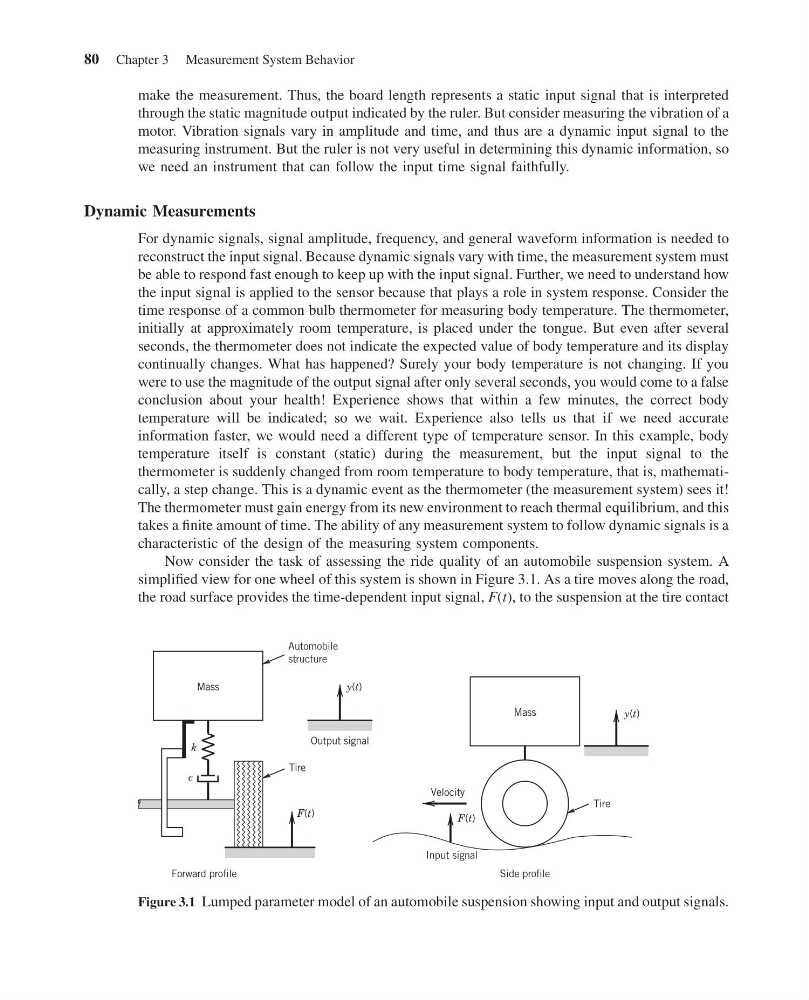
Now consider the task of assessing the ride quality of an automobile suspension system. A
simplified view for one wheel of this system is shown in Figure 3.1. As a tire moves along the road,
the road surface provides the time-dependent input signal, F(t), to the suspension at the tire contact
Mass
Mass
Automobile
structure
Tire
Tire
Forward profile
k
c
F(t)
y(t)
y(t)
Output signal
Velocity
Input signal
Side profile
F(t)
Figure 3.1 Lumped parameter model of an automobile suspension showing input and output signals.
80 Chapter 3 Measurement System Behavior
15:24:52 Page 80
make the measurement. Thus, the board length represents a static input signal that is interpreted
through the static magnitude output indicated by the ruler. But consider measuring the vibration of a
motor. Vibration signals vary in amplitude and time, and thus are a dynamic input signal to the
measuring instrument. But the ruler is not very useful in determining this dynamic information, so
we need an instrument that can follow the input time signal faithfully.
Dynamic Measurements
For dynamic signals, signal amplitude, frequency, and general waveform information is needed to
reconstruct the input signal. Because dynamic signals vary with time, the measurement system must
be able to respond fast enough to keep up with the input signal. Further, we need to understand how
the input signal is applied to the sensor because that plays a role in system response. Consider the
time response of a common bulb thermometer for measuring body temperature. The thermometer,
initially at approximately room temperature, is placed under the tongue. But even after several
seconds, the thermometer does not indicate the expected value of body temperature and its display
continually changes. What has happened? Surely your body temperature is not changing. If you
were to use the magnitude of the output signal after only several seconds, you would come to a false
conclusion about your health! Experience shows that within a few minutes, the correct body
temperature will be indicated; so we wait. Experience also tells us that if we need accurate
information faster, we would need a different type of temperature sensor. In this example, body
temperature itself is constant (static) during the measurement, but the input signal to the
thermometer is suddenly changed from room temperature to body temperature, that is, mathematically, a step change. This is a dynamic event as the thermometer (the measurement system) sees it!
The thermometer must gain energy from its new environment to reach thermal equilibrium, and this
takes a finite amount of time. The ability of any measurement system to follow dynamic signals is a
characteristic of the design of the measuring system components.
Now consider the task of assessing the ride quality of an automobile suspension system. A
simplified view for one wheel of this system is shown in Figure 3.1. As a tire moves along the road,
the road surface provides the time-dependent input signal, F(t), to the suspension at the tire contact
Mass
Mass
Automobile
structure
Tire
Tire
Forward profile
k
c
F(t)
y(t)
y(t)
Output signal
Velocity
Input signal
Side profile
F(t)
Figure 3.1 Lumped parameter model of an automobile suspension showing input and output signals.
80 Chapter 3 Measurement System Behavior