

E1C02 09/14/2010
13:35:23 Page 74
2.8 A spring with k ¼ 5000 N/cm supports a mass of 1 kg. Determine the natural frequency of this system
in radians/second and hertz.
2.9 For the following sine and cosine functions determine the period, the frequency in hertz, and the
circular frequency in radians/second. (Note: t represents time in seconds).
a. sin 10pt/5
b. 8 cos 8t
c. sin 5npt for n ¼ 1 to 1
2.10 Express the following function in terms of (a) a cosine term only and (b) a sine term only:
y t
ð Þ ¼ 5 sin 4t þ 3 cos 4t
2.11 Express the function
y t
ð Þ ¼ 4 sin 2pt þ 15 cos 2pt
in terms of (a) a cosine term only and (b) a sine term only.
2.12 Express the Fourier series given by
y t
ð Þ ¼
X 1
n¼1
2pn
6
sin npt þ
4pn
6
cos npt
using only cosine terms.
2.13 The nth partial sum of a Fourier series is defined as
A 0 þ A 1 cos v 1 t þ B 1 sin v 1 t þ Á Á Á þ A n cos v n t þ B n sin v n t
For the third partial sum of the Fourier series given by
y t
ð Þ ¼
P 1
n¼1
3n
2
sin nt þ
5n
3
cos nt
a. What is the fundamental frequency and the associated period?
b. Express this partial sum as cosine terms only.
2.14 For the Fourier series given by
y t
ð Þ ¼ 4 þ
X 1
n¼1
2pn
10
cos
np
4
t þ
120np
30
sin
np
4
t
where t is time in seconds:
a. What is the fundamental frequency in hertz and radians/second?
b. What is the period T associated with the fundamental frequency?
c. Express this Fourier series as an infinite series containing sine terms only.
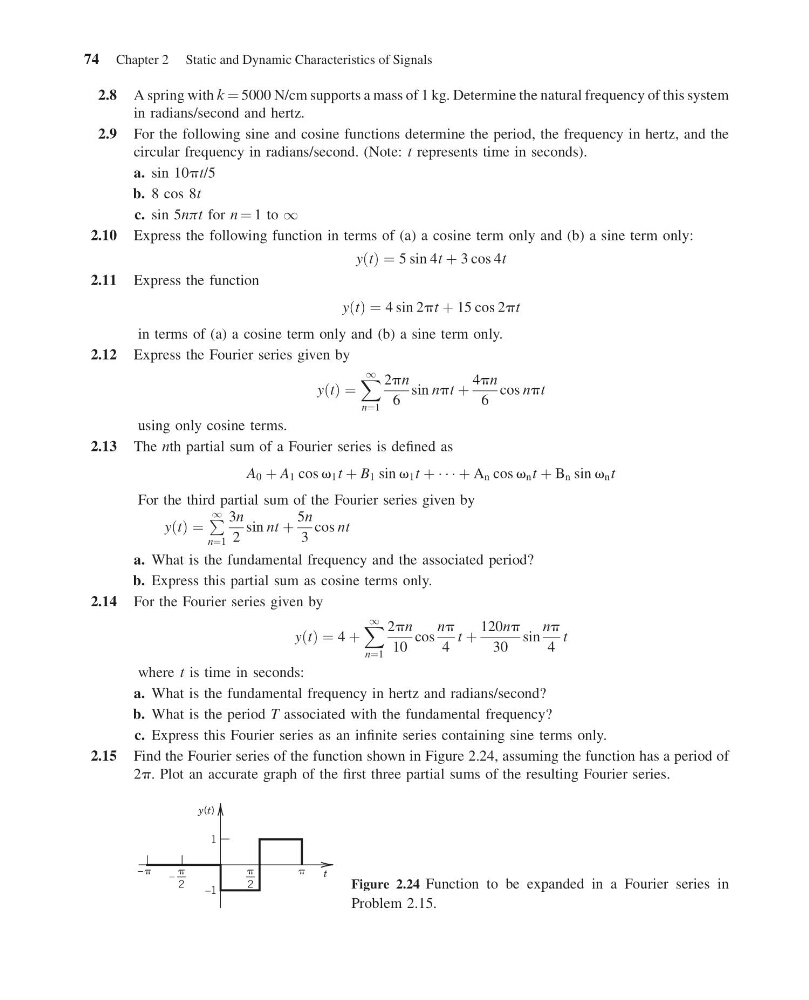
2.15 Find the Fourier series of the function shown in Figure 2.24, assuming the function has a period of
2p. Plot an accurate graph of the first three partial sums of the resulting Fourier series.
t
2
1
–1
–
y(t)
2
–
Figure 2.24 Function to be expanded in a Fourier series in
Problem 2.15.
74 Chapter 2 Static and Dynamic Characteristics of Signals
13:35:23 Page 74
2.8 A spring with k ¼ 5000 N/cm supports a mass of 1 kg. Determine the natural frequency of this system
in radians/second and hertz.
2.9 For the following sine and cosine functions determine the period, the frequency in hertz, and the
circular frequency in radians/second. (Note: t represents time in seconds).
a. sin 10pt/5
b. 8 cos 8t
c. sin 5npt for n ¼ 1 to 1
2.10 Express the following function in terms of (a) a cosine term only and (b) a sine term only:
y t
ð Þ ¼ 5 sin 4t þ 3 cos 4t
2.11 Express the function
y t
ð Þ ¼ 4 sin 2pt þ 15 cos 2pt
in terms of (a) a cosine term only and (b) a sine term only.
2.12 Express the Fourier series given by
y t
ð Þ ¼
X 1
n¼1
2pn
6
sin npt þ
4pn
6
cos npt
using only cosine terms.
2.13 The nth partial sum of a Fourier series is defined as
A 0 þ A 1 cos v 1 t þ B 1 sin v 1 t þ Á Á Á þ A n cos v n t þ B n sin v n t
For the third partial sum of the Fourier series given by
y t
ð Þ ¼
P 1
n¼1
3n
2
sin nt þ
5n
3
cos nt
a. What is the fundamental frequency and the associated period?
b. Express this partial sum as cosine terms only.
2.14 For the Fourier series given by
y t
ð Þ ¼ 4 þ
X 1
n¼1
2pn
10
cos
np
4
t þ
120np
30
sin
np
4
t
where t is time in seconds:
a. What is the fundamental frequency in hertz and radians/second?
b. What is the period T associated with the fundamental frequency?
c. Express this Fourier series as an infinite series containing sine terms only.
2.15 Find the Fourier series of the function shown in Figure 2.24, assuming the function has a period of
2p. Plot an accurate graph of the first three partial sums of the resulting Fourier series.
t
2
1
–1
–
y(t)
2
–
Figure 2.24 Function to be expanded in a Fourier series in
Problem 2.15.
74 Chapter 2 Static and Dynamic Characteristics of Signals