

E1C02 09/14/2010
13:35:17 Page 46
2.3 SIGNAL ANALYSIS
In this section, we consider concepts related to the characterization of signals. A measurement
system produces a signal that may be analog, discrete time, or digital. An analog signal is continuous
with time and has a magnitude that is analogous to the magnitude of the physical variable being
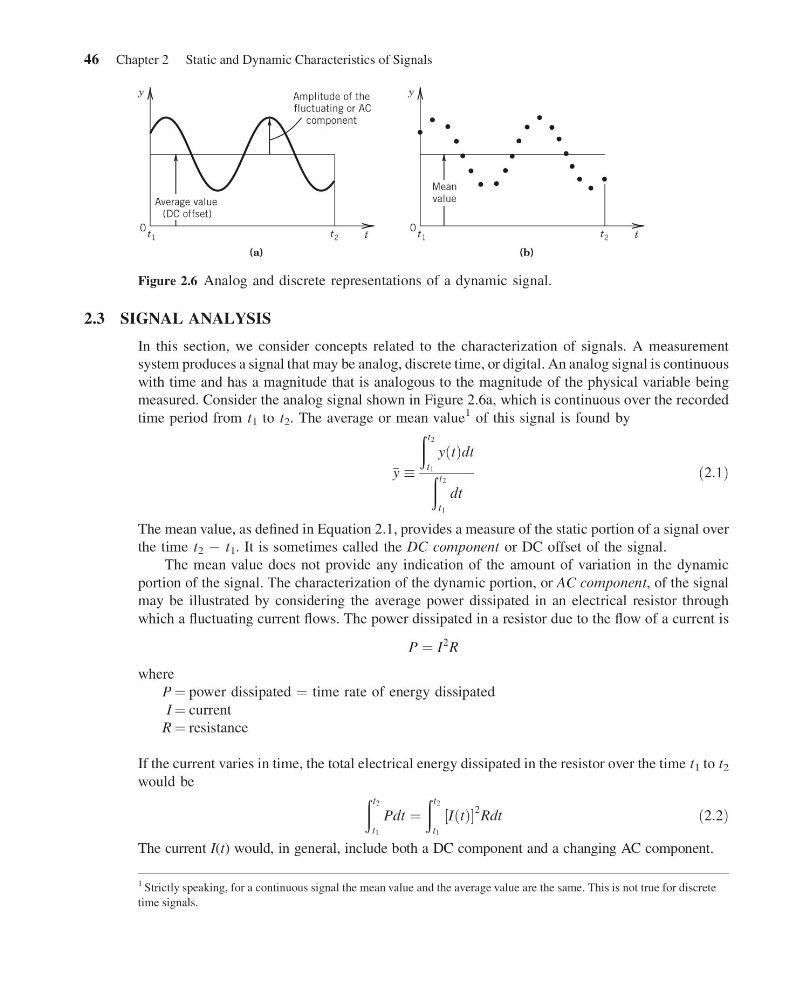
measured. Consider the analog signal shown in Figure 2.6a, which is continuous over the recorded
time period from t 1 to t 2 . The average or mean value
1 of this signal is found by
y
ð t 2
t 1
yðtÞdt
ð t 2
t 1
dt
ð2:1Þ
The mean value, as defined in Equation 2.1, provides a measure of the static portion of a signal over
the time t 2 À t 1 . It is sometimes called the DC component or DC offset of the signal.
The mean value does not provide any indication of the amount of variation in the dynamic
portion of the signal. The characterization of the dynamic portion, or AC component, of the signal
may be illustrated by considering the average power dissipated in an electrical resistor through
which a fluctuating current flows. The power dissipated in a resistor due to the flow of a current is
P ¼ I
2
R
where
P ¼ power dissipated ¼ time rate of energy dissipated
I ¼ current
R ¼ resistance
If the current varies in time, the total electrical energy dissipated in the resistor over the time t 1 to t 2
would be
ð t 2
t 1
Pdt ¼
ð t 2
t 1
IðtÞ
½
2 Rdt
ð2:2Þ
The current I(t) would, in general, include both a DC component and a changing AC component.
t
y
0
(a)
t 1
t 2
t
y
0
(b)
t 1
t 2
Average value
(DC offset)
Mean
value
Amplitude of the
fluctuating or AC
component
Figure 2.6 Analog and discrete representations of a dynamic signal.
1 Strictly speaking, for a continuous signal the mean value and the average value are the same. This is not true for discrete
time signals.
46 Chapter 2 Static and Dynamic Characteristics of Signals
13:35:17 Page 46
2.3 SIGNAL ANALYSIS
In this section, we consider concepts related to the characterization of signals. A measurement
system produces a signal that may be analog, discrete time, or digital. An analog signal is continuous
with time and has a magnitude that is analogous to the magnitude of the physical variable being
measured. Consider the analog signal shown in Figure 2.6a, which is continuous over the recorded
time period from t 1 to t 2 . The average or mean value
1 of this signal is found by
y
ð t 2
t 1
yðtÞdt
ð t 2
t 1
dt
ð2:1Þ
The mean value, as defined in Equation 2.1, provides a measure of the static portion of a signal over
the time t 2 À t 1 . It is sometimes called the DC component or DC offset of the signal.
The mean value does not provide any indication of the amount of variation in the dynamic
portion of the signal. The characterization of the dynamic portion, or AC component, of the signal
may be illustrated by considering the average power dissipated in an electrical resistor through
which a fluctuating current flows. The power dissipated in a resistor due to the flow of a current is
P ¼ I
2
R
where
P ¼ power dissipated ¼ time rate of energy dissipated
I ¼ current
R ¼ resistance
If the current varies in time, the total electrical energy dissipated in the resistor over the time t 1 to t 2
would be
ð t 2
t 1
Pdt ¼
ð t 2
t 1
IðtÞ
½
2 Rdt
ð2:2Þ
The current I(t) would, in general, include both a DC component and a changing AC component.
t
y
0
(a)
t 1
t 2
t
y
0
(b)
t 1
t 2
Average value
(DC offset)
Mean
value
Amplitude of the
fluctuating or AC
component
Figure 2.6 Analog and discrete representations of a dynamic signal.
1 Strictly speaking, for a continuous signal the mean value and the average value are the same. This is not true for discrete
time signals.
46 Chapter 2 Static and Dynamic Characteristics of Signals