

E1C02 09/14/2010
13:35:17 Page 45
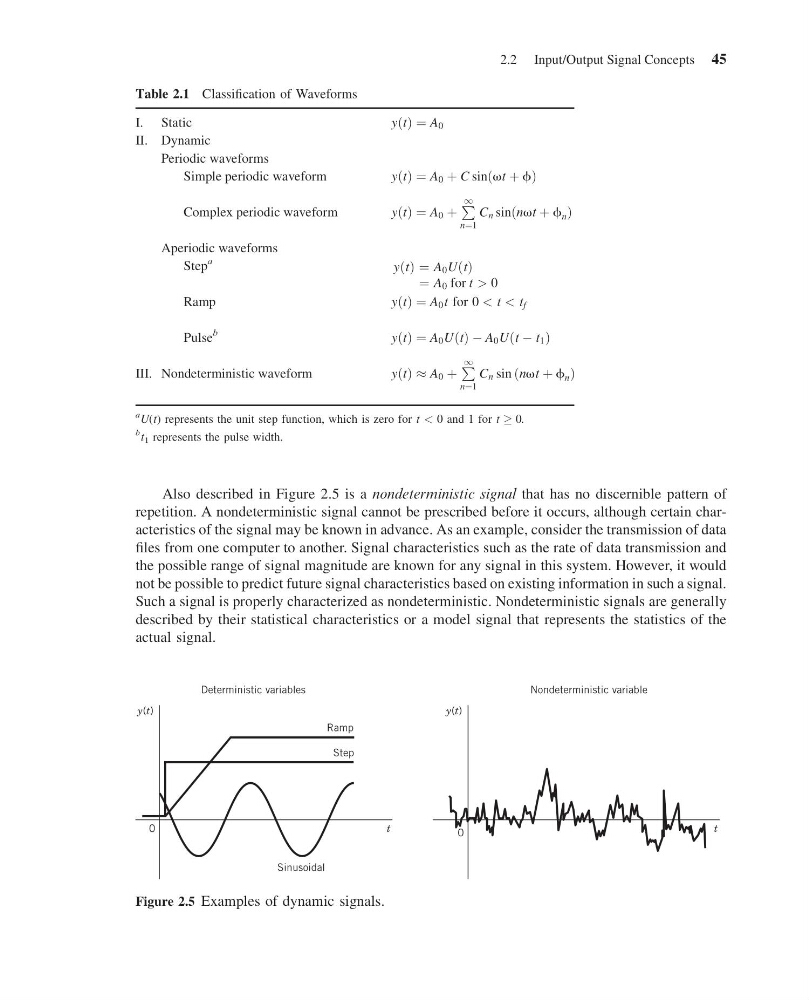
Also described in Figure 2.5 is a nondeterministic signal that has no discernible pattern of
repetition. A nondeterministic signal cannot be prescribed before it occurs, although certain characteristics of the signal may be known in advance. As an example, consider the transmission of data
files from one computer to another. Signal characteristics such as the rate of data transmission and
the possible range of signal magnitude are known for any signal in this system. However, it would
not be possible to predict future signal characteristics based on existing information in such a signal.
Such a signal is properly characterized as nondeterministic. Nondeterministic signals are generally
described by their statistical characteristics or a model signal that represents the statistics of the
actual signal.
Table 2.1 Classification of Waveforms
I. Static
y t
ð Þ ¼ A 0
II. Dynamic
Periodic waveforms
Simple periodic waveform
y t
ð Þ ¼ A 0 þ C sin vt þ f
ð
Þ
Complex periodic waveform
y t
ð Þ ¼ A 0 þ
P 1
n¼1
C n sin nvt þ f n
ð
Þ
Aperiodic waveforms
Step
a
y t
ð Þ ¼ A 0 U t
ð Þ
¼ A 0 for t > 0
Ramp
y t
ð Þ ¼ A 0 t for 0 < t < t f
Pulse
b
y t
ð Þ ¼ A 0 U t
ð Þ À A 0 U t À t 1
ð
Þ
III. Nondeterministic waveform
y t
ð Þ % A 0 þ
P 1
n¼1
C n sin nvt þ f n
ð
Þ
a U(t) represents the unit step function, which is zero for t < 0 and 1 for t ! 0.
b t 1 represents the pulse width.
0
Nondeterministic variable
Deterministic variables
Ramp
Step
Sinusoidal
y(t)
t
0
y(t)
t
Figure 2.5 Examples of dynamic signals.
2.2 Input/Output Signal Concepts 45
13:35:17 Page 45
Also described in Figure 2.5 is a nondeterministic signal that has no discernible pattern of
repetition. A nondeterministic signal cannot be prescribed before it occurs, although certain characteristics of the signal may be known in advance. As an example, consider the transmission of data
files from one computer to another. Signal characteristics such as the rate of data transmission and
the possible range of signal magnitude are known for any signal in this system. However, it would
not be possible to predict future signal characteristics based on existing information in such a signal.
Such a signal is properly characterized as nondeterministic. Nondeterministic signals are generally
described by their statistical characteristics or a model signal that represents the statistics of the
actual signal.
Table 2.1 Classification of Waveforms
I. Static
y t
ð Þ ¼ A 0
II. Dynamic
Periodic waveforms
Simple periodic waveform
y t
ð Þ ¼ A 0 þ C sin vt þ f
ð
Þ
Complex periodic waveform
y t
ð Þ ¼ A 0 þ
P 1
n¼1
C n sin nvt þ f n
ð
Þ
Aperiodic waveforms
Step
a
y t
ð Þ ¼ A 0 U t
ð Þ
¼ A 0 for t > 0
Ramp
y t
ð Þ ¼ A 0 t for 0 < t < t f
Pulse
b
y t
ð Þ ¼ A 0 U t
ð Þ À A 0 U t À t 1
ð
Þ
III. Nondeterministic waveform
y t
ð Þ % A 0 þ
P 1
n¼1
C n sin nvt þ f n
ð
Þ
a U(t) represents the unit step function, which is zero for t < 0 and 1 for t ! 0.
b t 1 represents the pulse width.
0
Nondeterministic variable
Deterministic variables
Ramp
Step
Sinusoidal
y(t)
t
0
y(t)
t
Figure 2.5 Examples of dynamic signals.
2.2 Input/Output Signal Concepts 45