

E1C02 09/14/2010
13:35:16 Page 43
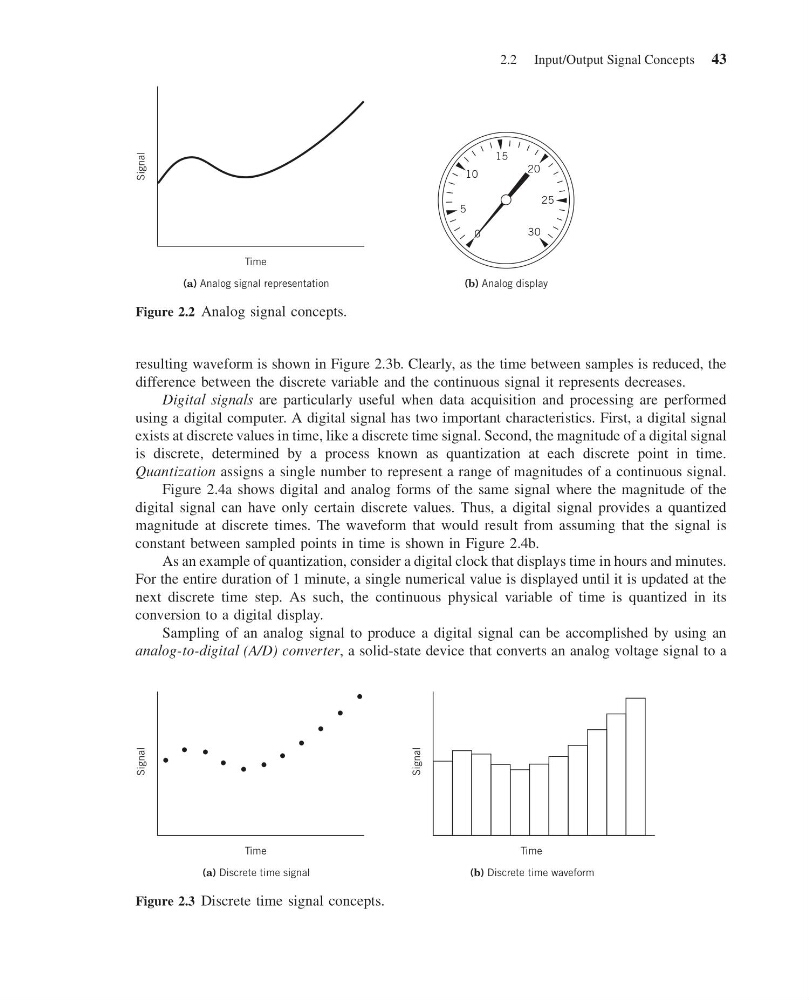
resulting waveform is shown in Figure 2.3b. Clearly, as the time between samples is reduced, the
difference between the discrete variable and the continuous signal it represents decreases.
Digital signals are particularly useful when data acquisition and processing are performed
using a digital computer. A digital signal has two important characteristics. First, a digital signal
exists at discrete values in time, like a discrete time signal. Second, the magnitude of a digital signal
is discrete, determined by a process known as quantization at each discrete point in time.
Quantization assigns a single number to represent a range of magnitudes of a continuous signal.
Figure 2.4a shows digital and analog forms of the same signal where the magnitude of the
digital signal can have only certain discrete values. Thus, a digital signal provides a quantized
magnitude at discrete times. The waveform that would result from assuming that the signal is
constant between sampled points in time is shown in Figure 2.4b.
As an example of quantization, consider a digital clock that displays time in hours and minutes.
For the entire duration of 1 minute, a single numerical value is displayed until it is updated at the
next discrete time step. As such, the continuous physical variable of time is quantized in its
conversion to a digital display.
Sampling of an analog signal to produce a digital signal can be accomplished by using an
analog-to-digital (A/D) converter, a solid-state device that converts an analog voltage signal to a
Time
(a) Analog signal representation
(b) Analog display
Signal
0
5
10
15
20
30
25
Figure 2.2 Analog signal concepts.
Time
(a) Discrete time signal
Signal
Time
(b) Discrete time waveform
Signal
Figure 2.3 Discrete time signal concepts.
2.2 Input/Output Signal Concepts 43
13:35:16 Page 43
resulting waveform is shown in Figure 2.3b. Clearly, as the time between samples is reduced, the
difference between the discrete variable and the continuous signal it represents decreases.
Digital signals are particularly useful when data acquisition and processing are performed
using a digital computer. A digital signal has two important characteristics. First, a digital signal
exists at discrete values in time, like a discrete time signal. Second, the magnitude of a digital signal
is discrete, determined by a process known as quantization at each discrete point in time.
Quantization assigns a single number to represent a range of magnitudes of a continuous signal.
Figure 2.4a shows digital and analog forms of the same signal where the magnitude of the
digital signal can have only certain discrete values. Thus, a digital signal provides a quantized
magnitude at discrete times. The waveform that would result from assuming that the signal is
constant between sampled points in time is shown in Figure 2.4b.
As an example of quantization, consider a digital clock that displays time in hours and minutes.
For the entire duration of 1 minute, a single numerical value is displayed until it is updated at the
next discrete time step. As such, the continuous physical variable of time is quantized in its
conversion to a digital display.
Sampling of an analog signal to produce a digital signal can be accomplished by using an
analog-to-digital (A/D) converter, a solid-state device that converts an analog voltage signal to a
Time
(a) Analog signal representation
(b) Analog display
Signal
0
5
10
15
20
30
25
Figure 2.2 Analog signal concepts.
Time
(a) Discrete time signal
Signal
Time
(b) Discrete time waveform
Signal
Figure 2.3 Discrete time signal concepts.
2.2 Input/Output Signal Concepts 43