

E1C12 09/14/2010
13:54:12 Page 532
The American Society of Mechanical Engineers (ASME) Performance Test Code (PTC) 19.7
(6) provides guidelines for the measurement of shaft power. According to PTC 19.7, overall
uncertainty in the measurement of shaft power by a cradled dynamometer results from (1) trunnionbearing friction error uncertainty, (2) force measurement uncertainty (F r ), (3) moment arm length
uncertainty (L r ), (4) static unbalance of dynamometer error uncertainty and, (5) uncertainty in
rotational speed measurement.
A means of supplying a controllable load to the prime mover, and dissipating the energy
absorbed in the dynamometer, are an integral part of the design of any dynamometer. Several
techniques are described for providing an appropriate load.
Eddy Current Dynamometers: A direct current field coil and a rotor allow shaft power to be
dissipated by eddy currents in the stator winding. The resulting conversion to thermal energy by
joulian heating of the eddy currents necessitates some cooling be supplied, typically using cooling
water.
Alternating Currrent and DC Generators: Cradled AC and DC machines are employed as power
absorbing elements in dynamometers. The AC applications require variable frequency capabilities
to allow a wide range of power and speed measurements. The power produced in such dynamometers may be dissipated as thermal energy using resistive loads.
Waterbrake Dynamometers: A waterbrake dynamometer employs fluid friction and momentum
transport to create a means of energy dissipation. Two representative designs are provided in
Figure 12.29. The viscous shear type brake is useful for high rotational speeds, and the agitator type
unit is used over a range of speeds and loads. Waterbrakes may be employed for applications up to
10,000 HP (7450 kW). The load absorbed by waterbrakes can be adjusted using water level and flow
rates in the brake.
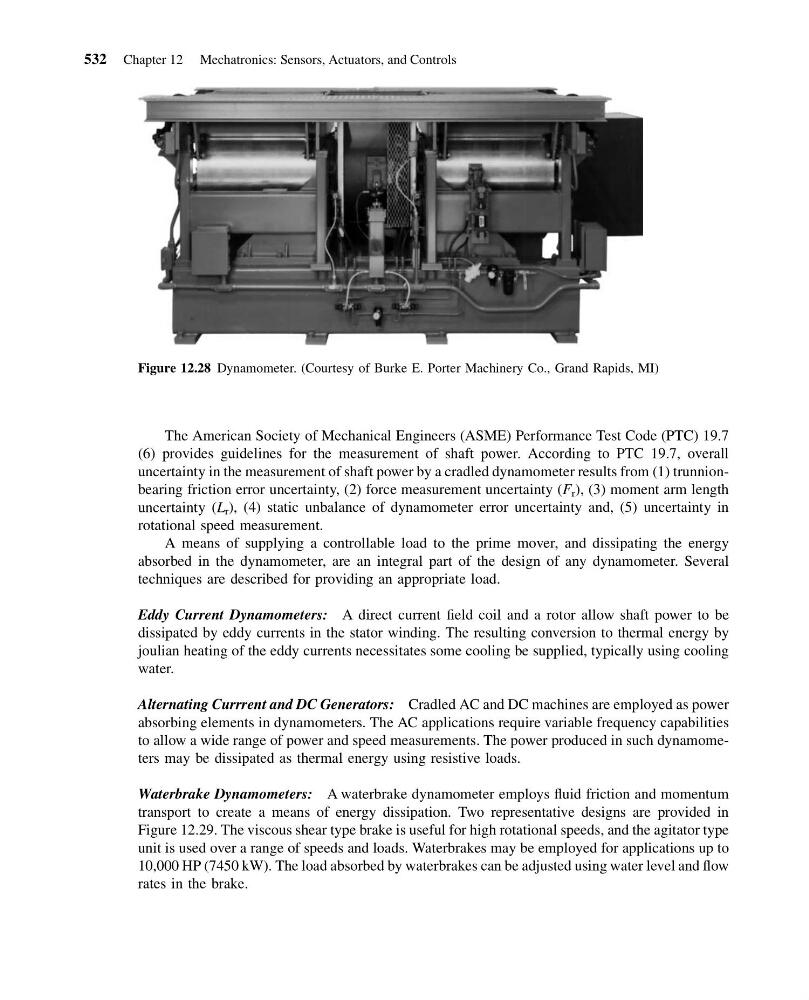
Figure 12.28 Dynamometer. (Courtesy of Burke E. Porter Machinery Co., Grand Rapids, MI)
532 Chapter 12 Mechatronics: Sensors, Actuators, and Controls
13:54:12 Page 532
The American Society of Mechanical Engineers (ASME) Performance Test Code (PTC) 19.7
(6) provides guidelines for the measurement of shaft power. According to PTC 19.7, overall
uncertainty in the measurement of shaft power by a cradled dynamometer results from (1) trunnionbearing friction error uncertainty, (2) force measurement uncertainty (F r ), (3) moment arm length
uncertainty (L r ), (4) static unbalance of dynamometer error uncertainty and, (5) uncertainty in
rotational speed measurement.
A means of supplying a controllable load to the prime mover, and dissipating the energy
absorbed in the dynamometer, are an integral part of the design of any dynamometer. Several
techniques are described for providing an appropriate load.
Eddy Current Dynamometers: A direct current field coil and a rotor allow shaft power to be
dissipated by eddy currents in the stator winding. The resulting conversion to thermal energy by
joulian heating of the eddy currents necessitates some cooling be supplied, typically using cooling
water.
Alternating Currrent and DC Generators: Cradled AC and DC machines are employed as power
absorbing elements in dynamometers. The AC applications require variable frequency capabilities
to allow a wide range of power and speed measurements. The power produced in such dynamometers may be dissipated as thermal energy using resistive loads.
Waterbrake Dynamometers: A waterbrake dynamometer employs fluid friction and momentum
transport to create a means of energy dissipation. Two representative designs are provided in
Figure 12.29. The viscous shear type brake is useful for high rotational speeds, and the agitator type
unit is used over a range of speeds and loads. Waterbrakes may be employed for applications up to
10,000 HP (7450 kW). The load absorbed by waterbrakes can be adjusted using water level and flow
rates in the brake.
Figure 12.28 Dynamometer. (Courtesy of Burke E. Porter Machinery Co., Grand Rapids, MI)
532 Chapter 12 Mechatronics: Sensors, Actuators, and Controls