

E1C12 09/14/2010
13:54:12 Page 531
Cradled Dynamometers
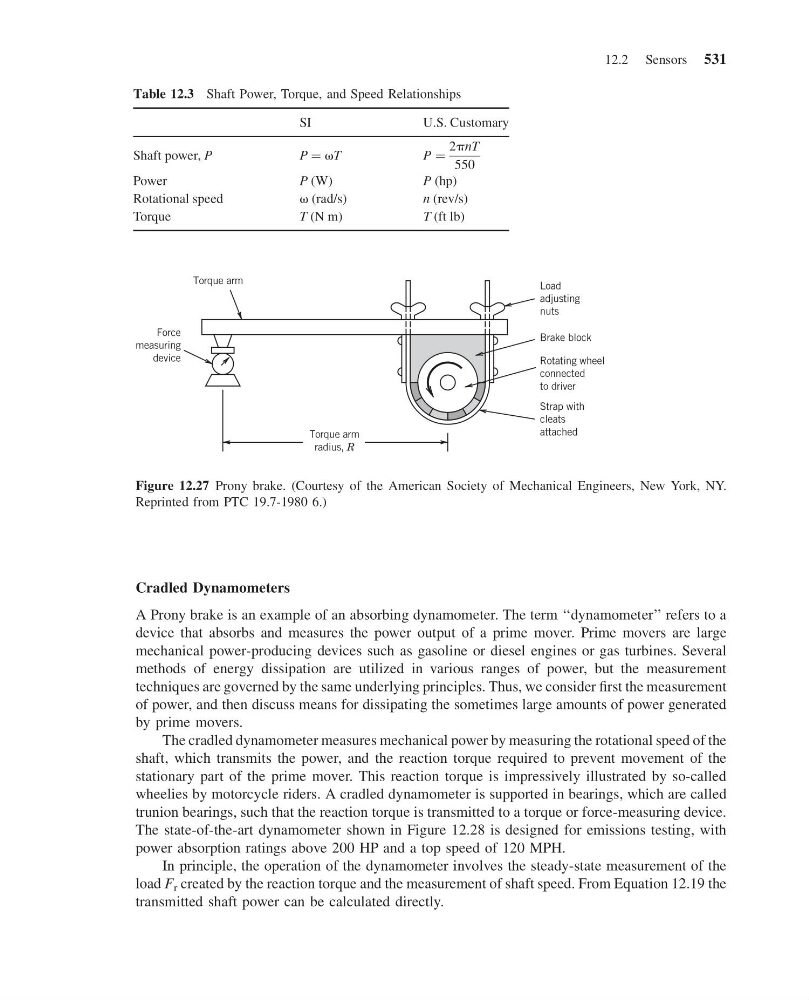
A Prony brake is an example of an absorbing dynamometer. The term ‘‘dynamometer’’ refers to a
device that absorbs and measures the power output of a prime mover. Prime movers are large
mechanical power-producing devices such as gasoline or diesel engines or gas turbines. Several
methods of energy dissipation are utilized in various ranges of power, but the measurement
techniques are governed by the same underlying principles. Thus, we consider first the measurement
of power, and then discuss means for dissipating the sometimes large amounts of power generated
by prime movers.
The cradled dynamometer measures mechanical power by measuring the rotational speed of the
shaft, which transmits the power, and the reaction torque required to prevent movement of the
stationary part of the prime mover. This reaction torque is impressively illustrated by so-called
wheelies by motorcycle riders. A cradled dynamometer is supported in bearings, which are called
trunion bearings, such that the reaction torque is transmitted to a torque or force-measuring device.
The state-of-the-art dynamometer shown in Figure 12.28 is designed for emissions testing, with
power absorption ratings above 200 HP and a top speed of 120 MPH.
In principle, the operation of the dynamometer involves the steady-state measurement of the
load F r created by the reaction torque and the measurement of shaft speed. From Equation 12.19 the
transmitted shaft power can be calculated directly.
Torque arm
Force
measuring
device
Torque arm
radius, R
Load
adjusting
nuts
Brake block
Rotating wheel
connected
to driver
Strap with
cleats
attached
Figure 12.27 Prony brake. (Courtesy of the American Society of Mechanical Engineers, New York, NY.
Reprinted from PTC 19.7-1980 6.)
Table 12.3 Shaft Power, Torque, and Speed Relationships
SI
U.S. Customary
Shaft power, P
P ¼ vT
P ¼
2pnT
550
Power
P (W)
P (hp)
Rotational speed
v (rad/s)
n (rev/s)
Torque
T (N m)
T (ft lb)
12.2 Sensors 531
13:54:12 Page 531
Cradled Dynamometers
A Prony brake is an example of an absorbing dynamometer. The term ‘‘dynamometer’’ refers to a
device that absorbs and measures the power output of a prime mover. Prime movers are large
mechanical power-producing devices such as gasoline or diesel engines or gas turbines. Several
methods of energy dissipation are utilized in various ranges of power, but the measurement
techniques are governed by the same underlying principles. Thus, we consider first the measurement
of power, and then discuss means for dissipating the sometimes large amounts of power generated
by prime movers.
The cradled dynamometer measures mechanical power by measuring the rotational speed of the
shaft, which transmits the power, and the reaction torque required to prevent movement of the
stationary part of the prime mover. This reaction torque is impressively illustrated by so-called
wheelies by motorcycle riders. A cradled dynamometer is supported in bearings, which are called
trunion bearings, such that the reaction torque is transmitted to a torque or force-measuring device.
The state-of-the-art dynamometer shown in Figure 12.28 is designed for emissions testing, with
power absorption ratings above 200 HP and a top speed of 120 MPH.
In principle, the operation of the dynamometer involves the steady-state measurement of the
load F r created by the reaction torque and the measurement of shaft speed. From Equation 12.19 the
transmitted shaft power can be calculated directly.
Torque arm
Force
measuring
device
Torque arm
radius, R
Load
adjusting
nuts
Brake block
Rotating wheel
connected
to driver
Strap with
cleats
attached
Figure 12.27 Prony brake. (Courtesy of the American Society of Mechanical Engineers, New York, NY.
Reprinted from PTC 19.7-1980 6.)
Table 12.3 Shaft Power, Torque, and Speed Relationships
SI
U.S. Customary
Shaft power, P
P ¼ vT
P ¼
2pnT
550
Power
P (W)
P (hp)
Rotational speed
v (rad/s)
n (rev/s)
Torque
T (N m)
T (ft lb)
12.2 Sensors 531