

E1C12 09/14/2010
13:54:9 Page 516
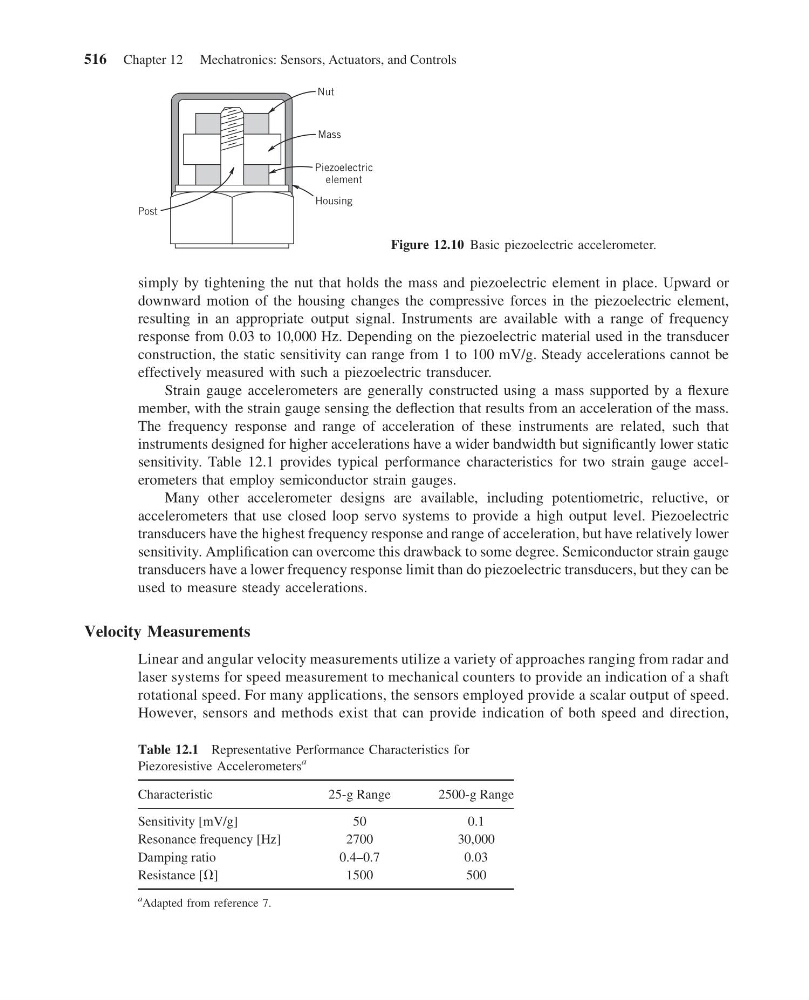
simply by tightening the nut that holds the mass and piezoelectric element in place. Upward or
downward motion of the housing changes the compressive forces in the piezoelectric element,
resulting in an appropriate output signal. Instruments are available with a range of frequency
response from 0.03 to 10,000 Hz. Depending on the piezoelectric material used in the transducer
construction, the static sensitivity can range from 1 to 100 mV/g. Steady accelerations cannot be
effectively measured with such a piezoelectric transducer.
Strain gauge accelerometers are generally constructed using a mass supported by a flexure
member, with the strain gauge sensing the deflection that results from an acceleration of the mass.
The frequency response and range of acceleration of these instruments are related, such that
instruments designed for higher accelerations have a wider bandwidth but significantly lower static
sensitivity. Table 12.1 provides typical performance characteristics for two strain gauge accelerometers that employ semiconductor strain gauges.
Many other accelerometer designs are available, including potentiometric, reluctive, or
accelerometers that use closed loop servo systems to provide a high output level. Piezoelectric
transducers have the highest frequency response and range of acceleration, but have relatively lower
sensitivity. Amplification can overcome this drawback to some degree. Semiconductor strain gauge
transducers have a lower frequency response limit than do piezoelectric transducers, but they can be
used to measure steady accelerations.
Velocity Measurements
Linear and angular velocity measurements utilize a variety of approaches ranging from radar and
laser systems for speed measurement to mechanical counters to provide an indication of a shaft
rotational speed. For many applications, the sensors employed provide a scalar output of speed.
However, sensors and methods exist that can provide indication of both speed and direction,
Post
Housing
Piezoelectric
element
Mass
Nut
Figure 12.10 Basic piezoelectric accelerometer.
Table 12.1 Representative Performance Characteristics for
Piezoresistive Accelerometers
a
Characteristic
25-g Range
2500-g Range
Sensitivity [mV/g]
50
0.1
Resonance frequency [Hz]
2700
30,000
Damping ratio
0.4–0.7
0.03
Resistance [V]
1500
500
a
Adapted from reference 7.
516 Chapter 12 Mechatronics: Sensors, Actuators, and Controls
13:54:9 Page 516
simply by tightening the nut that holds the mass and piezoelectric element in place. Upward or
downward motion of the housing changes the compressive forces in the piezoelectric element,
resulting in an appropriate output signal. Instruments are available with a range of frequency
response from 0.03 to 10,000 Hz. Depending on the piezoelectric material used in the transducer
construction, the static sensitivity can range from 1 to 100 mV/g. Steady accelerations cannot be
effectively measured with such a piezoelectric transducer.
Strain gauge accelerometers are generally constructed using a mass supported by a flexure
member, with the strain gauge sensing the deflection that results from an acceleration of the mass.
The frequency response and range of acceleration of these instruments are related, such that
instruments designed for higher accelerations have a wider bandwidth but significantly lower static
sensitivity. Table 12.1 provides typical performance characteristics for two strain gauge accelerometers that employ semiconductor strain gauges.
Many other accelerometer designs are available, including potentiometric, reluctive, or
accelerometers that use closed loop servo systems to provide a high output level. Piezoelectric
transducers have the highest frequency response and range of acceleration, but have relatively lower
sensitivity. Amplification can overcome this drawback to some degree. Semiconductor strain gauge
transducers have a lower frequency response limit than do piezoelectric transducers, but they can be
used to measure steady accelerations.
Velocity Measurements
Linear and angular velocity measurements utilize a variety of approaches ranging from radar and
laser systems for speed measurement to mechanical counters to provide an indication of a shaft
rotational speed. For many applications, the sensors employed provide a scalar output of speed.
However, sensors and methods exist that can provide indication of both speed and direction,
Post
Housing
Piezoelectric
element
Mass
Nut
Figure 12.10 Basic piezoelectric accelerometer.
Table 12.1 Representative Performance Characteristics for
Piezoresistive Accelerometers
a
Characteristic
25-g Range
2500-g Range
Sensitivity [mV/g]
50
0.1
Resonance frequency [Hz]
2700
30,000
Damping ratio
0.4–0.7
0.03
Resistance [V]
1500
500
a
Adapted from reference 7.
516 Chapter 12 Mechatronics: Sensors, Actuators, and Controls