

E1C12 09/14/2010
13:54:8 Page 505
Displacement Sensors
Methods to measure position or displacement are a key element in many mechatronic systems. Often
potentiometric or linear variable differential transformer (LVDT) transducers are employed in these
applications.
Potentiometers
A potentiometer is a device employed to measure linear or rotary displacement. The principle of
operation relies on an increase in electrical resistance with displacement.
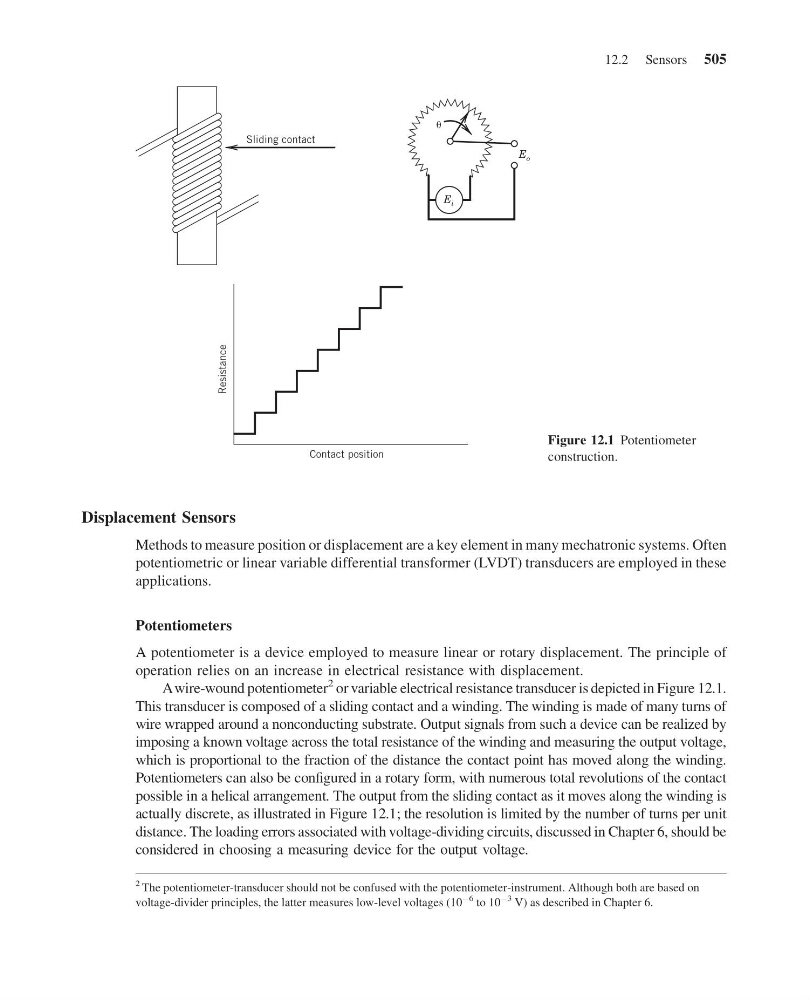
Awire-wound potentiometer
2 or variable electrical resistance transducer is depicted in Figure 12.1.
This transducer is composed of a sliding contact and a winding. The winding is made of many turns of
wire wrapped around a nonconducting substrate. Output signals from such a device can be realized by
imposing a known voltage across the total resistance of the winding and measuring the output voltage,
which is proportional to the fraction of the distance the contact point has moved along the winding.
Potentiometers can also be configured in a rotary form, with numerous total revolutions of the contact
possible in a helical arrangement. The output from the sliding contact as it moves along the winding is
actually discrete, as illustrated in Figure 12.1; the resolution is limited by the number of turns per unit
distance. The loading errors associated with voltage-dividing circuits, discussed in Chapter 6, should be
considered in choosing a measuring device for the output voltage.
Sliding contact
Contact position
Resistance
E o
E i
Figure 12.1 Potentiometer
construction.
2 The potentiometer-transducer should not be confused with the potentiometer-instrument. Although both are based on
voltage-divider principles, the latter measures low-level voltages (10
À6 to 10
À3 V) as described in Chapter 6.
12.2 Sensors 505
13:54:8 Page 505
Displacement Sensors
Methods to measure position or displacement are a key element in many mechatronic systems. Often
potentiometric or linear variable differential transformer (LVDT) transducers are employed in these
applications.
Potentiometers
A potentiometer is a device employed to measure linear or rotary displacement. The principle of
operation relies on an increase in electrical resistance with displacement.
Awire-wound potentiometer
2 or variable electrical resistance transducer is depicted in Figure 12.1.
This transducer is composed of a sliding contact and a winding. The winding is made of many turns of
wire wrapped around a nonconducting substrate. Output signals from such a device can be realized by
imposing a known voltage across the total resistance of the winding and measuring the output voltage,
which is proportional to the fraction of the distance the contact point has moved along the winding.
Potentiometers can also be configured in a rotary form, with numerous total revolutions of the contact
possible in a helical arrangement. The output from the sliding contact as it moves along the winding is
actually discrete, as illustrated in Figure 12.1; the resolution is limited by the number of turns per unit
distance. The loading errors associated with voltage-dividing circuits, discussed in Chapter 6, should be
considered in choosing a measuring device for the output voltage.
Sliding contact
Contact position
Resistance
E o
E i
Figure 12.1 Potentiometer
construction.
2 The potentiometer-transducer should not be confused with the potentiometer-instrument. Although both are based on
voltage-divider principles, the latter measures low-level voltages (10
À6 to 10
À3 V) as described in Chapter 6.
12.2 Sensors 505