

E1C11 09/14/2010
13:14:2 Page 471
where
A c ¼
p
4
D
2
¼
p
4
1 Â 10
À3
À
Á 2 ¼ 7:85 Â 10
À7 m
2
The resistance is then
R ¼
1:7 Â 10
À8
V m
À
Á
5 Â 10
À2 m
À
Á
7:85 Â 10
À7 m 2
¼ 1:08 Â 10
À3
V
COMMENT If the material were nickel (r e ¼ 7:8 Â 10
À8
V m) instead of copper, the resistance would be 5 Â 10
À3
V for the same diameter and length of wire.
Example 11.2
A very common material for the construction of strain gauges is the alloy constantan (55% copper
with 45% nickel), having a resistivity of 49 Â 10
À8
V m. A typical strain gauge might have a
resistance of 120 V. What length of constantan wire of diameter 0.025 mm would yield a resistance
of 120 V?
KNOWN The resistivity of constantan is 49 Â 10
À8
V m.
FIND The length of constantan wire needed to produce a total resistance of 120 V
SOLUTION From Equation 11.6, we may solve for the length, which yields in this case
L ¼
RA c
r e
¼
120 V
ð
Þ 4:91 Â 10
À10 m
2
À
Á
49 Â 10
À8
V m
¼ 0:12 m
The wire would then be 12 cm in length to achieve a resistance of 120 V.
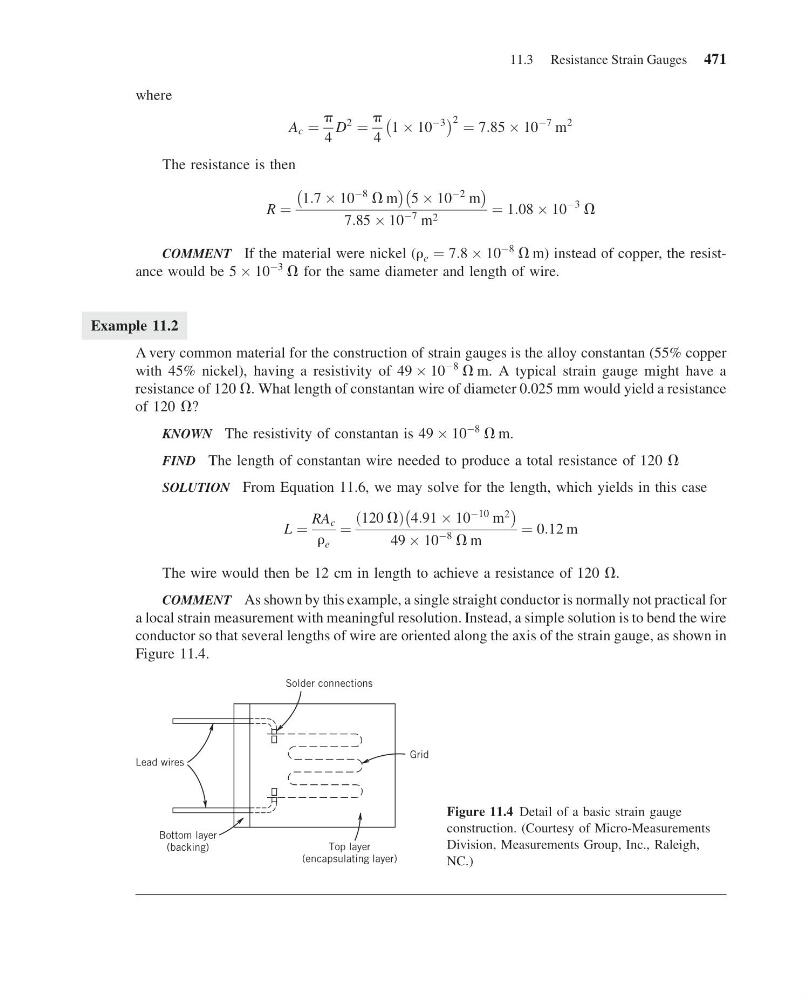
COMMENT As shown by this example, a single straight conductor is normally not practical for
a local strain measurement with meaningful resolution. Instead, a simple solution is to bend the wire
conductor so that several lengths of wire are oriented along the axis of the strain gauge, as shown in
Figure 11.4.
Lead wires
Bottom layer
(backing)
Top layer
(encapsulating layer)
Grid
Solder connections
Figure 11.4 Detail of a basic strain gauge
construction. (Courtesy of Micro-Measurements
Division, Measurements Group, Inc., Raleigh,
NC.)
11.3 Resistance Strain Gauges 471
13:14:2 Page 471
where
A c ¼
p
4
D
2
¼
p
4
1 Â 10
À3
À
Á 2 ¼ 7:85 Â 10
À7 m
2
The resistance is then
R ¼
1:7 Â 10
À8
V m
À
Á
5 Â 10
À2 m
À
Á
7:85 Â 10
À7 m 2
¼ 1:08 Â 10
À3
V
COMMENT If the material were nickel (r e ¼ 7:8 Â 10
À8
V m) instead of copper, the resistance would be 5 Â 10
À3
V for the same diameter and length of wire.
Example 11.2
A very common material for the construction of strain gauges is the alloy constantan (55% copper
with 45% nickel), having a resistivity of 49 Â 10
À8
V m. A typical strain gauge might have a
resistance of 120 V. What length of constantan wire of diameter 0.025 mm would yield a resistance
of 120 V?
KNOWN The resistivity of constantan is 49 Â 10
À8
V m.
FIND The length of constantan wire needed to produce a total resistance of 120 V
SOLUTION From Equation 11.6, we may solve for the length, which yields in this case
L ¼
RA c
r e
¼
120 V
ð
Þ 4:91 Â 10
À10 m
2
À
Á
49 Â 10
À8
V m
¼ 0:12 m
The wire would then be 12 cm in length to achieve a resistance of 120 V.
COMMENT As shown by this example, a single straight conductor is normally not practical for
a local strain measurement with meaningful resolution. Instead, a simple solution is to bend the wire
conductor so that several lengths of wire are oriented along the axis of the strain gauge, as shown in
Figure 11.4.
Lead wires
Bottom layer
(backing)
Top layer
(encapsulating layer)
Grid
Solder connections
Figure 11.4 Detail of a basic strain gauge
construction. (Courtesy of Micro-Measurements
Division, Measurements Group, Inc., Raleigh,
NC.)
11.3 Resistance Strain Gauges 471