

E1C10 09/14/2010
13:4:41 Page 460
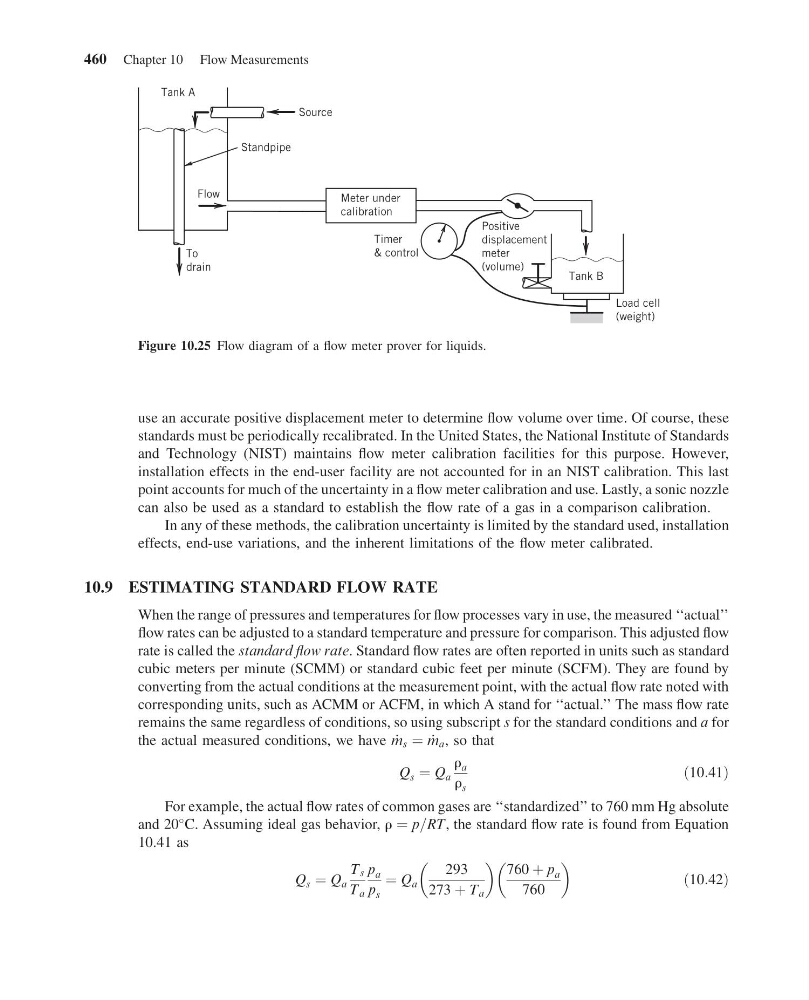
use an accurate positive displacement meter to determine flow volume over time. Of course, these
standards must be periodically recalibrated. In the United States, the National Institute of Standards
and Technology (NIST) maintains flow meter calibration facilities for this purpose. However,
installation effects in the end-user facility are not accounted for in an NIST calibration. This last
point accounts for much of the uncertainty in a flow meter calibration and use. Lastly, a sonic nozzle
can also be used as a standard to establish the flow rate of a gas in a comparison calibration.
In any of these methods, the calibration uncertainty is limited by the standard used, installation
effects, end-use variations, and the inherent limitations of the flow meter calibrated.
10.9 ESTIMATING STANDARD FLOW RATE
When the range of pressures and temperatures for flow processes vary in use, the measured ‘‘actual’’
flow rates can be adjusted to a standard temperature and pressure for comparison. This adjusted flow
rate is called the standard flow rate. Standard flow rates are often reported in units such as standard
cubic meters per minute (SCMM) or standard cubic feet per minute (SCFM). They are found by
converting from the actual conditions at the measurement point, with the actual flow rate noted with
corresponding units, such as ACMM or ACFM, in which A stand for ‘‘actual.’’ The mass flow rate
remains the same regardless of conditions, so using subscript s for the standard conditions and a for
the actual measured conditions, we have _
m s ¼ _
m a , so that
Q s ¼ Q a
r a
r s
ð10:41Þ
For example, the actual flow rates of common gases are ‘‘standardized’’ to 760 mm Hg absolute
and 20
C. Assuming ideal gas behavior, r ¼ p=RT, the standard flow rate is found from Equation
10.41 as
Q s ¼ Q a
T s
T a
p a
p s
¼ Q a
293
273 þ T a
760 þ p a
760
ð10:42Þ
Tank A
Source
Standpipe
Flow
To
drain
Meter under
calibration
Timer
& control
Positive
displacement
meter
(volume)
Tank B
Load cell
(weight)
Figure 10.25 Flow diagram of a flow meter prover for liquids.
460 Chapter 10 Flow Measurements
13:4:41 Page 460
use an accurate positive displacement meter to determine flow volume over time. Of course, these
standards must be periodically recalibrated. In the United States, the National Institute of Standards
and Technology (NIST) maintains flow meter calibration facilities for this purpose. However,
installation effects in the end-user facility are not accounted for in an NIST calibration. This last
point accounts for much of the uncertainty in a flow meter calibration and use. Lastly, a sonic nozzle
can also be used as a standard to establish the flow rate of a gas in a comparison calibration.
In any of these methods, the calibration uncertainty is limited by the standard used, installation
effects, end-use variations, and the inherent limitations of the flow meter calibrated.
10.9 ESTIMATING STANDARD FLOW RATE
When the range of pressures and temperatures for flow processes vary in use, the measured ‘‘actual’’
flow rates can be adjusted to a standard temperature and pressure for comparison. This adjusted flow
rate is called the standard flow rate. Standard flow rates are often reported in units such as standard
cubic meters per minute (SCMM) or standard cubic feet per minute (SCFM). They are found by
converting from the actual conditions at the measurement point, with the actual flow rate noted with
corresponding units, such as ACMM or ACFM, in which A stand for ‘‘actual.’’ The mass flow rate
remains the same regardless of conditions, so using subscript s for the standard conditions and a for
the actual measured conditions, we have _
m s ¼ _
m a , so that
Q s ¼ Q a
r a
r s
ð10:41Þ
For example, the actual flow rates of common gases are ‘‘standardized’’ to 760 mm Hg absolute
and 20
C. Assuming ideal gas behavior, r ¼ p=RT, the standard flow rate is found from Equation
10.41 as
Q s ¼ Q a
T s
T a
p a
p s
¼ Q a
293
273 þ T a
760 þ p a
760
ð10:42Þ
Tank A
Source
Standpipe
Flow
To
drain
Meter under
calibration
Timer
& control
Positive
displacement
meter
(volume)
Tank B
Load cell
(weight)
Figure 10.25 Flow diagram of a flow meter prover for liquids.
460 Chapter 10 Flow Measurements