

E1C01 09/14/2010
15:40:39 Page 35
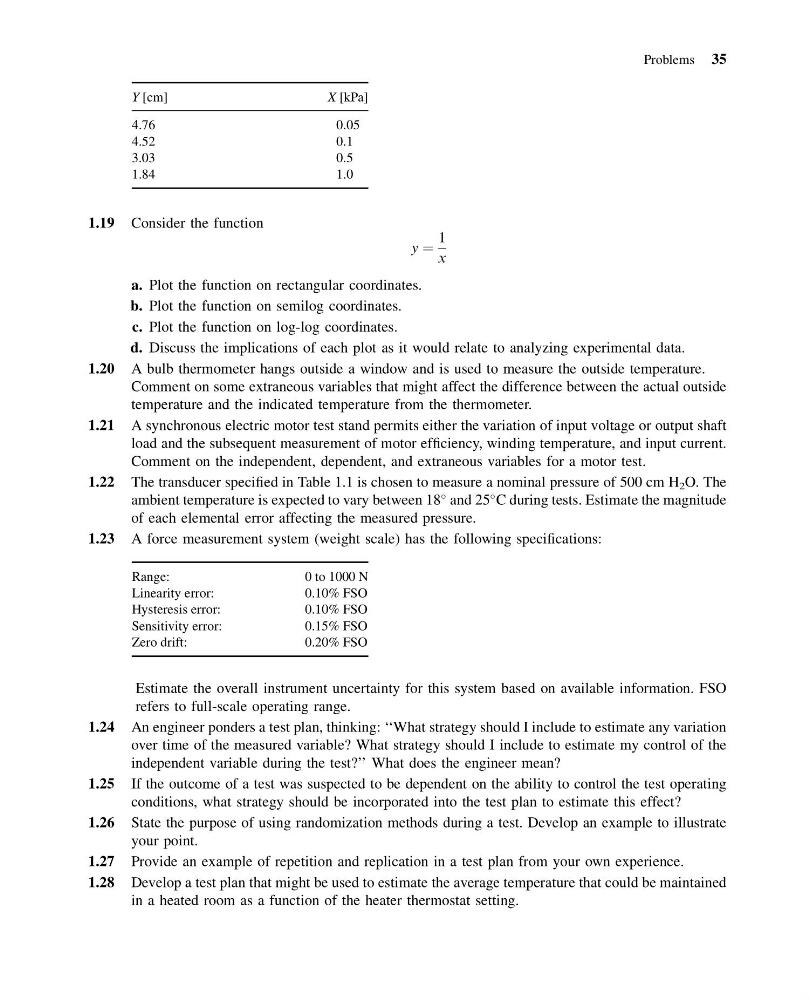
Y [cm]
X [kPa]
4.76
0.05
4.52
0.1
3.03
0.5
1.84
1.0
1.19 Consider the function
y ¼
1
x
a. Plot the function on rectangular coordinates.
b. Plot the function on semilog coordinates.
c. Plot the function on log-log coordinates.
d. Discuss the implications of each plot as it would relate to analyzing experimental data.
1.20 A bulb thermometer hangs outside a window and is used to measure the outside temperature.
Comment on some extraneous variables that might affect the difference between the actual outside
temperature and the indicated temperature from the thermometer.
1.21 A synchronous electric motor test stand permits either the variation of input voltage or output shaft
load and the subsequent measurement of motor efficiency, winding temperature, and input current.
Comment on the independent, dependent, and extraneous variables for a motor test.
1.22 The transducer specified in Table 1.1 is chosen to measure a nominal pressure of 500 cm H 2 O. The
ambient temperature is expected to vary between 18
and 25
C during tests. Estimate the magnitude
of each elemental error affecting the measured pressure.
1.23 A force measurement system (weight scale) has the following specifications:
Range:
0 to 1000 N
Linearity error:
0.10% FSO
Hysteresis error:
0.10% FSO
Sensitivity error:
0.15% FSO
Zero drift:
0.20% FSO
Estimate the overall instrument uncertainty for this system based on available information. FSO
refers to full-scale operating range.
1.24 An engineer ponders a test plan, thinking: ‘‘What strategy should I include to estimate any variation
over time of the measured variable? What strategy should I include to estimate my control of the
independent variable during the test?’’ What does the engineer mean?
1.25 If the outcome of a test was suspected to be dependent on the ability to control the test operating
conditions, what strategy should be incorporated into the test plan to estimate this effect?
1.26 State the purpose of using randomization methods during a test. Develop an example to illustrate
your point.
1.27 Provide an example of repetition and replication in a test plan from your own experience.
1.28 Develop a test plan that might be used to estimate the average temperature that could be maintained
in a heated room as a function of the heater thermostat setting.
Problems 35
15:40:39 Page 35
Y [cm]
X [kPa]
4.76
0.05
4.52
0.1
3.03
0.5
1.84
1.0
1.19 Consider the function
y ¼
1
x
a. Plot the function on rectangular coordinates.
b. Plot the function on semilog coordinates.
c. Plot the function on log-log coordinates.
d. Discuss the implications of each plot as it would relate to analyzing experimental data.
1.20 A bulb thermometer hangs outside a window and is used to measure the outside temperature.
Comment on some extraneous variables that might affect the difference between the actual outside
temperature and the indicated temperature from the thermometer.
1.21 A synchronous electric motor test stand permits either the variation of input voltage or output shaft
load and the subsequent measurement of motor efficiency, winding temperature, and input current.
Comment on the independent, dependent, and extraneous variables for a motor test.
1.22 The transducer specified in Table 1.1 is chosen to measure a nominal pressure of 500 cm H 2 O. The
ambient temperature is expected to vary between 18
and 25
C during tests. Estimate the magnitude
of each elemental error affecting the measured pressure.
1.23 A force measurement system (weight scale) has the following specifications:
Range:
0 to 1000 N
Linearity error:
0.10% FSO
Hysteresis error:
0.10% FSO
Sensitivity error:
0.15% FSO
Zero drift:
0.20% FSO
Estimate the overall instrument uncertainty for this system based on available information. FSO
refers to full-scale operating range.
1.24 An engineer ponders a test plan, thinking: ‘‘What strategy should I include to estimate any variation
over time of the measured variable? What strategy should I include to estimate my control of the
independent variable during the test?’’ What does the engineer mean?
1.25 If the outcome of a test was suspected to be dependent on the ability to control the test operating
conditions, what strategy should be incorporated into the test plan to estimate this effect?
1.26 State the purpose of using randomization methods during a test. Develop an example to illustrate
your point.
1.27 Provide an example of repetition and replication in a test plan from your own experience.
1.28 Develop a test plan that might be used to estimate the average temperature that could be maintained
in a heated room as a function of the heater thermostat setting.
Problems 35