

E1C10 09/14/2010
13:4:40 Page 453
Turbine meters offer a low-pressure drop and very good accuracy. A typical instrument’s
systematic uncertainty in flow rate is $0.25% (95%) with a turndown of 20:1. The measurements are
exceptionally repeatable making the meters good candidates for local flow rate standards. However,
their use must be restricted to clean fluids because of possible fouling of their rotating parts. The
turbine meter rotational speed is sensitive to temperature changes, which affect fluid viscosity and
density and therefore K 1 . Some compensation for viscosity variations can be made electronically
(11). The turbine meter is very susceptible to installation errors caused by pipe flow swirl (7), and a
careful selection of installation position must be made.
Transit Time and Doppler (Ultrasonic) Flow Meters
Ultrasonic meters use sound waves to determine flow rate. Transit time flow meters use the travel time
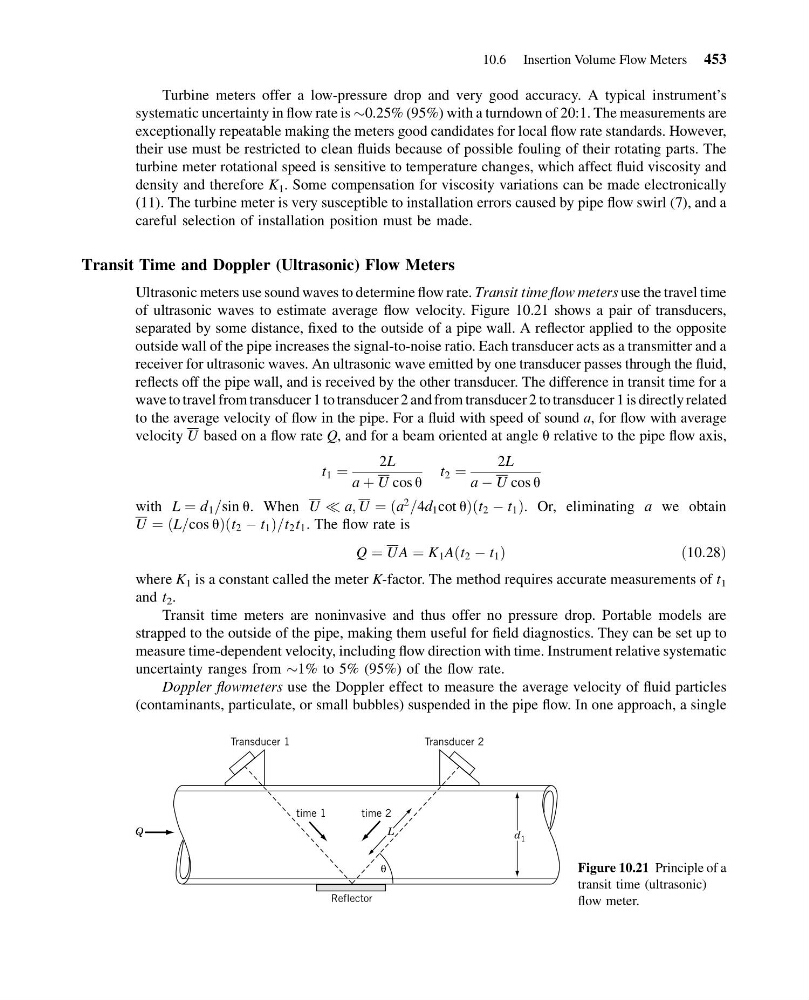
of ultrasonic waves to estimate average flow velocity. Figure 10.21 shows a pair of transducers,
separated by some distance, fixed to the outside of a pipe wall. A reflector applied to the opposite
outside wall of the pipe increases the signal-to-noise ratio. Each transducer acts as a transmitter and a
receiver for ultrasonic waves. An ultrasonic wave emitted by one transducer passes through the fluid,
reflects off the pipe wall, and is received by the other transducer. The difference in transit time for a
wave to travel from transducer 1 to transducer 2 and from transducer 2 to transducer 1 is directly related
to the average velocity of flow in the pipe. For a fluid with speed of sound a, for flow with average
velocity U based on a flow rate Q, and for a beam oriented at angle u relative to the pipe flow axis,
t 1 ¼
2L
a þ U cos u
t 2 ¼
2L
a À U cos u
with L ¼ d 1 =sin u. When U ( a; U ¼ ða
2
=4d 1 cot uÞ t 2 À t 1
ð
Þ. Or, eliminating a we obtain
U ¼ ðL=cos uÞ t 2 À t 1
ð
Þ=t 2 t 1 . The flow rate is
Q ¼ UA ¼ K 1 A t 2 À t 1
ð
Þ
ð10:28Þ
where K 1 is a constant called the meter K-factor. The method requires accurate measurements of t 1
and t 2 .
Transit time meters are noninvasive and thus offer no pressure drop. Portable models are
strapped to the outside of the pipe, making them useful for field diagnostics. They can be set up to
measure time-dependent velocity, including flow direction with time. Instrument relative systematic
uncertainty ranges from $1% to 5% (95%) of the flow rate.
Doppler flowmeters use the Doppler effect to measure the average velocity of fluid particles
(contaminants, particulate, or small bubbles) suspended in the pipe flow. In one approach, a single
d 1
L
Q
θ
Reflector
2
r
e
c
u
d
s
n
a
r
T
1
r
e
c
u
d
s
n
a
r
T
time 2
time 1
Figure 10.21 Principle of a
transit time (ultrasonic)
flow meter.
10.6 Insertion Volume Flow Meters 453
13:4:40 Page 453
Turbine meters offer a low-pressure drop and very good accuracy. A typical instrument’s
systematic uncertainty in flow rate is $0.25% (95%) with a turndown of 20:1. The measurements are
exceptionally repeatable making the meters good candidates for local flow rate standards. However,
their use must be restricted to clean fluids because of possible fouling of their rotating parts. The
turbine meter rotational speed is sensitive to temperature changes, which affect fluid viscosity and
density and therefore K 1 . Some compensation for viscosity variations can be made electronically
(11). The turbine meter is very susceptible to installation errors caused by pipe flow swirl (7), and a
careful selection of installation position must be made.
Transit Time and Doppler (Ultrasonic) Flow Meters
Ultrasonic meters use sound waves to determine flow rate. Transit time flow meters use the travel time
of ultrasonic waves to estimate average flow velocity. Figure 10.21 shows a pair of transducers,
separated by some distance, fixed to the outside of a pipe wall. A reflector applied to the opposite
outside wall of the pipe increases the signal-to-noise ratio. Each transducer acts as a transmitter and a
receiver for ultrasonic waves. An ultrasonic wave emitted by one transducer passes through the fluid,
reflects off the pipe wall, and is received by the other transducer. The difference in transit time for a
wave to travel from transducer 1 to transducer 2 and from transducer 2 to transducer 1 is directly related
to the average velocity of flow in the pipe. For a fluid with speed of sound a, for flow with average
velocity U based on a flow rate Q, and for a beam oriented at angle u relative to the pipe flow axis,
t 1 ¼
2L
a þ U cos u
t 2 ¼
2L
a À U cos u
with L ¼ d 1 =sin u. When U ( a; U ¼ ða
2
=4d 1 cot uÞ t 2 À t 1
ð
Þ. Or, eliminating a we obtain
U ¼ ðL=cos uÞ t 2 À t 1
ð
Þ=t 2 t 1 . The flow rate is
Q ¼ UA ¼ K 1 A t 2 À t 1
ð
Þ
ð10:28Þ
where K 1 is a constant called the meter K-factor. The method requires accurate measurements of t 1
and t 2 .
Transit time meters are noninvasive and thus offer no pressure drop. Portable models are
strapped to the outside of the pipe, making them useful for field diagnostics. They can be set up to
measure time-dependent velocity, including flow direction with time. Instrument relative systematic
uncertainty ranges from $1% to 5% (95%) of the flow rate.
Doppler flowmeters use the Doppler effect to measure the average velocity of fluid particles
(contaminants, particulate, or small bubbles) suspended in the pipe flow. In one approach, a single
d 1
L
Q
θ
Reflector
2
r
e
c
u
d
s
n
a
r
T
1
r
e
c
u
d
s
n
a
r
T
time 2
time 1
Figure 10.21 Principle of a
transit time (ultrasonic)
flow meter.
10.6 Insertion Volume Flow Meters 453