

E1C10 09/14/2010
13:4:40 Page 451
cubed. This indicates that a meter’s accuracy drops off as pipe diameter increases, placing an upper
limit on the meter size.
Rotameters
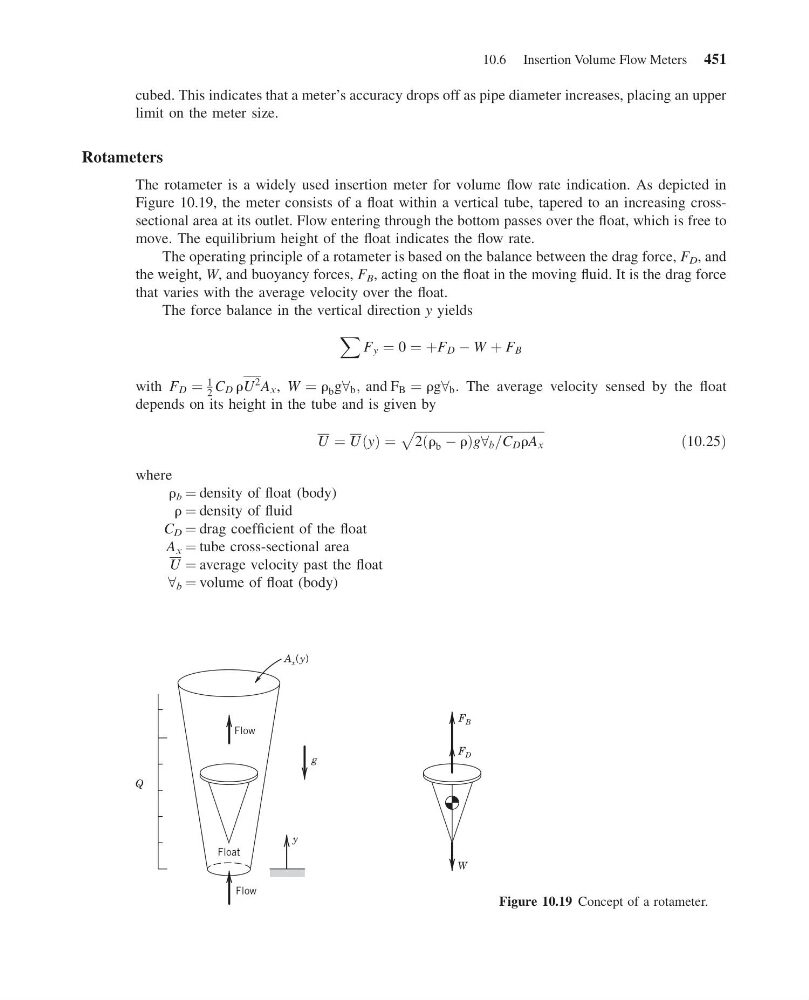
The rotameter is a widely used insertion meter for volume flow rate indication. As depicted in
Figure 10.19, the meter consists of a float within a vertical tube, tapered to an increasing crosssectional area at its outlet. Flow entering through the bottom passes over the float, which is free to
move. The equilibrium height of the float indicates the flow rate.
The operating principle of a rotameter is based on the balance between the drag force, F D , and
the weight, W, and buoyancy forces, F B , acting on the float in the moving fluid. It is the drag force
that varies with the average velocity over the float.
The force balance in the vertical direction y yields
X F y ¼ 0 ¼ þF D À W þ F B
with F D ¼
1
2 C D rU
2
A x , W ¼ r b g8 b ; and F B ¼ rg8 b . The average velocity sensed by the float
depends on its height in the tube and is given by
U ¼ U y
ð Þ ¼
ffiffiffiffiffiffiffiffiffiffiffiffiffiffiffiffiffiffiffiffiffiffiffiffiffiffiffiffiffiffiffiffiffiffiffiffiffiffiffiffiffi ffi
2ðr b À rÞg8 b =C D rA x
p
ð10:25Þ
where
r b ¼ density of float (body)
r ¼ density of fluid
C D ¼ drag coefficient of the float
A x ¼ tube cross-sectional area
U ¼ average velocity past the float
8 b ¼ volume of float (body)
Flow
Float
y
g
Flow
A x ( y)
F B
F D
W
Q
Figure 10.19 Concept of a rotameter.
10.6 Insertion Volume Flow Meters 451
13:4:40 Page 451
cubed. This indicates that a meter’s accuracy drops off as pipe diameter increases, placing an upper
limit on the meter size.
Rotameters
The rotameter is a widely used insertion meter for volume flow rate indication. As depicted in
Figure 10.19, the meter consists of a float within a vertical tube, tapered to an increasing crosssectional area at its outlet. Flow entering through the bottom passes over the float, which is free to
move. The equilibrium height of the float indicates the flow rate.
The operating principle of a rotameter is based on the balance between the drag force, F D , and
the weight, W, and buoyancy forces, F B , acting on the float in the moving fluid. It is the drag force
that varies with the average velocity over the float.
The force balance in the vertical direction y yields
X F y ¼ 0 ¼ þF D À W þ F B
with F D ¼
1
2 C D rU
2
A x , W ¼ r b g8 b ; and F B ¼ rg8 b . The average velocity sensed by the float
depends on its height in the tube and is given by
U ¼ U y
ð Þ ¼
ffiffiffiffiffiffiffiffiffiffiffiffiffiffiffiffiffiffiffiffiffiffiffiffiffiffiffiffiffiffiffiffiffiffiffiffiffiffiffiffiffi ffi
2ðr b À rÞg8 b =C D rA x
p
ð10:25Þ
where
r b ¼ density of float (body)
r ¼ density of fluid
C D ¼ drag coefficient of the float
A x ¼ tube cross-sectional area
U ¼ average velocity past the float
8 b ¼ volume of float (body)
Flow
Float
y
g
Flow
A x ( y)
F B
F D
W
Q
Figure 10.19 Concept of a rotameter.
10.6 Insertion Volume Flow Meters 451